Published November 30, 2020 11:32PM
Mason Ferlic Talks About Falling, and Getting Back Up
We spoke with the former University of Michigan All-American and recent XC Town USA Meet of Champions victor about the highs and lows of his running career, and how he’s built resilience.
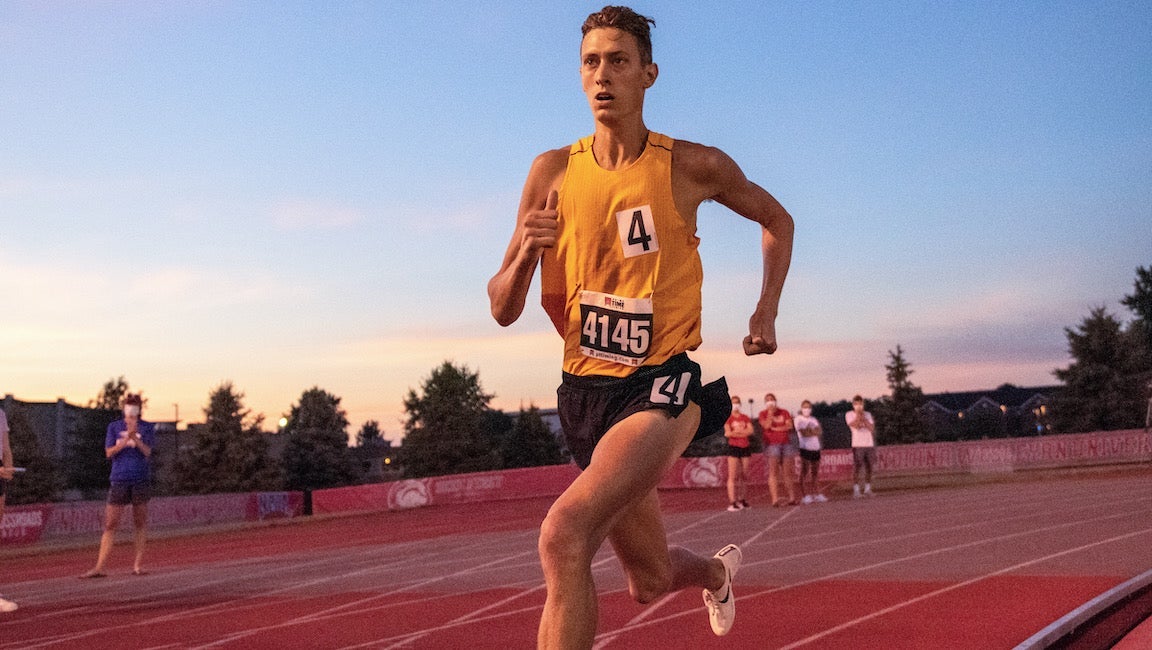
(Photo: courtesy Mason Ferlic)
In an interview following his upset win at the XC Town USA Meet of Champions on Nov. 14, Mason Ferlic mentioned how the Terre Haute, Indiana course had always been good to him. While it’s true that Ferlic had achieved All-American finishes on the course for the University of Michigan in 2013 and 2015, and was part of the 2016 Wolverine team that took the NCAA cross country title there, his first experience with the Terre Haute course wasn’t a particularly pleasant one.
As a freshman in 2011, he’d come dead last at NCAAs; 252nd out of 252 finishers. And the day was not over. On the bus ride back to Ann Arbor he overheard some seniors talking to the coach about the results. Coming to his name at the very bottom of the list, they said, “Dang, he shouldn’t even be here.”
Ferlic, now 27 and an Olympic hopeful (hopeful that the 2021 Olympics will happen at all and that he’ll be a part of Team USA) in the steeplechase, has had plenty of spectacular falls, literal and figurative.
“But I don’t want to be portrayed as the victim of disappointment,” Ferlic texted before we spoke. “They didn’t really weigh me down.”
ADVERTISEMENT
The Fall: Freshman Hero
“I was the small school [Minnesota] cross country champion, winner of the mile and two-mile my senior year, coming into a D1 powerhouse. I was going to prove to myself and to everyone that I belonged there. Crushed every workout. Let everyone else determine how hard I ran. The freshman hero? I was that guy. Yes, I clawed my way to a traveling spot as a freshman which was something, but by the time we got to NCAAs [cross country championships in Terre Haute] I was fried at both ends. I was an empty shell, mentally and physically. Thus, 252nd place.”
Getting Up: Learning to Tune-Inward
“Getting last was certainly a reality check. I took a step back — actually, I had to because I had a stress fracture — and realized I had to get good at my own pace. I was still 18 and trying to hop in with the top dogs. I had to get control of how things were going. I guess it was sort of a nirvana or self-awareness thing. Anyway, running day-to-day on my timeline, my trajectory not someone else’s. It’s the race that matters, not crushing every day. That’s helped me every year since.”
The Fall: Winning Cross Training
“Sophomore year [2012 into 2013] I had an achilles injury and, later, mono. I was completely sidelined, so I cross trained like a fiend. For six weeks, I crushed it on the bike and in the pool. I thought, ‘I’m going to come out of this even stronger.’ All those horrible hours on the bike and in the pool were not worth it. It just burned me out mentally. Sometimes cross training like crazy is lack of confidence, fear that you won’t be able to get that fitness back. I’ve always been confident and enjoyed the process of training on the track. I realized I’d be better served by riding out injury, letting my body heal so I could work hard on the track, not the bike.”
ADVERTISEMENT
Getting Up: A Blessing in Disguise
“That long layoff was a blessing in disguise — that’s how I was introduced to the steeple. In the spring of 2013 I did some 5Ks but I was still so fatigued from mono, there was no way I was going to qualify for Big Tens. My coach suggested I try the steeple. I had no desire to race it, but this was my ticket. I won that first race in 8:50, which was then the second-fastest time in the Big Ten. I thought, okay, I’m going to be a steeplechaser.”
The Fall: Literally
“By 2015, I’d won some Big Ten titles, had been All-American. I thought, I’m going to compete with the best guys in the country [in the steeple]. Up to then, my trajectory had been pretty linear so I thought it was a given that as I got older, I’d get better. I got kind of complacent. I didn’t think I had to worry about getting over the barriers any more, so I started skipping steeple drills. I didn’t practice going over the water. I thought I was past that. About three laps in at [Track] Nationals, I clipped the top of the water barrier, and in slow motion, realized I was diving head first into six inches of water. I must have done some kind of somersault — all I know is that I was completely submerged. I got up and started running but I was drenched, embarrassed, and disoriented. In front of this big crowd at Hayward Field. I finished dead last.”

Getting Up: Good is in The Details
“Because of that, I came into my senior year with a totally different mentality. I was exceptionally focused — my teammates would say I was a hardnose — about doing the small things, the things I needed to do to get 100 percent out of myself. So, yes, I did the steeple practice and the water pit. I stretched, foam rolled, iced. Never a fan of the weight room, but I went in the weight room. We won the Big Ten title in cross country, and [in spring 2016] I won the NCAA title in the steeple, definitely the highlight of my collegiate career.”
ADVERTISEMENT
The Fall: “Just Running” Gets Dull
“I’d graduated with a Master’s [in aerospace engineering] in 2016, and had signed a pro contract with Nike. I stayed in Ann Arbor with my college coach, Kevin Sullivan. Ran a bit with Nick Willis but primarily with the college guys. I was the volunteer assistant coach but I wasn’t working, I just ran. I got very bored, very quickly. My friends had full-time jobs. I’d run in the morning and think, now what am I going to do for ten hours?”
Getting Up: Finding Balance
“Luckily I got a part-time job in the performance research lab at the University. Later, that became a full-time job as the lab manager. I really need stimulation outside of running. It keeps me even keeled, balanced.”
The Fall: Doom Scrolling
“My pro career was up and down, but mostly down in 2017 and 2018. There were glimmers of hope followed by long periods of nothingness, injuries. I started comparing myself to everyone I wanted to beat, and got caught up in how other people were training, scrolling through social media. I thought, this is my job now — I should be doing more mileage, training harder, more than other people.”
ADVERTISEMENT
Getting Up: Taking Social Media Breaks
“I had to find my love of the sport again. Part of that was deleting Instagram and Twitter at certain parts of the year. In fact, I had to re-download it to post something about this last race in Terre Haute. And not seeing other people’s posts made it easier to take a day off every week. I’ve been doing that for the last year. A day when you don’t have to think about training has been hugely valuable. I’m more focused, more efficient on the six days I do run, and it’s really hard to overtrain. I also take three to four weeks at the end of the season with barely any running.”
The Fall: A Deluge of Injuries, Abandonment by Sponsor, and a Pandemic
Getting Up: And Now For Something Completely Different
“No track season, the Olympics not happening. That was tough. I thought, I’m taking as many days off as I want. I went on a road trip back to Minnesota with my brother which was great, just to enjoy something outside of the sport. Sometime in May I decided to try something completely different — I set a goal of breaking 4 minutes for the mile.
“I’ve always been a strength guy, the one who crushed long tempos. This was polar opposite — pure speed. So me and Nick Willis and a couple other guys spent the summer just seeing how fast we could go. Warm summer nights, doing things like 4 x 400 all out. It was fun, and it paid off. I ran two sub-4:00 miles. Then in the fall — and this is what led to the win at Terre Haute — we got away from the watch and did a lot of unstructured strength fartleks on the Michigan golf course. That’s when I deleted Instagram, trying not to get bent out of shape about the pandemic and other people’s training. You know, running is a simple sport. I focused on that and really enjoyed it.”