Published November 30, 2021 08:38PM
Do-Anywhere Mobility Plan for Runners
You can stay mobile even at home, counteracting hours of sitting with this plan of creative drills and work positions.
(Photo: Kyle Norman)
Modern life often means a lot of sitting. It’s easy to become transfixed by work, social media, and streaming services. You look up and it’s been several hours of sitting, staring at a screen. Sitting still too long robs your hips, spine, and shoulders of mobility thus making you a less effective athlete. But you can stay mobile even if you’re confined at home. You have multiple opportunities to maintain or increase your movement skills with minimal time, space, and no special equipment.
Mobility Plan
The most important thing to remember is this: You need to move more. No one posture or position is best. Ideally, you should assume different positions frequently throughout the day. The best way to maintain mobility while fulfilling work and parenting requirements is to get up frequently and move around for a few minutes.
One strategy is to set a timer to go off every hour or so. Get up when it sounds and spend 5-10 minutes doing a few of the following drills, then return to work. Repeat throughout the day. You’ll gain mobility and by giving yourself a break from work you’ll come back refreshed and more productive. Another strategy involves working from different positions, not just sitting at your desk.
Mobility Drills
3D Hip Flexor Stretch
Kneel on one knee and tuck the rear foot under with your foot pulled toward the shin. Tilt your hips backward by thinking of pulling your belt buckle up to your chin. This should initiate a stretch in the thigh of the kneeling leg. Glide forward and back into and out of the stretch. You can vary the stretch in two ways: Rotate the kneeling foot outward (hip internal rotation) or rotate the foot inward (hip external rotation) and perform the stretch the same way. Do 10-20 reps.
ADVERTISEMENT
Doorway Mobility
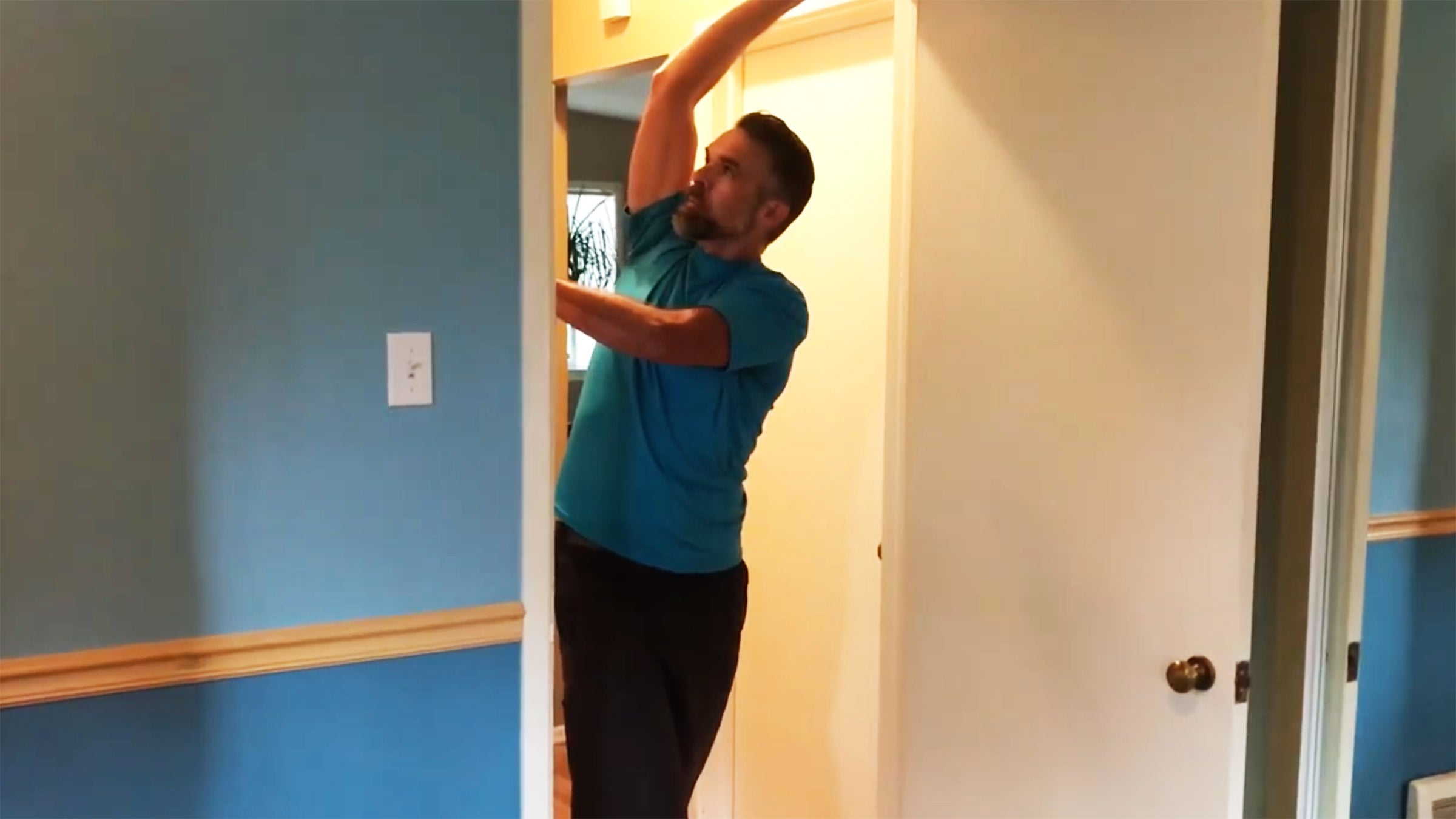
You can use a doorway for several whole-body mobility drills.
- Chest: Put your right foot forward and your left foot back with both feet pointing straight. Place your hands at about head height with elbows bent about 90 degrees. Drive your chest forward/backward. Next, drive the hips side to side. Finally, turn the head and body left/right. Perform about 10–15 reps in each position. Switch the feet and repeat the series. You’ll stretch the chest, arms, hips, and rear-leg calf.
- Overhead: This series is similar to the first but you’ll work with your hands overhead. Assume the same split stance as above. Put both hands overhead against the doorframe. Drive forward/backward. Tweak the stretch by putting your hands overhead at an angle and perform the same stretch. This creates a side bend in your trunk. Do the same to the other side. Switch legs and repeat. Perform about 10–15 reps in each position. You’ll feel the stretch in your lats, triceps, and trunk.
- Crossover: Keeping your arms at chest height, grab the front of the door frame with your left hand and grab the back of the door frame with your right. Cross your right leg over your left. Drive your hips left/right for 10–15 reps. Repeat with your hands to your left and your left leg crossed over your right. You’ll feel the stretch through your lateral shoulders, trunk, and hips.
- Type 2 Crossover: Put your right foot forward and your left foot back with both feet pointing straight. Turn your left hand over, thumb down, reach across your chest, and grab the back of the doorframe. Reach your right hand overhead to your left, palm forward, and grab the top back of the doorframe. Drive your trunk forward/backward for 10–15 reps. Then drive your hips left/right for 10–15 reps. Finally, rotate your trunk right/left for 10–15 reps. Reverse your foot and hand position and repeat the process. You’ll feel a stretch throughout your shoulders, trunk, and hips.
- Spine/Posterior Chain: Stand just outside the doorway with your feet close together. Reach down low and grab the doorframe with your thumbs turned down. Glide forward and backward in and out of the stretch. You’ll feel this in your lats, low-back, and hamstrings.
Different Work Positions
Hip Extension at Your Desk
Sitting in a chair isn’t your only option when typing on your computer. You can do the above hip flexor stretch at your desk. Or you can simply kneel on either both knees (tall kneeling) or on one knee (half-kneeling) while at your desk.
ADVERTISEMENT

This helps open up the hips and improve hip extension. Hip extension is essential for pushing off the ground while running. Kneeling while typing at your desk also requires you to extend your spine. A tall, neutral spine is an efficient running posture. Hunching over isn’t necessarily bad, but doing it for hours on end isn’t conducive to efficient running posture.
Floor Sitting Positions
If you work on a laptop then you can leave the desk altogether and get on the floor. The floor offers a galaxy of novel sitting positions: cross-legged, side-lying, on your stomach—the list is endless. You can work, watch videos, and communicate with others all while engaging in variable movement and postures. Simply getting up and down off the ground is a practical exercise and it’s something most adults rarely do.
Standing desks
Using a standing desk is fine but standing in one position for a prolonged time isn’t better than sitting. Remember, you need to move more often. Further, you don’t need to be on your feet a lot more if you’re still running regularly. You should rest and recover appropriately between runs.
ADVERTISEMENT
Keep Moving, Keep Changing
Sitting still all day is no way for an athlete to live. Frequent movement is essential to maintaining joint health and movement skills. You can maintain your movement skills by assuming different postures and sitting positions, and by performing a few mobility drills throughout the day. Use this mobility routine in combination with an at-home strength training program to be a faster, more durable runner. Your running options may be limited but your movement options aren’t.
—
ADVERTISEMENT
Kyle Norman, MS, is a Denver, Colorado-based personal trainer, strength coach and running coach with 20 years of experience. He specializes in helping people move well, get strong and get out of pain. You can follow his blog at www.denverfitnessjournal.com.