Published October 13, 2020 04:19PM
Jenny Spangler's Best Race and How She Achieved It
Spangler says a balanced training program with key confidence-building workouts, a more relaxed mental approach, and a “finely tuned taper” carried her to victory in the 1996 Olympic Marathon Trials.
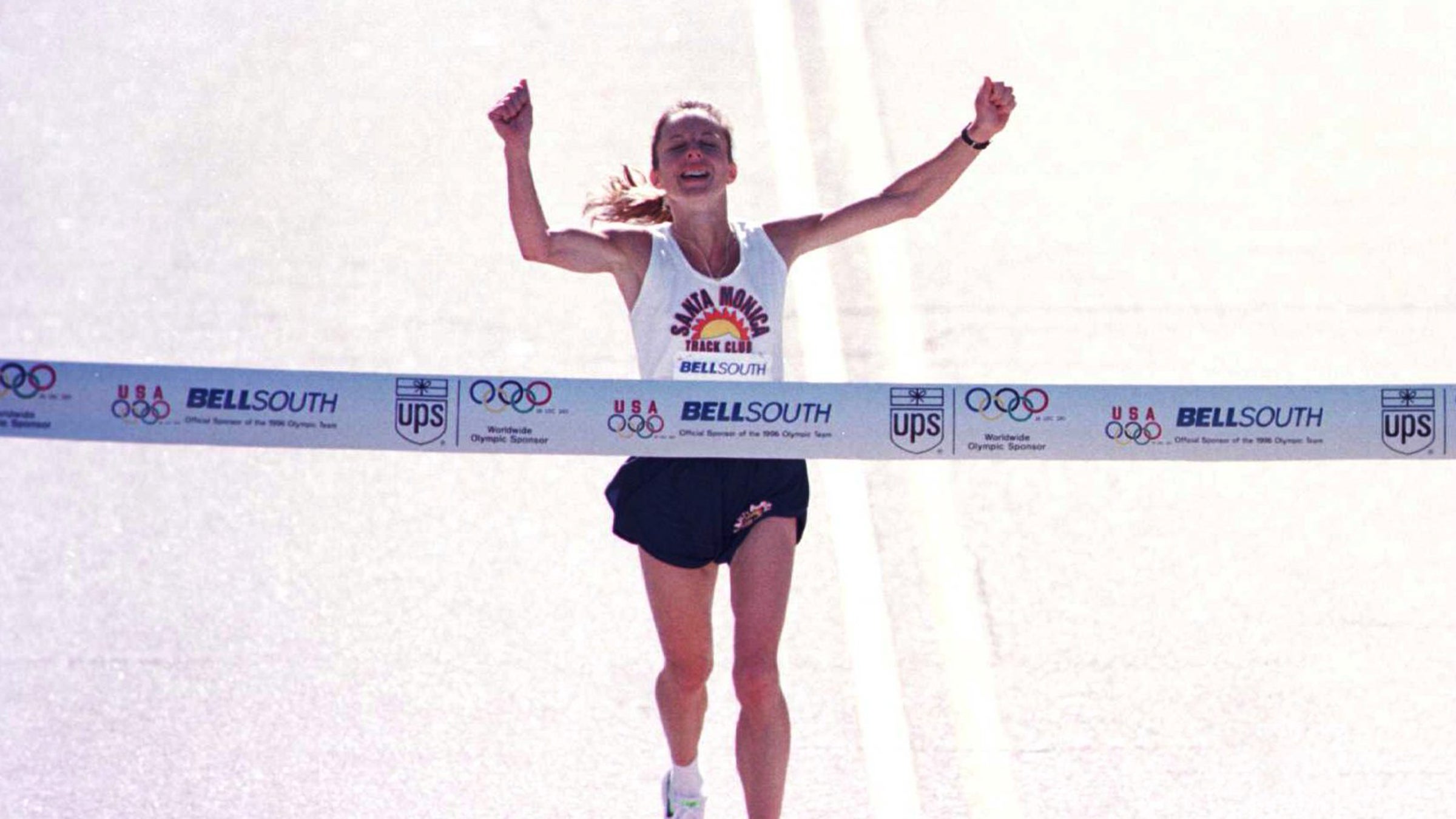
10 Feb 1996: Jenny Spangler of Gurnee, Illinois, raises her hands in celebration just before crossing the finish line to win the 1996 Women''s Olympic Marathon Time Trials held in Columbia, South Carolina. (Photo: Getty Images)
Jenny Spangler spent more than 20 years near the very top of U.S. women’s marathoning. In 1983, in her first marathon, she won Grandma’s in 2:33:51, setting a 19 & under American record that still stands. Twenty years later, as a 40-year-old in 2003, she set the American masters marathon record of 2:32:39 in Chicago. The next spring, she placed ninth overall, and first masters, in the 2004 U.S. Olympic Marathon Trials in 2:36:30.
But Spangler doesn’t rank either American record or the 2004 Marathon Trials as her best race. Her best, and most surprising, was her victory in the 1996 Olympic Marathon Trials. She entered the event, her third Trials, with the 61st-fastest qualifying time. No marathon experts saw her win coming. Yet on that warm February morning in Columbia, S.C., Spangler broke the tape in 2:29:54, snatching the win from dozens of more heralded runners.
She ranks her 1983 Grandma’s Marathon and 2003 Chicago Marathon in a tie for her second-best race.
Spangler currently lives in Lake Forest, Ill., where she organizes training sessions for local runners, and operates an internet-based coaching service at JennySpangler.com.
ADVERTISEMENT
Why the 1996 Olympic Marathon Trials was Spangler’s best race:
Not because she won it. That was secondary — an outcome that naturally followed her preparations. “It was one of those ‘magic races’ for me,” she says. “One of those days when everything just came together.”
As a veteran competitor, Spangler had experienced plenty of highs and lows in prior marathons. She knew she couldn’t simply will her way to a top performance. Everybody wants to run their best. Instead, Spangler sought a degree of detachment. “I put my expectations out of mind, and just ran — no pace goals, no place goals,” she remembers. “I simply wanted to run in the moment and let the race unfold.”

Buildup training for the Marathon Trials:
In advance of the April race, for most of November and December 1995, Spangler averaged 90 miles a week. The last week of December, she hit a mileage PR with 110 miles. She also ran 100+ miles for the first two weeks of January before beginning to ease back a bit prior to her serious taper.
ADVERTISEMENT
Several key workouts:
- In November, she ran a hilly 10-mile time-trial with the goal of splitting a fast first mile. She hit 5:06 for that mile.
- In December, she gained confidence from a session of 8 x 1-mile, alternating between 5:25 and 5:45.
- Several times, she did 24 x 400 meters, broken into four sets of six repeats each. For the first and third sets, she did a 100-meter recovery jog, and averaged 75 seconds per 400. For the second and fourth sets, she did a 200-meter recovery, and averaged 72 seconds per 400.
Key workouts in the last month:
During the last six weeks pre-Trials, Spangler picked up a new coach. She moved from Chicago to Santa Monica to train under Joe Douglas of the Los Angeles Track Club. She continued to be advised by her Chicago-based coach, Willie Rios.
Several key workouts:
- Long hilly weekend runs of 20 miles in the morning at 6:00 pace, followed by 4 miles in the afternoon. “I knew I was in really good shape when the 4-milers started feeling easy.”
- 16 x 400 meters in 70-73 with 100-meter jogs. “These built my confidence and kept some zip in my legs after all the long runs and tempos.”
Taper:
In the last month pre-Marathon Trials, Spangler ran weekly mile totals of: 86, 78, 62, and 38 (Mon.-Fri.). Eight days pre-marathon, she completed a 9-mile tempo run at 6:00 pace. During the last week, she continued running twice daily, as was her custom, but covering much less distance. She also did 10 x 100-meter strides after one of her daily runs.
Race-day plan:
Of course, Spangler had a dream goal — to make the Olympic team. However, that wasn’t the main thought she carried to the start line. Instead, she aimed to race “the best marathon of my life” by following her coaches’ advice. They wanted her to run at “a slight level of discomfort.”

ADVERTISEMENT
Key moment in the marathon:
“I’m a rule-follower,” says Spangler, so she followed the slight-discomfort advice. That put her with the leaders at the half-marathon, reached in 1:14 plus, an effort that actually felt easier than her discomfort zone. Spangler thought about surging, but remembered past races in which she “had blown up.”
She tried to stay patient. At 16 miles, she increased her pace to the slight discomfort level, and was “freaked out” when no one went with her. (Later she learned she had hit 5:20 for this mile.) Spangler was never caught, winning by a margin of 12 seconds over Linda Smith.
What enabled Spangler to achieve a Best Race:
She believes there were three key contributors: 1) a physical peak; 2) a mental peak; and 3) the extras. First, Spangler did more miles than ever before, over hillier courses, at a faster pace. She thrived on the challenge. She notes the advantage of having coaches monitor every session in person, and adjusting the work load as appropriate. “One day I was finishing a 20-miler, and very happy about it,” she says. “Then Joe drove up beside me and said, ‘Go ahead and do two more miles.’”
ADVERTISEMENT
Second, her workouts gave her great confidence, and a “finely-tuned” taper left her fresh. “Before other races, I sometimes thought, ‘I can’t wait until this is over,’” she says. “This time I was excited for race day to come.”
Last, with no other distractions during her last six weeks in Santa Monica, “I was able to focus on stretching, nutrition, sleep, and relaxing between runs like never before,” she says. “This was an opportunity, I had never had before, and it made a huge difference.”
How to achieve your Best Race the Jenny Spangler way:
“It is extremely important to listen to your body, and adjust your training appropriately,” she says. Spangler also believes in slightly under-training to preserve freshness while still maintaining confidence in your approach. She places great faith in “the extras” like stretching, strength-training, sleep and nutrition, believing it is better to cut a run short to accommodate the extras rather than pushing on to accumulate a few more miles.
ADVERTISEMENT
Avoid: Any comparison between your training and someone else’s. “There’s so much social media and online training logs that we often second-guess our training and paces against others,” Spangler notes. “This can lead to overtraining and/or injury.”
