Published November 2, 2023 03:51PM
Want to Win a Race with No End? Work on Your Poker Face.
Harvey Lewis, who recently ran 450 miles to win Big’s Backyard Ultra, discusses the mental trickery that goes on during ultrarunning’s hardest race
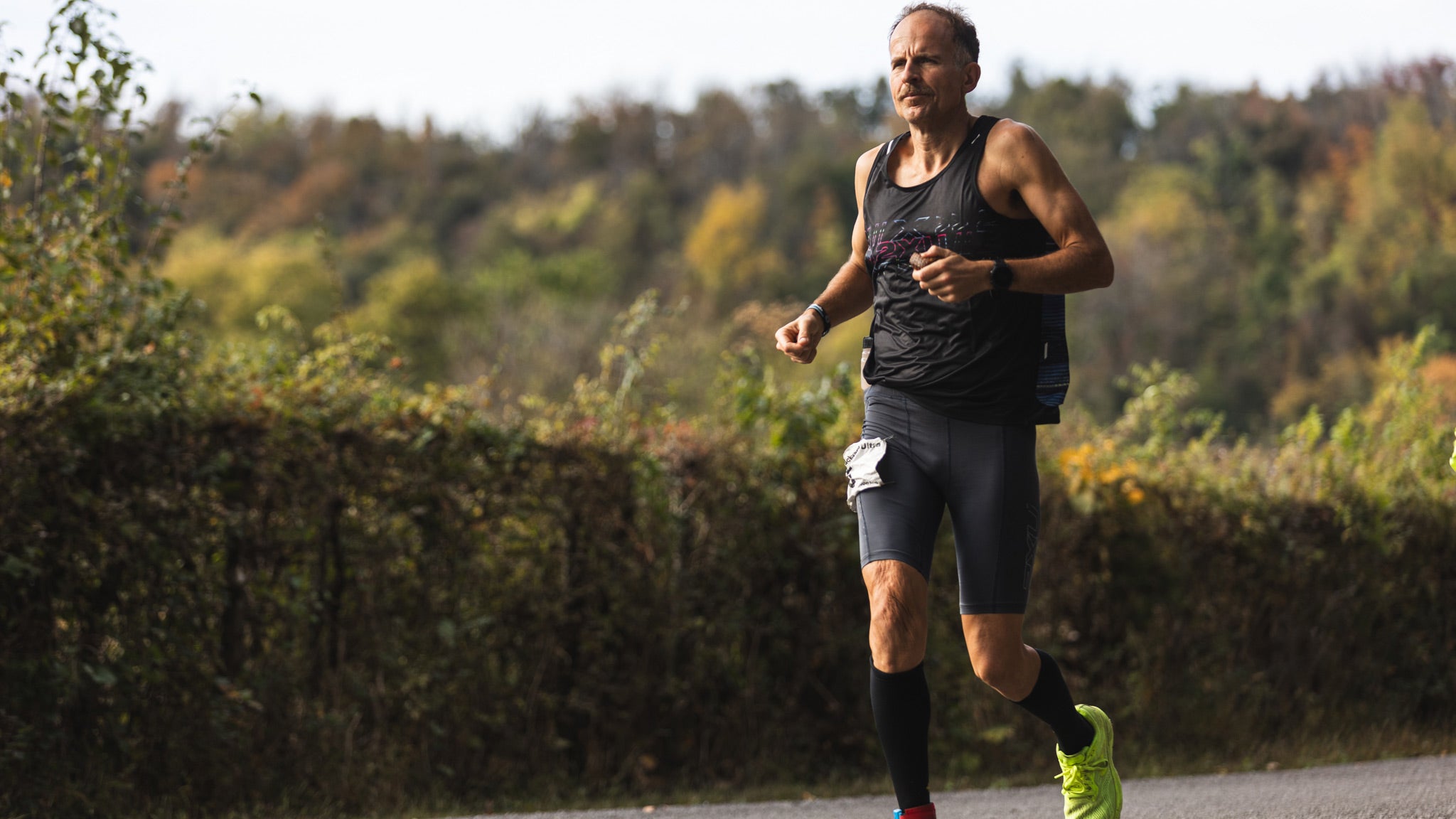
Harvey Lewis runs during the 2023 Big’s Backyard Ultra (Photo: Mike Trimpe)
Not many people can run 400 consecutive miles and still stand upright—fewer can complete this athletic feat and continue running. I think there’s just one person alive who could do it and then unleash a sprint that would make Usain Bolt proud. That’s Harvey Lewis, the newly crowned world champion for the niche sport of Backyard Ultrarunning.
As it turns out, he was. “I’m really fired up in that video,” Lewis recently told me. “There are times during races when I have to hype myself up, but not there. I am already so hyped up, just mentally and physically. That’s what you have to do to keep yourself in the game.”
ADVERTISEMENT
The game that Lewis is referring to is the strategy—nay, the psychological warfare—that goes on during one of these grueling races. At Big’s and other backyard ultras, participants run around a 4.167-mile loop every hour, hour after hour, for days on end (the distance means they complete 100 miles every day). They start and finish in the same location, and can rest or eat or use the toilet in the time between each lap, which is never long enough for them to sleep for more than a minute or two. As the event goes on, participants drop out due to sleep deprivation or blisters or diarrhea or because their brains simply cannot fathom any more running. The winner is the final person left standing.
This twisted format was dreamed up by Gary Cantrell—known as “Lazarus Lake”—the designer of the infamous Barkley Marathons. Backyard ultras foster some unorthodox head games amongst the handful of elite runners. At some point, they become hardcore body-language analysts, eyeing each for signs of injury or exhaustion. Simultaneously, they mask their own ailments in an attempt to convince their peers that they are feeling just fine and dandy—even thought every one of their muscles throbs with pain.
“There’s a lot of poker faces out there,” Lewis says “If one of the competitors starts to show weakness, it just adds thunder to everyone else. Part of the game is showing that you’re strong.”
ADVERTISEMENT
There are plenty of telltale signs that a runner is nearing the end: limping, wincing, sitting down. Some athletes, after running hundreds of miles, begin to list to one side like a torpedoed warship. Oftentimes, runners nearing the limit will finish each lap just a few seconds before the next one is to begin—the countdown is marked by three whistles and then a bell.
There are also all manners of tricks for covering up the pain. Lewis said that his toughest competitor at Big’s, Ihor Verys of Ukraine, maintained a stoic and expressionless demeanor—think Ivan Drago from Rocky IV—right until the moment he dropped out at mile 445. Dutch ultrarunner Merijn Geerts, who dropped at mile 417, told the Bad Boy Running podcast that he will purposely start a race looking disheveled so that competitors cannot notice a meaningful change in his appearance as the event goes on. “If someone looks very fresh from the beginning, and suddenly he doesn’t look fresh anymore, you know there is a problem,” Geerts said. “If you don’t look very [fresh] all the time, then your opponent doesn’t know you are suffering.”
Fibbing is another formidable tactic. As Big’s stretched past the two-day mark, Lewis heard some competitors respond truthfully to a familiar question that runners ask one another on the trail: how are you feeling? “I was surprised to hear people saying ‘I was hallucinating’ or ‘I have a blister on my foot,‘” Lewis said. “Loose lips sink ships.” Lewis, who teaches U.S. government at a high school in Cinncinatti, Ohio, told me that he’d never divulge his aches and pains to a competitor.
“I don’t know why anyone would ask me how I feel during a race,” he says. “I could have blood pouring out of my head and I’d still say, ‘I feel amazing!’”
ADVERTISEMENT
And then there’s the whole sprinting thing. Running fast is absolutely a psychological flex—a way to show the competition that you are supremely confident and also feeling fantastic. Think of it as the backyard ultra version of Steph Curry’s highly-intimidating pregame warmup. Lewis’s mad dashes were an integral weapon in his psychological war chest, he said, and he sprinted out of the gate again and again during Big’s.
“It’s like here we are at mile 400 and I can just go man,” Lewis says.
“I did it way too much and got carried away feeling invincible and not reigning myself in,” Lewis admits. “Because the counter to it is to just run your own race.”
ADVERTISEMENT
At Big’s, Lewis only sprinted at the start—he actually didn’t complete the loops fastest, and during many laps he finished several minutes behind Bartosz Fudali of Poland, who exited the race after completing 429 miles. For all of the psychological gamesmanship that goes on in a backyard ultra, Lewis said there’s really no way to overcome a runner who has a steady rhythm, an expert nutrition plan, and the steely attitude to keep going—no matter what. Lewis said his winning tactic was more about mindset than about mind games.
“I don’t care what distance anyone else goes—I’m just going to commit to going further,” he says.
