Published October 23, 2018 04:21PM
Foot Strengthening Exercises to Treat Plantar Fasciitis
Two simple exercises to strengthen the feet while stretching and mobilizing the plantar fascia and surrounding tissues
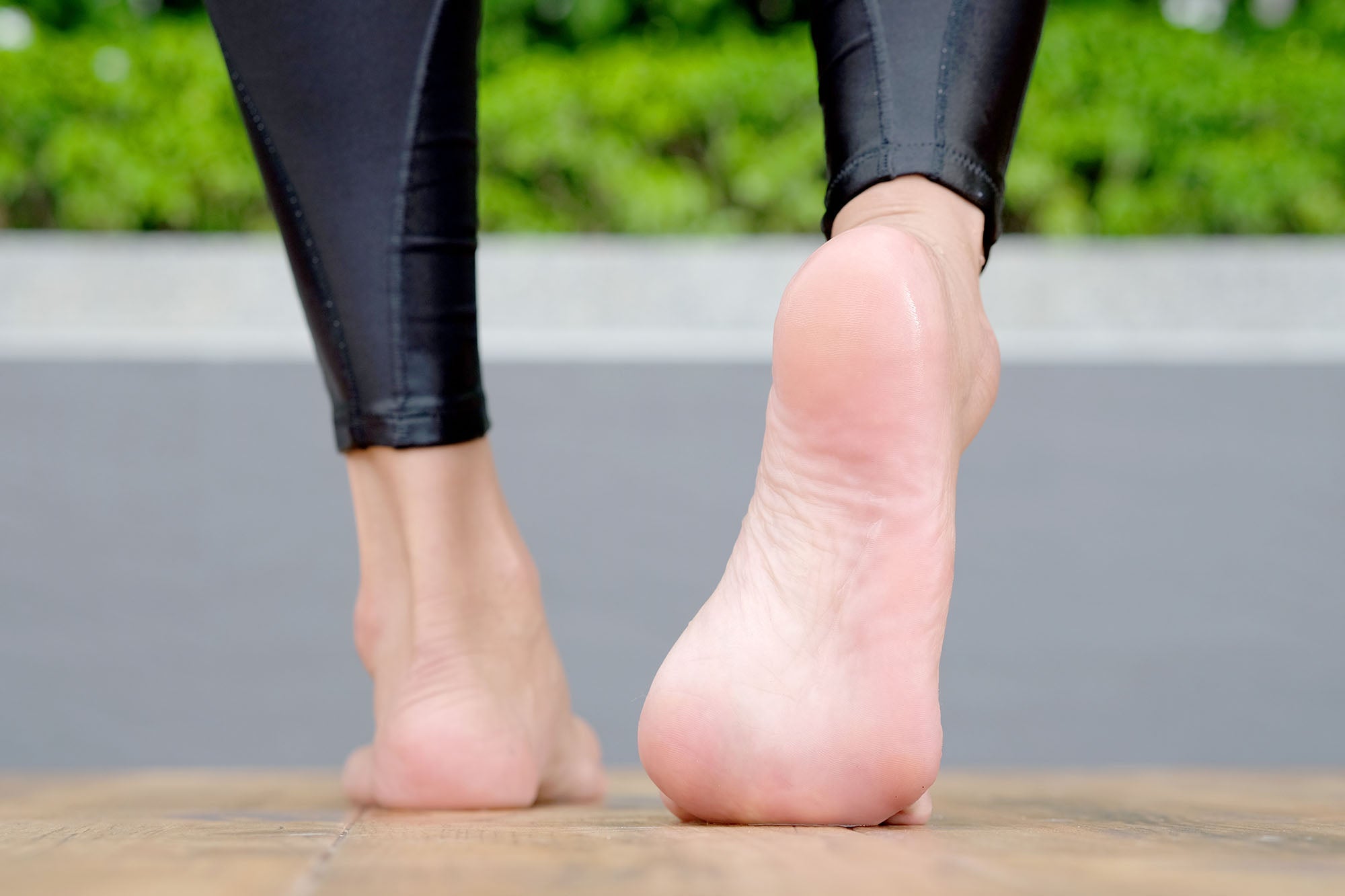
Photo Credit: Shutterstock
Plantar fasciitis is debilitating, frustrating and tenacious. If you’re unfamiliar with the condition, the plantar fascia is a thick band of connective tissue that runs along the sole of the foot and the term is used to describe irritation of that tissue.
Common symptoms include:
- Sharp pain in the arch of the foot, often near the heel
- Arch/heel pain upon first stepping out of bed in the morning or after prolonged rest
- Arch/heel pain with prolonged activity
To be clear, fasciitis indicates tissue inflammation. Evidence suggests that plantar heel pain (PHP) doesn’t involve inflammation but rather tissue degradation, so calling it fasciitis is inaccurate. Whatever the case, arch/heel pain is the problem we’re addressing.
What Causes PHP?
One idea is that PHP is due to weak foot stabilizer muscles, the intrinsic foot muscles. All the tissues of the foot must help manage impact forces. If the intrinsic muscles are too weak to do their share of the work then excess forces are transmitted to other tissues such as the plantar fascia. If the tolerance of the plantar fascia is exceeded, then pain may arise.
ADVERTISEMENT
Treating PHP
If you’ve tried stretching, orthotics, taping, ultrasound, massage, ice, heat and similar treatments and those approaches haven’t worked, then it’s time to try something different: progressive loading. PHP is similar to tendinopathy in that it responds well to heavy loading. Loading strengthens the foot muscles, the plantar fascia and other connective tissue. The following exercises not only strengthen the feet but they also stretch and mobilize the plantar fascia and surrounding tissues.
Weight, Reps & Sets
Use heavy loads: You should reach failure in 5-10 reps. These aren’t endurance exercises. Many gyms have specialized calf raise machines which work well for this exercise. You may also add weight by holding dumbbells or wearing a backpack loaded with books or something similar.
- Pick one of the following exercises.
- Start with one or two sets of 5-10 reps. You may progress up to five sets.
- Accumulate a total of 20-40 reps.
- Try different rep x set schemes: 2 x 10 reps, 4 x 8 reps, 8 x 5 reps, etc. depending on the load lifted.
- More sets must be done when using heavier weights since you can’t lift as many reps per set.
- The stronger you get, the more work it takes to get stronger.
- Perform the workout every other day.
- Alternate between exercises each workout.
Toes-Elevated Heel Raise
This is a heel raise with a rolled-up towel under the toes which stretches the plantar fascia. Start by doing the exercise on two feet. If that’s easy then go to one foot. Progress to using one foot then continue to add weight. For some, the jump from two to one foot may be too difficult, so you can add weight while still working on two feet.
ADVERTISEMENT
Twisting Heel Raise
This is similar to the previous exercise but a bit more complex in that it involves knee flexion/extension plus tilting and twisting of the ankle and foot to load and mobilize the plantar fascia. No towel under the toes is needed.
Pain During or After The Exercise
It’s acceptable to feel mild pain during these exercises. Pain should be no higher than 3 on a 10-scale with 10 being the most pain. If your pain flares up significantly the next day then you may have worked it a little too much but you’ll be okay. Back off the weight, reps and/or sets for your next workout.
Finally
If you’ve had recurring PHP then think of the affected area as your true Achilles heel. It’s your weak link. Thus it’s a good idea to continue doing these exercises twice a week to forestall future pain. Some individuals may be able to continue running while rehabbing PHP via this protocol, but others may need to cease running for a short while. Either way, you’ll probably need to reduce your running volume. A running coach can provide precise guidance.