Published August 4, 2020 06:04PM
Hip Adductor Exercises to Become a Stronger Runner
Avoid injury and improve your stride with these 5 simple stretches and strength exercises for your groin muscles.
(Photo: Kyle Norman)
You may not associate groin muscles (aka hip adductors) with running; they, and injuries to them, are typically associated with sports like tennis, ice hockey, basketball, or soccer — sports with significant lateral movement. But if your hip adductors are weak and tight, you’re not the best runner you can be. Hip adductor problems can cause knee pain, low-back pain, hip pain, and inefficient running. Mobilizing and strengthening your adductors can help cure these pains, and make you a more powerful runner.
The Adductors’ Role in Running
Your hip adductors work constantly during the running gait. They decelerate your femur at footstrike and stabilize the pelvis as you pass over your foot. They also propel you forward at push-off and slow your trail leg as it moves behind you. Adductor activity increases as you run uphill, downhill, or run faster.
Adductor Mobility & Strength Exercises
The following mobility and strength exercises will make your adductors strong and resilient. All of the exercises are demonstrated in this video and described below.
Stay mindful and stay in strict control of these exercises. Don’t rush, and don’t let the exercise control you. Any stretch should feel moderate — not too intense and never painful. For the strength exercises, work to the point of exertion and stop just short of total exhaustion.
Stay mindful and stay in strict control of these exercises. Don’t rush, and don’t let the exercise control you. Any stretch should feel moderate — not too intense and never painful. For the strength exercises, work to the point of exertion and stop just short of total exhaustion.
Mobility Drills:

1) Kneeling Adductor Matrix
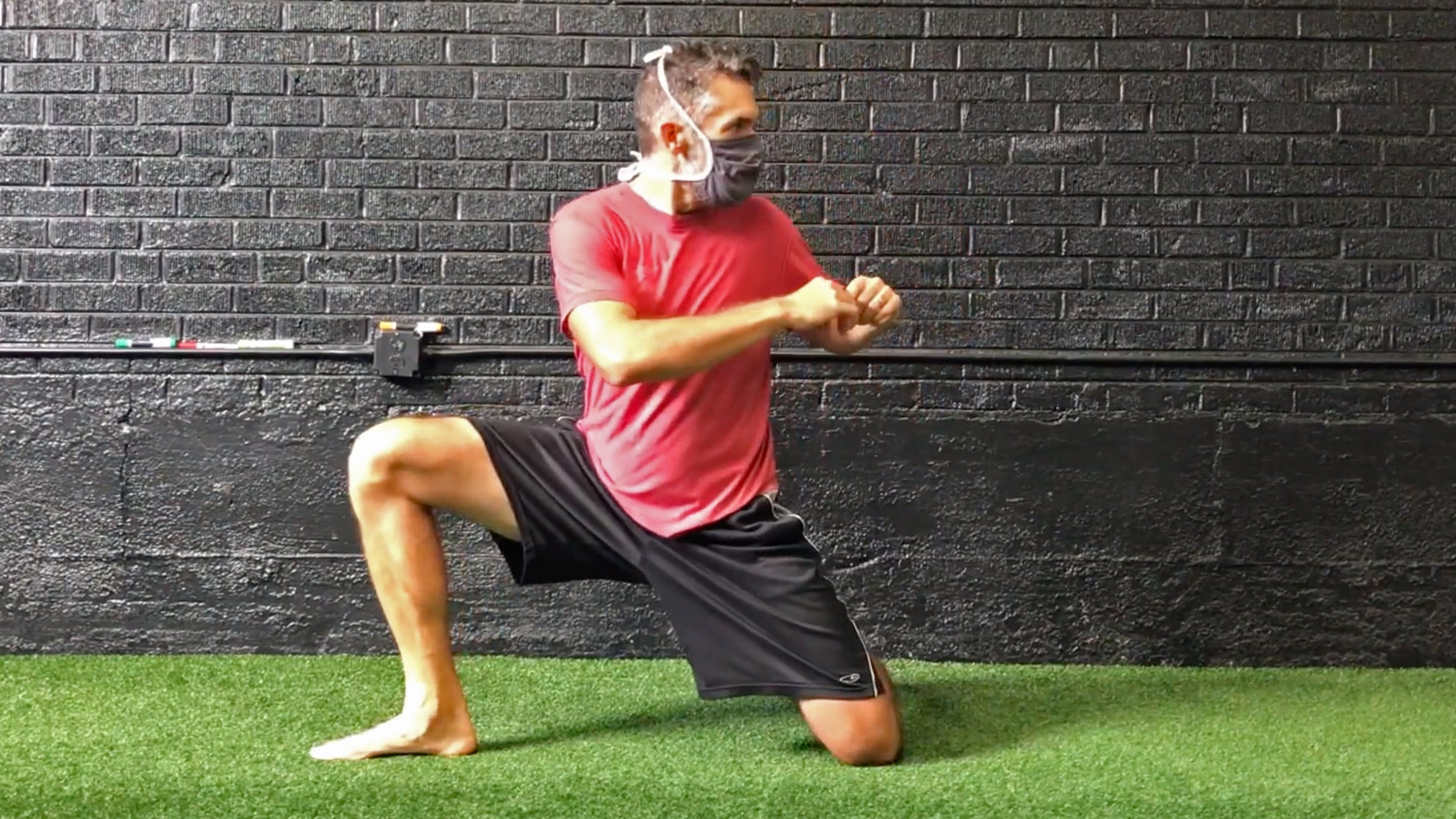
Kneel on the left knee and swivel the right leg out to the side with the right foot perpendicular to the left leg and the left knee in line with the right heel. The further away the right foot is from the left knee, the greater the groin stretch. Adjust your foot appropriately to get the best stretch. Stay tall and glide right for 5–10 reps, pausing briefly at the end range where you feel the stretch, then return to the start position.
ADVERTISEMENT
Repeat this exercise, but now as you glide into the stretch, reach your arms in one of six directions:
- Reach your hands forward and down, allowing your trunk to lean forward as you glide right.
- Reach your hands high overhead as you glide right.
- Rotate your arms and trunk to the right as you glide right.
- Rotate your arms and trunk to the left as your lower-body glides right.
- Reach your left arm overhead to the right, side-bending right as you glide right.
- Reach your right arm overhead to the left, side-bending left as your lower-body glides right.
Repeat entire sequence kneeling on your right knee.

2) Quadruped Straight-Leg Rocking
Kneel on both knees. Straighten one leg out to the side so that this leg is perpendicular to your kneeling leg. Place both hands flat on the ground a little in front of your shoulders. Keep your eyes forward to help keep your spine in neutral, and rock your hips back toward your heels, away from your hands, then rock your hips forward toward the ground. You should feel a strong stretch in the adductors of the straight leg. You should also feel a stretch in your legs when you sit back.
To mobilize the thoracic spine, sit back into the stretch and freeze. Reach one hand under your torso then reverse and reach up to the ceiling. Do 5–10 reps. Then use the other hand to perform the same reaches the other direction. Switch legs and repeat the process.
ADVERTISEMENT
Strength Exercises:

1) Loaded Groin Glide
This exercise is similar to the kneeling groin matrix. The difference is that you’ll hold weight in front of you. You may use a dumbbell or dumbbells, a kettlebell, stack of books, bowling ball, or anything else you like. You can increase the load by holding the weight further away from your body, and you should notice a reflexive tightening of the core as a result. Stay tall and glide into the stretch, pausing briefly at the end range, then return. Repeat for 6–10 reps to the point of exertion.

2) Copenhagen Adductor Exercise
You’ll need a weight bench, a coffee table with a pillow on it, or another similar surface. Arrange yourself in a side plank position with your elbow underneath your torso and your knee (easy), shin (harder), or ankle (hardest) on the bench. Keep the top hand on your hip. Use the leg on the bench to lift your hips and trunk off the ground (the only points of contact now being your top leg and your bottom elbow). Pause and lower yourself to the ground. Repeat for reps or hold yourself in the up position for time. Work to exertion. Flip over and repeat on the other side. Experiment with the knee/shin/ankle positions on the bench.

3) Common Lunge Matrix:
Start with four lunges in each direction (two per leg.) Work up to 10 lunges per leg in each direction, then you can add weight.
- Anterior lunge: Brace the core. (Holding weight in front of the body will help.) Take a lunge step forward, allowing both knees to bend upon impact. Pause briefly in the bottom position then drive forcefully into the ground to return to the start.
- Same-side lateral lunge: Brace the core as above. Keeping both feet aimed straight, step out to one side, allowing the lunge-side hip, knee, and ankle to bend upon impact. Keep the trail knee locked or nearly locked. Pause and return as described above.
- Same-side rotational lunge: Brace the core as above. Take a rotational lunge step to one side of the body, away from the trail leg. (Similar to stepping out of a car.) Allow the lunge hip, knee, and ankle to bend upon impact. Pause and return as described above.
ADVERTISEMENT
Consistent Progress to a Better Runner
The adductors are critical to effective, healthy running but they are often overlooked. Adductor weakness and tightness may contribute to pain in other regions of your body. Appropriate mobility and strength work will help you run better.
Much like running, you will be rewarded if you’re consistent. Try doing the above routine 1–2 times per week. Progress the strength exercises by adding weight and/or reps, or time. Consult a medical professional if you’re in pain and you suspect an injury.
ADVERTISEMENT
–
Kyle Norman, MS, is a Denver, Colorado-based personal trainer, strength coach and running coach with 20 years of experience. He specializes in helping people move well, get strong and get out of pain. You can follow his blog at www.denverfitnessjournal.com.