Published August 26, 2020 03:00PM
Deadlifts to Enhance Running Efficiency and Mobility
Every runner’s strength program should include a version of the deadlift. Here’s how to do them safely and effectively.
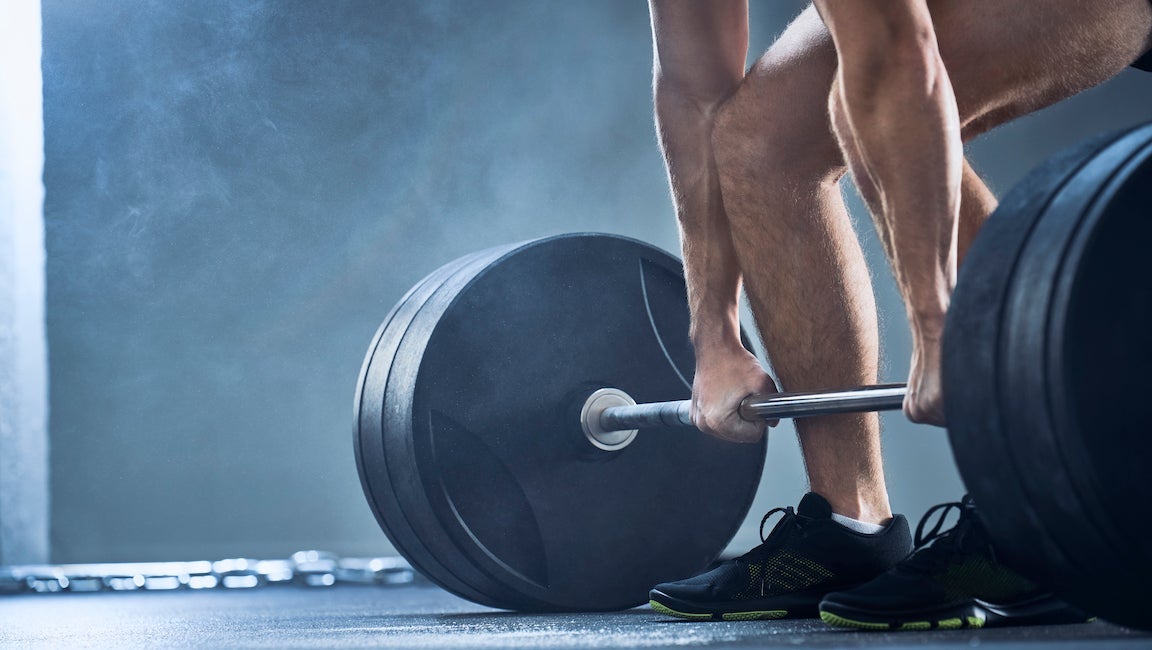
(Photo: Getty Images)
Resistance training works for runners. The right strength training program will make you more efficient and durable. Strength training also facilitates mobility. The deadlift has long been a staple strength exercise, and it belongs in your weight training arsenal.
The Deadlift (DL)
1) Reach down. 2) Grab a loaded barbell. 3) Stand up.
That’s a DL in the simplest terms. The DL strengthens your hamstrings, glutes, spinal erectors, and shoulders. More specifically, the DL and its variations train hip extension, or the pushing motion that drives you forward when you run. Here are several effective versions of the DL.
Conventional DL
Use a barbell loaded with Olympic-sized plates. Your legs and hips drive the movement. Depending on your flexibility, you may need to raise the bar higher by setting it on blocks, on pins inside of a squat cage, or on top of other weight plates. The conventional DL is easier to break from the floor but harder to lockout at the top than the sumo DL which is discussed later.


Set-up: Take your time and be precise.
- Stand with your feet hip-width apart (not shoulder-width like a squat.) Position your feet under the bar so the bar divides your feet in half, front to back.
- To reach the bar, perform a hip hinge: Keep a neutral spine and push your hips back as if you’re pushing a door shut with your rear end. (Stick your butt way out!) Your trunk leans forward simultaneously.
- Then, bend your knees, keeping your shins as vertical as possible. Shins now touch the bar.
- Grab the bar with a grip just outside of your legs using an alternated grip (one hand over, the other hand under) or a hook grip (thumb around the bar and fingers wrapped around the thumb, locking it in place.)


- Knuckles down.
- Hips slightly higher than knees.
- Chest forward and abs braced.
- The bar now touches your shins.
- The bar is slightly behind your shoulders.
- Look forward to the floor about 3-4 ft.
- Stay balanced with your weight through your mid-foot. Grip the ground with your feet.
Get tight: Tension is critical for safe deadlifting. Your entire body must be tight.
- Shoulders: Tighten your lats to keep the bar close to you.
- These cues may help: Shrug your shoulder blades into your back pockets. Crush an egg in your armpit. Squeeze your lats.
- Lockout your arms.
- Inhale, hold, brace your abs, feel tension in your glutes and hamstrings.
Lift!
- Build tension gradually and eliminate slack in the bar. Don’t yank the bar.
- Stand up forcefully. Drive your feet into the ground and drag the bar up your legs.
- Drive your hips into the bar, lockout, and stand tall at the top with your hips pressed into the bar. Contract the quads, glutes, abs, and lats. Stay tight!
Return to start
- Keep the bar against you, perform a hip hinge, and return the bar to the ground.
- Exhale.
- Re-tighten, inhale and lift again. Repeat the process for 3-6 reps.
- Maintain this strict technique until you’re finished. You’re finished when you set the bar down for the final time.
ADVERTISEMENT
Sumo DL
This version uses a wide, sumo-wrestler-type of stance. The torso is more upright compared to the conventional deadlift and it uses the adductors and quads more. The sumo DL is harder to break from the floor but locks out more easily than the conventional DL.


Set-up: Take your time and be precise.
- Take a wide stance, toes pointed out, shins a few inches from the bar. Thighs, shins, and feet should align. You may need to experiment with your stance width.
- Squat down, bending your knees while dropping your hips toward the bar.
- Using either grip, grab the bar inside your legs, with a shoulder-width grip, arms vertical so the arms and legs don’t interfere.
- Stay balanced with your weight through your mid-foot. Grip the ground with your feet.
- Shins vertical, or nearly so.
- Chest up and abs braced.
- Eyes forward or up.
- Inhale and get tight as described above. Feel tension in your quads, adductors, and hamstrings.
Lift!
- Build tension gradually and eliminate slack in the bar. Don’t yank the bar.
- Stand up by forcefully driving the floor apart with your feet and drag the bar up your legs.
- Lockout, following the guidelines from above.
- Return to the ground and repeat the above process for 2-6 reps.
- Maintain strict technique until you’re finished. You’re finished when you set the bar down for the final time.
ADVERTISEMENT
Romanian deadlift (RDL)
The RDL uses less weight than the other DLs, starts in the upright position, and doesn’t let the weight touch the ground.
- Stand with feet hip-width and hold a loaded barbell or dumbbells in front of you, arms straight.
- Brace your abs.
- Keep a strict neutral spine and perform a hip hinge as described above.
- Arms locked, lats tight, the bar against your legs.
- Knees are almost locked.
- Pause briefly at the bottom, feeling a stretch in the hamstrings, then return to an upright, locked out position, hips pressed to the bar. Repeat for 6-10 reps.
Unilateral RDL
The previous exercises are done on two feet (bilateral). Bilateral exercises allow you to generate a lot of force. Unilateral RDLs are less stable and demand more coordination than bilateral exercises. Both types of exercises are valuable. The unilateral RDL moves much the same way as the bilateral version but one leg pivots up from the ground as the trunk hinges forward. You may load the exercise with a variety of tools including dumbbells, barbells, kettlebells, cables, or tubing.
ADVERTISEMENT
Put It All Together
Select either the conventional or sumo deadlift and stay with it for 4-6 weeks. Take an easy week then try the other deadlift. Include the RDL and one of the unilateral deadlifts in your workout. If you’re lifting twice per week then consider alternating a deadlift-centered workout with a squat- or lunge-centered workout. Separate your weight workouts by 2-3 days. Be content with gradual progress.
Note: Don’t deadlift in cushioned running shoes. Flat, non-cushioned shoes are best. The Converse Chuck Taylor is a good, inexpensive choice. Minimalist running shoes also work well, like the Altra Solstice XT, Topo ST-3 or Xero HFS or Prio.
Warm-up with several minutes of jump rope or something similar and do some mobility work. Do several progressively heavier sets, increasing the load with each set until you get to your working weight. Your working weight should feel like a 7-8 on an RPE scale of 10. For example, if you’re doing 5-rep sets then your working weight should allow you to barely lift seven reps. Recover fully by resting 2-3 minutes between sets. Once at your working weight do 1-4 sets of:
- 2-6 reps of either deadlift
- 6-15 reps for the RDL and unilateral RDLs
Regarding weight, a set of Olympic-sized plates typically consists of 10, 25, 35, and 45 lb. plates. Most gyms also have small 2.5 and 5 lb. plates. An Olympic bar weighs 45 lbs. Women-specific Olympic bars are 35 lbs. I can’t tell you exactly what weight to use but err on the lighter side if you’re new to deadlifting, and work up as you feel confident and able.
ADVERTISEMENT
A sample six-week progression: Pick either the conventional or sumo deadlift.
- Week 1-2: 6 reps x 2 sets, add 5-10 lbs. to working sets the 2nd week.
- Weeks 3-4: 4 reps x 3 sets, add 5-10 lbs. to working sets the 2nd week
- Week 5: 2 reps x 4-5 sets
- Week 6: De-load week: Take off entirely or lift very lightly
- Start the process again with the other deadlift.
Consistent deadlifting will improve your running, and you’ll appreciate the results. While the deadlift is fairly simple, certain cues and body positions aren’t necessarily obvious. The best way to learn these exercises is with the instruction of a qualified coach or trainer.
–
Kyle Norman, MS, is a Denver, Colorado-based personal trainer, strength coach and running coach with 20 years of experience. He specializes in helping people move well, get strong and get out of pain. You can follow his blog at www.denverfitnessjournal.com.