Published March 4, 2019 04:07PM
Ready for Power-Building Plyometrics? Take This Test and Start with These Exercises
Plyometrics build running power and efficiency, but they are intense. Here's how to begin safely.
Plyometrics, aka plyos, are explosive exercises such as jumping or bounding that increase muscle power. Research shows that plyometrics increase running efficiency, thus lowering the energy demands of running, and may help prevent injuries.
Plyometrics, however, are intense. The same impact and rebound forces that make plyometrics powerfully effective can overwhelm muscles, bones, and connective tissue if not used properly. Runners must possess adequate strength and stability to tolerate jump training. Furthermore, runners must respect the need for progression from low- to high-intensity plyos. A little bit of jump training goes a long way.
Before You Jump
To reduce the risk of injury, all runners should meet baseline levels of muscular strength and stability before starting a plyometric program. Before you do any plyos, you should meet these criteria:
- No pain in the lower extremities
- Full range of motion in all involved joints
- Single-leg balance with eyes open for 30 seconds
- Single-leg balance with eyes closed for 30 seconds
- Full squats and lunges with no pain or compensations
- Single-leg half-squat with no pain and good movement patterns
- Squat 1.5 your body mass once or
- Squat 60% of your body mass 5 times in 5 seconds
You can do many of the assessments yourself, but, ideally you should enlist a coach or personal trainer to help assess strength and stability. Recently injured runners should first consult with a physical therapist.
ADVERTISEMENT
Where to Start
Jump rope
Two-footed jump rope is an easy introduction to low-intensity plyometrics. Jumping rope requires coordination which helps build overall athleticism. If you don’t have a rope or find jumping rope too difficult, jump an imaginary rope. Count the times you jump and multiply by two. That’s your number of foot contacts. Start with 2–3 sets of 10–20 jumps for 80–120 foot contacts. After two weeks, if you can do two-foot jumps comfortably, progress to the jog step—alternating landing on each foot. The jog step is a low-intensity unilateral plyometric.
3D Hops
This is similar to jumping rope with the addition of front/back, side-to-side, and rotational movement. These hops are short, low, and quick.
- Hop forward/backward 10 times, rest 20–30 seconds.
- Hop side-to-side 10 times, rest 20–30 seconds.
- Hop in place and twist the lower body left/right 10 times.
- Rest 1–2 minutes.
- Repeat once for 120 total foot contacts. More advanced athletes may do 20 reps per set.
- After 2–3 weeks of doing these hops with both legs you can progress to single-leg 3D hops.
ADVERTISEMENT
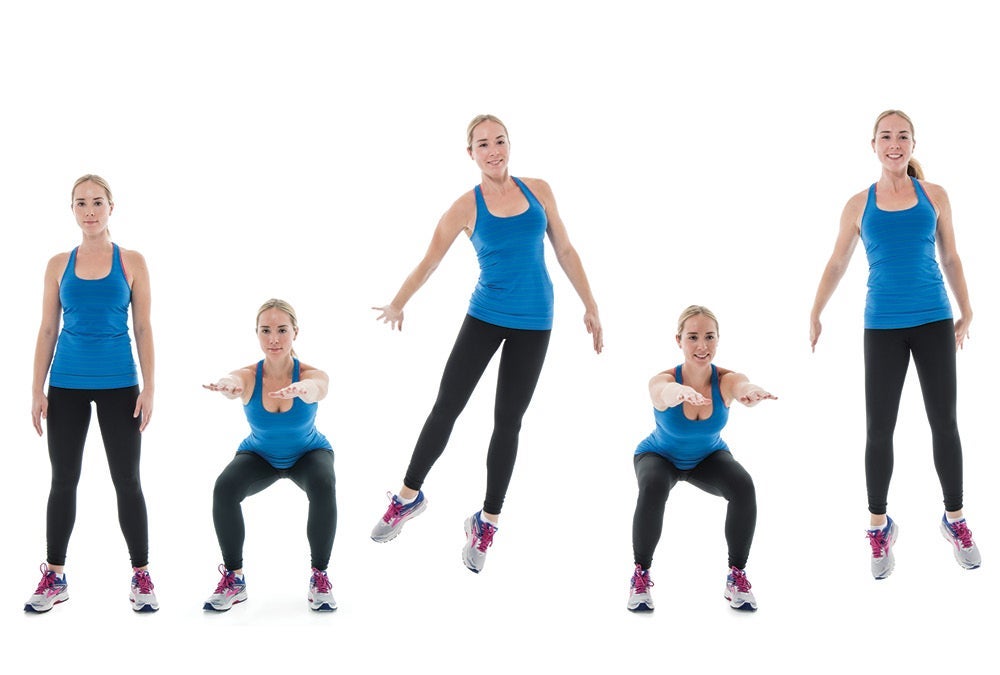
Squat Jump in Place
This drill is more intense than jumping rope or hops.
- Stand with hands on hips.
- Quickly squat down halfway.
- Explode up as high as possible.
- Land softly.
- Do 3–5 reps for 6–10 foot contacts.
- Rest 1–2 minutes
- Do 10–20 sets for a total of 80–100 foot contacts.
Plyo Progression
Intensity
Plyometric exercises range from lower-intensity two-legged jumps and hops on the floor, such as above, to high-intensity single-leg jumps that may involve jumping off of boxes of various heights. Here are some rules of progression:
- Start with bilateral (two-leg) drills and progress to unilateral (single-leg) drills.
- Progress from slow to fast.
- Progress from low to high.
- Progress from short to long.
- Emphasize quality over quantity.
- Start with general movements. Progress to sport-specific.
- Use linear, lateral, and rotational movements.
Good movement quality is crucial for plyometric training. Athletes should demonstrate precise control at all times. Plyos should ideally be done on non-running days, easy days, or with several hours between runs.
ADVERTISEMENT
Fatigue causes poor movement. Stop plyometric exercise before fatigue sets in. The purpose and benefits of plyometrics have nothing to do with feeling gassed. This isn’t endurance training!
Rest intervals are important in maintaining good movement quality. Recover fully between sets of plyos. One to two minutes rest between sets of exercises is usually adequate.
Frequency
Runners should start with one plyometric session per week. Stay with one session per week for two to three weeks. If all goes well you can add a second session. The second workout should come 48–72 hours after the first session. Two plyometric training sessions per week are probably the maximum for any distance runner.
Volume
It’s important to track plyometric training volume, defined as the number of foot contacts per training session. A jump and land on two feet equals two contacts. A jump and land on one foot equals one contact. Jumping and landing on two feet for 10 reps equals 20 contacts.
Plyometric training volume recommendations are:
- Beginner
- 80-100 contacts
- Intermediate
- 100-120 contacts
- Advanced
- 120-140 contacts
These guidelines change as the athlete moves from lower- to higher-intensity drills. For example, one hundred foot contacts of low-intensity hops are less strenuous than 100 contacts of depth jumps. The drills described above are low-intensity and thus tolerable for most beginners up to 120 contacts.
ADVERTISEMENT
Stepping Up
Incorporating plyos into a running program doesn’t need to be complicated. Make sure you’re prepared to tolerate the explosive stress. Start with simple jumps and hops. As they become easy, progress to more intense moves such as single-leg jumps, weighted jumps and depth jumps onto and off boxes.