Published July 29, 2020 03:13PM
Speed Work: Acceleration Training
The acceleration mechanics practiced by the world’s top sprinters are, by and large, the same mechanics you’ll use (or should use) in your sport.
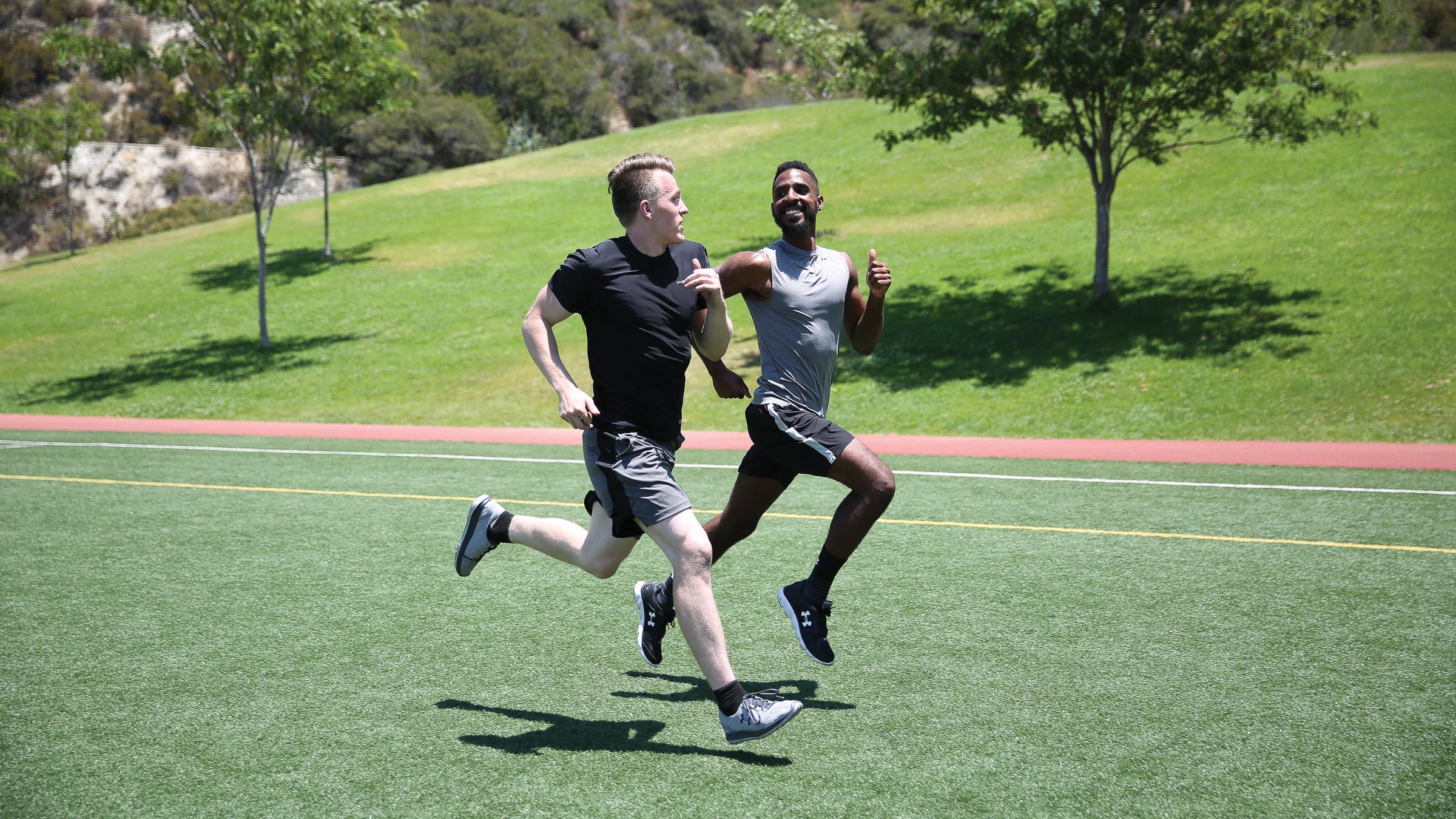
Acceleration at its most basic is the act of increasing your running speed. From a standing start (or blocks), you explode into action. If you’re already running, you pick up the pace. Acceleration continues until you can no longer increase your speed, at which point you achieve maximum velocity (top-end speed). Acceleration seems simple enough. You want to go faster, so you run harder. In reality, acceleration requires a different gait cycle than steady-pace running, an emphasis on powerful concentric contractions (at least at the start), and, most importantly, enough newly generated force to overcome inertia.
So what’s acceleration? It means applying enough force to the ground to increase your speed.
Most of what we know about acceleration comes from sprinters, sprint coaches, and studies on sprinters. That doesn’t mean the knowledge isn’t relevant to speedsters outside the sport of track & field. The acceleration mechanics practiced by the world’s top sprinters are, by and large, the same mechanics you’ll use (or should use) in your sport. Sure, you’ll run with a slightly lower center of mass, less knee lift, and less knee flexion (bending) when agility is required, but anytime you explode for a 5- to 20-yard burst, you’ll want to be acceleration-trained according to the same gold standard that produces elite sprinters.
Acceleration lasts between one to five seconds in team-sports contests. No matter how many hours you put into every other skill required for your sport, success in your sport comes down to those seconds. Or, more accurately, it comes down to the tenths-of-a-second advantage you’ll need over your competition.
ADVERTISEMENT
Let’s Talk Acceleration Training
It shouldn’t come as a surprise that acceleration training will involve strengthening the muscles responsible for that push. You also want to perform exercises and drills that improve your horizontal force production through all phases of acceleration.
A Note on Volume and Recovery
Most of the exercises and drills offer a range for volume. Choose the volume that best represents your current fitness. New to training? Opt for the lower end when it comes to volume.
ADVERTISEMENT
If you’re sharpening skills and fitness developed over the course of years, you may want to begin with more volume. Either way, your fitness will improve, and you’ll soon be mastering more challenging workouts.
For recovery between sets, reps, and exercises, use this rule of thumb:
- 1–3 minutes of recovery following sets and single-rep exercises (e.g., a hill sprint)
- 10–30 seconds (or however long it takes you to switch exercises) during circuit training
That said, if you need more recovery time, take it. Remember, it’s not the training you do that counts; it’s the training from which your body can recover. If you overdo it, you won’t get faster; you’ll get injured, sick, or burned out.
Walk/Jogging

Photo: Diana Hernandez
The simplest way to warm up for training that involves running is walk/jogging. That’s because you literally warm up. When you walk and jog, your muscles produce aerobic energy, but you only capture about 25 percent of that energy for muscle contractions. The rest is lost as body heat—heat that warms your muscles, making them less stiff. When your muscles are limber and your legs feel light, you’re ready for action.
Walk for a prescribed time and then jog
- Begin with easy walking for 1–5 minutes.
- Jog at 55–65% effort for 10–12 minutes (15–18 minutes for athletes age 40+).
ADVERTISEMENT
Buildups 4-2-2

Photo: Diana Hernandez
This exercise is a great warm-up for those who find strides more engaging than jogging. Also, a 4-2-2 buildup better prepares an athlete’s nervous system for the workout intensity of a SpeedRunner session. Mixing strides of increasing intensity with walking raises body temperature, reduces muscle stiffness, and prepares the nervous system for the faster work ahead.
1 set of all strides and walk periods
- Begin with 4 strides of 60–100 yards, at 50–65% of maximum effort. Walk back to the start line after each stride.
- Run 2 more strides, same length, at 65–75% of maximum effort. Again, walk back to the start line after each stride.
- Finish with 2 strides, same length, at 75–85% of maximum effort. Walk back to the start line after each stride.
ADVERTISEMENT
3-Bounce & Run

Photo: Diana Hernandez
This exercise prepares you for game-time acceleration. Few sports allow you the luxury of starting your sprint from statue-like stillness, so it’s important that you train your nervous system to initiate a powerful start when you’re already on the move.
ADVERTISEMENT
2–3 reps of 15–20 yards
- Start from a 4-point stance.
- Bounce 3 times off the balls of your feet, lifting both legs at the same time. As you land the third time, explode into a sprint.
3-Point Stance & Sprint

Photo: Diana Hernandez
A 3-point stance is the start position for many drills, including NFL combine tests such as the 40-yard dash, 20-yard shuttle, and 3-cone drill. You’ll use intense concentric contractions (and a triple extension of hip, knee, and ankle) to explode off the start line, and you’ll practice the forward body lean that’s essential for first-steps acceleration.
2–3 reps of 10–20 yards
- Begin in a 3-point stance.
- On command (external or internal), drive forward for 10–20 yards.
ADVERTISEMENT
Bounding

Photo: Diana Hernandez
Bounding is a terrific training drill for both acceleration and maximum velocity. Research has found that it is the only exercise that simulates the EMG model (muscle activation sequence) of actual sprinting, mimicking sprinting’s short contact time, large generation of horizontal force, and high-power output. If you could only do one drill, this would be it!
1 rep of 20–60 yards
- Build into the drill with a few short hops from one foot to the other.
- Drive forward off the ball of one foot, completely extending your push-off leg as you leap forward and up (like Superman taking flight). Hold the position, keeping your front knee raised high for a moment of hang time.
- Land on your opposite foot, absorb the impact force, and then quickly spring into another bound. Switch your landing foot with each bound (i.e., this isn’t skipping).
ADVERTISEMENT
Jump & Sprint

Photo: Diana Hernandez
This exercise uses a standing forward jump to pre-tune your lower limbs and core muscles for the powerful concentric contractions that drive acceleration. As you land the jump, you create stretch-shortening cycles (triggered by eccentric contractions) in your hamstrings, glutes, and calves. Your nervous system harnesses this extra energy to create an explosive start.
ADVERTISEMENT
2–3 reps of 1 jump + 10–15 yards
- From a standing position, feet hip-width apart, bend your knees into a squat while drawing both arms behind you.
- Jump forward off both feet.
- As soon as you land, sprint forward.
Resisted Run

Photo: Diana Hernandez
Adding resistance through use of a tether allows you to mimic the forward lean of acceleration while working at less than 100 percent effort. When you’re sprinting, acceleration lasts 3–5 seconds. With resisted running, you can maintain an acceleration posture for twice as long. You’ll develop both strength and horizontal force capacity.
2 reps of 5–10 seconds
- Begin from a standing position with your left (or strongest) foot forward and a slight forward lean. The tether should be taut between your harness and your anchor (i.e., a stable object or a person holding the tether).
- Sprint at 90–95% effort.
- Gradually adopt a forward lean that mimics the period of acceleration you’re targeting.
- Run in place for 5–10 seconds, maintaining good acceleration form.
ADVERTISEMENT
Hill Sprints and Stadium Steps

Photo: Diana Hernandez
Hill Sprints allow runners to use area topography to recreate the body mechanics used for initial acceleration. Sprinting up a hill replicates acceleration’s forward lean. You also use an increased push to drive yourself upward against gravity, building power and horizontal force capacity. If your area lacks hills, stadium steps at your local high school or college offer a similar benefit.
2–8 reps lasting 8–12 seconds
- Choose an appropriately steep hill.
- Jog into the sprint for 5–10 yards.
- Sprint at 90–95% maximum effort.
ADVERTISEMENT
Medball Push & Sprint

Photo: Diana Hernandez
You’ll start by building force with your legs, then with your torso, and finally with your shoulders, chest, and arms. This movement culminates with a push, as you thrust the medball forward as far as you can. Once the medball is released, transition to a sprint, allowing your neuromuscular system to harness the momentum you’ve created and ignite an explosive start.
ADVERTISEMENT
2–3 reps of 1 medball push + 10–15 yards
- Begin from a standing position with your left foot (or right foot, if it’s your strongest foot) forward, the toes of your right foot even with your left heel, and a slight forward lean.
- Hold a medball close to your body, at chest level, with both hands.
- Quickly bend at the knees, then explode up while simultaneously propelling the medball forward.
- As soon as the medball is out of your hands, sprint forward.
Push-Up & Sprint

Photo: Diana Hernandez
This exercise requires less thinking and more instinctive reaction. By beginning from a push-up position, you eliminate the leverage offered by a traditional start position, and you short-circuit the inclination to overanalyze takeoff and first steps. Instead, you scramble to your feet, then let instinct guide you through the first 10 yards of acceleration. After 1–2 reps, you’ll find that you’ve adopted proper acceleration mechanics—from a good forward lean to the correct neuromuscular coordination for push-off.
2–3 reps of 10–15 yards acceleration
- Begin in a down push-up position.
- Scramble to your feet.
- Accelerate forward immediately (i.e., as soon as balance and body position allow).
ADVERTISEMENT
Standing Starts

Almost all team-sports athletes will be called upon to accelerate from a standing start—and you won’t just accelerate forward, but also laterally (I’m looking at you, baseball players). This drill prepares your nervous system to command powerful and efficient acceleration mechanics, regardless of which foot is forward or which direction you go.
1 set of the standing-start six pack (6 sprints)
- Begin in a standing start stance.
- On command (external or internal), sprint 10 yards.
- Complete 6 sprints (your six pack) as follows, resting for 30 seconds between starts/sprints:
-
- Left foot forward, sprint forward 10 yards
- Right foot forward, sprint forward 10 yards
- Left foot forward, sprint to your left 10 yards (shown)
- Right foot forward, sprint to your right 10 yards
- Both feet even, sprint to the right 10 yards
- Both feet even, sprint to the left 10 yards
ADVERTISEMENT
Standing 5-Jump (or 10-Jump)

Photo: Diana Hernandez
Acceleration is all about horizontal force. And the Standing 5-Jump is all about stringing together all-out, explosive, horizontal movement that will translate to powerful initial acceleration. This exercise puts the stretch-shortening cycles for your acceleration muscles into hyperdrive.
ADVERTISEMENT
2 sets of 5–10 consecutive jumps
- Stand with your feet hip-width apart, then squat, drawing your arms behind you.
- Jump forward as far as you can.
- Immediately drop into another squat, then spring forward with another jump. Repeat until you reach 5 jumps. As fitness improves, build up to 10 jumps.
Weight Sled Push

If there’s one exercise that benefits first-steps acceleration, it’s the sled push. You’ll work the big muscles (e.g., quadriceps and glutes) that drive acceleration, and you’ll engage your back and core to maintain stability. Tackle this exercise early in the workout, when your legs are strong and your fatigue minimal.
2 sets of 10–20 yards
- Load the sled with the desired weight—from as little as 10% of your body weight to as much weight as you can handle.
- Line up behind the sled, hands on the handles, arms fully extended. Your feet should be 2–3 feet behind the sled, one foot slightly ahead of the other.
- Drive forward off your front foot. Angle your body up to 45° for leverage, with your knees bending 90° with each step forward, mimicking the angle you’ll use for first-steps sprint acceleration. Keep eyes focused in front of the sled.
- Drive again . . . and again.
ADVERTISEMENT
Weight Sled Marching

Photo: Diana Hernandez
Sled marching is a special strength exercise; it includes the same basic joint dynamics of sprinting but not the exact same neuromuscular activation sequence. With special strength training, preserving good acceleration form isn’t a concern. That means you can load up on weight, with speedsters often using loads greater than 30 percent of body weight (BW). This is a terrific exercise for all phases of acceleration, from first steps to final steps.
2–3 sets of 15–20 yards (loads > 30% BW) or 2–3 sets of 15–30 yards (loads < 30% BW)
- Load the sled with the desired weight. (Start light; you can go heavier later.)
- Stand so the tether between you and the weight sled is tight.
- March forward, driving one knee high while pushing off with the opposite leg.
- Extend your hip, knee, and ankle while pressing the ball of your foot into the ground, keeping your elbows bent at about 90°.
- Synchronize arm swings with knee lifts: left knee up with right arm forward, right knee up with left arm forward.
ADVERTISEMENT
Weight Sled Run

Photo: Diana Hernandez
This exercise develops horizontal force for the transition phase of acceleration. It’s a specific strength exercise, mimicking the neuromuscular activation sequence of unresisted acceleration sprinting. That means you’ll need to accelerate at a minimum of 90 percent of your unresisted pace, while maintaining the same form you’d employ for unresisted acceleration. The traditional load for this exercise is 10–15 percent of body weight, but studies have shown that greater acceleration benefits can be had at heavier loads—that said, don’t overload the sled, as you won’t benefit from work performed with substandard form.
ADVERTISEMENT
2–3 reps of 15–20 yards
- Load the sled with your desired weight—try 10–15% of body weight, and adjust as your form and pace dictate.
- Begin with the tether stretched tight between you and the weight sled.
- Accelerate to 90–95% of your unresisted speed, using the first 2–3 steps to build into your pace.
Adapted from SpeedRunner: 4 Weeks to Your Fastest Leg Speed in Any Sport by Pete Magill with permission of VeloPress.
