Updated November 4, 2024 10:48AM
Planes Are Packed These Days. Is Reclining Your Seat Going to Start a Fight?
Flying in economy class feels claustrophobic these days, thanks to shrinking space between seats, and it's bringing some travelers to blows. These tips will keep you from fighting with your seatmates.
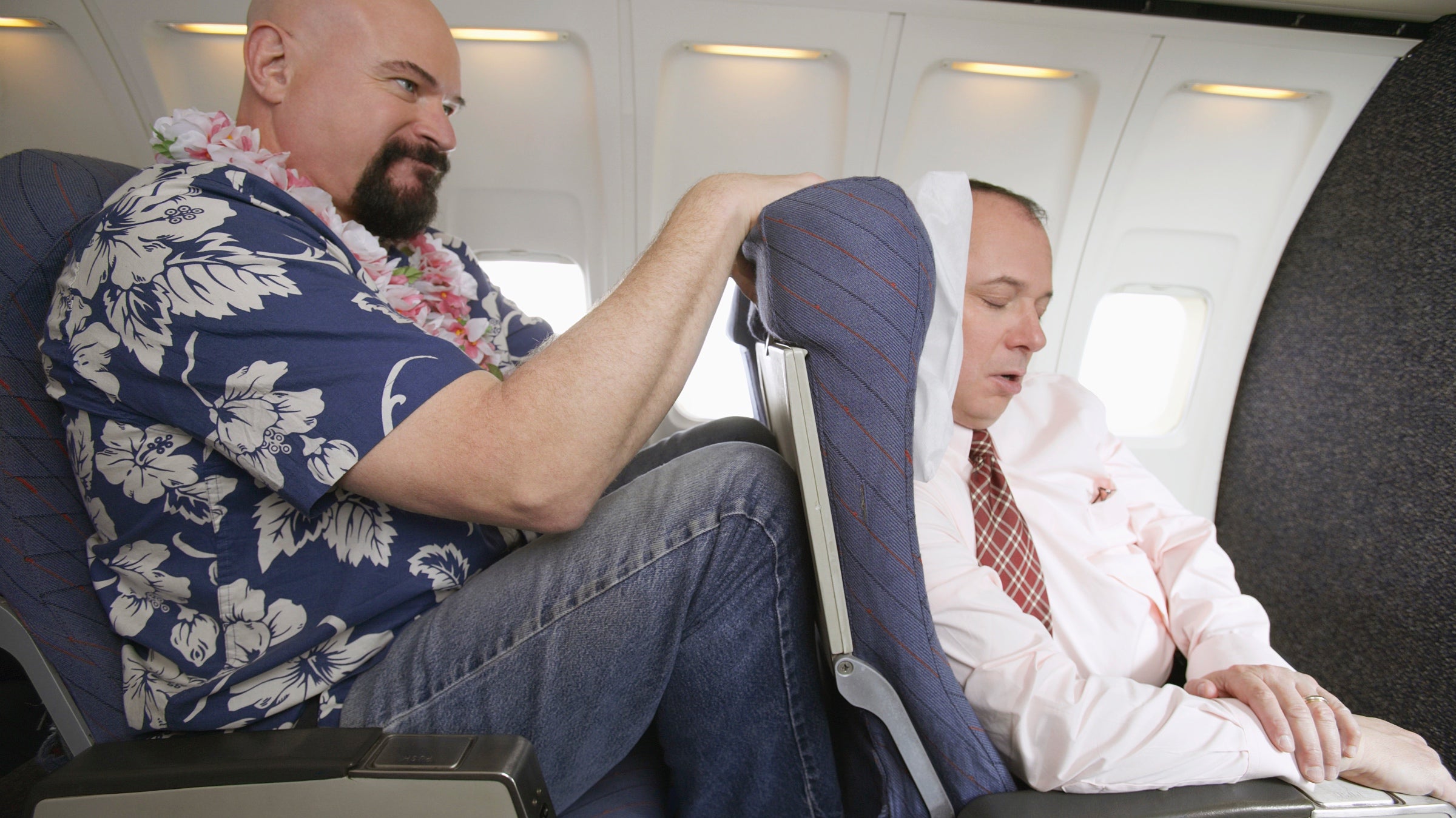
There’s really no room to recline in economy class anymore. (Photo: Digital Vision/Getty Images)
The next time I’m on a flight where someone reclines their airplane seat, I’m going to lose my shit. It seems like I’m always seated behind the person who feels no qualms about reducing my sliver of space to nil. Forget working on my laptop or eating a meal with their seat back crammed in my face. I think this is horribly inconsiderate—and I know others do, too—yet it still happens all the time. Don’t airlines need to put the kibosh on this? —Desperately Seeking Space
I agree that traveling in economy these days feels like being a packed sardine 31,000 feet in the air. I joke that my frequent flying motivates me to practice yoga: even as a relatively small person—I’m five foot four—I often need to contort my body into cramped plane seats, especially when the passenger in front of me decides to recline into my already limited space.
As airlines lure high-paying fliers with more space in premium economy class and flat-bed seats in business class, standard economy-class passengers have been left with less space. Since the early 2000s, seat width has narrowed from 18.5 inches to 17 inches on average, according to Flyers Rights, a Washington, D.C.–based advocacy group. That’s a tighter squeeze than seating in most sports stadiums.
ADVERTISEMENT
And seat pitch—the distance between a row of seats—in economy has shrunk from an average of 35 inches to around 30 inches and even as cramped as 28 inches. (If you’re looking to compare seat width and pitch among airlines and aircraft types, check out SeatGuru, a website owned by TripAdvisor that collects such data.)
Federal Aviation Administration regulations do not address seat size, unfortunately. It’s up to individual airlines to determine seat configurations. That could be changing, however. In 2022, Flyers Rights petitioned the FAA to establish minimum seat standards to fit 90 to 92 percent of people, for both safety reasons (in an emergency, how can you bend forward with your hands over your head if someone’s seat is in your face?) and health reasons (deep-vein thrombosis, for example, can be caused by sitting in cramped quarters for prolonged periods).
Currently, the average seat width only accommodates 50 percent of passengers at most.
ADVERTISEMENT
The squeeze has led to some ugly in-air incidents. In August, a viral clip on a flight from Paris to Los Angeles captured a woman pushing her arms against the reclined seat in front of her, admonishing, “Can you please stop moving it back? Respect the person behind you.” In November, another viral video of passenger conflict circulated (seen below), this time of a woman unleashing her fury at the passenger behind her, who she said tried to push her seat upright the whole flight. “I’m allowed to put my seat back,” the reclining passenger protested.
Until economy seating gets more spacious, to recline or not to recline remains a major debate. Some passengers contend that adjustable airline seats are meant to recline and that leaning back is an in-flight right, while others view reclining as disrespectful. Still others argue that painful physical health issues require them to recline in order to be comfortable.
Until economy seating gets more spacious, to recline or not to recline remains a major debate. Some passengers contend that adjustable airline seats are meant to recline and that leaning back is an in-flight right, while others view reclining as disrespectful. Still others argue that painful physical health issues require them to recline in order to be comfortable.
I spoke with passengers, flight attendants, and experts to get their take on proper etiquette.
Reclining Your Airplane Seat Is a Right, but Many Feel It’s Still Rude
Outside correspondent Tim Neville, a travel writer who also frequently flies, told me that on a recent flight a pilot came out to give everyone the “reclining-seat talk.” The pilot’s take: the seat in front of you belongs to the person in front of you, so it’s up to them on how they use it.
At six foot seven inches tall, Neville feels the effects of reclining passengers more than most. He admits that reclining even a little is more comfortable for him, but unless he’s on a long-haul flight, he doesn’t recline at all. And if someone in front of him tries to recline, they typically don’t get too far. “My knees are literally already pressed against their seat,” he says. “They often think something’s wrong with the recline function and stop trying. Or they turn around, see me, and generally get the picture that it ain’t happening.”
If Neville gets up from his seat, the passenger in front of him often uses the opportunity to fully recline in his absence and he has to shoehorn himself back in. But he will never ask them to put the seat back upright. “The only time this truly annoys me is when I’m trying to work and their seat blocks my laptop, or when it’s a little kid with all the room in the world,” he says. “But even then I just suck it up and try to be zen about it.”
ADVERTISEMENT
Outside senior brand director Mary Turner isn’t as zen. “I find it disrespectful when someone reclines their seat on a plane in coach,” says Turner, who never reclines her own seat unless it’s an overnight flight. “There’s already an inhumane lack of space, and then someone leans back into the three inches of room I have and I admittedly lose my cool.”
On one flight, Turner was working on her laptop when a man in front of her reclined his seat, making it impossible for her to see her screen. Also, every time he rearranged himself, her tray table and computer shook. “I gave the back of his seat a few hard kicks,” she told me. Her partner, who often reclines his seat during flights, was appalled.
Turner admits that flying in coach these days sometimes brings out the worst in her and that the more mature approach would’ve been to ask him kindly to put his seat back up or to have closed her laptop and taken some deep breaths.
“I’m allowed to put my seat back,” protested a passenger. “Can you please stop moving it back? Respect the person behind you.”
ADVERTISEMENT
Carmino DeMercurio, another tall guy (six foot six), confesses that he has also intentionally dug his knees into the back of a reclined seat to express his frustration, but he restrains the urge to argue. “I try to remember that the passengers did not create the issue, airlines did,” he says. “It’s their right to recline, even if it’s inconsiderate.” DeMercurio says that as a courtesy to other passengers, he does not recline his own seat, but he will pay for extra leg room on every flight when available.
On a recent flight of mine on United, an attendant requested that passengers bring their seats upright before meal service to accommodate the person behind them. When I asked her what prompted the announcement, she told me that the request helps minimize complaints from passengers who can barely lift their fork due to tight quarters.
Another time, on Hawaiian Airlines, an attendant watched as the passenger in front of me jolted his seat back, causing my laptop to slam closed as I was typing. The attendant came to my rescue and politely asked the gentleman if he’d mind giving me some room. He obliged and then apologized to me, explaining it wasn’t intentional.
The Right and Wrong Times to Recline
I will recline my airplane seat, but only in certain circumstances. If I’m seated in front of someone whose seat does not recline, I try to keep mine upright to be sympathetic. But I always recline on a red-eye, because I want to sleep.
I queried six flight attendants over the past month about whether I was rude to recline at such times, and their unanimous reply was: not if I reclined respectfully (i.e., not jolting my seat back suddenly). All of the attendants said they encourage passengers to bring their seats upright when meals are served. Two told me that passengers who pull on the seat in front of them when they get up to stand (my personal pet peeve) is far more of an annoyance for other passengers and tends to be the cause of more arguments.
ADVERTISEMENT
Etiquette and Advice on Reclining Your Seat
- Even though you’ve purchased your seat, common courtesy dictates that you remain cognizant of those around you, stay aware of your surroundings, and respect others’ basic comfort level when in a tight public space, said Diane Gottsman, a national etiquette expert at the Protocol School of Texas in San Antonio. Reclining your seat in an airplane can get tricky when the person behind you has their tray table down or their knees are leaning up against the seat because they’re very tall. Whatever the case, be thoughtful enough to look backwards before you recline, she suggests.
- If you suspect a potential altercation might ensue, contact a flight attendant and ask for assistance, she says. For example, if someone asks you to put your seat up, it’s generally because they are inconvenienced. “Why would you want to refuse the request?” she says. No fight is worth it.
- My advice to flyers who get annoyed at recliners? Book a bulkhead seat, which does not have a seat in front of it, so you’re guaranteed your own personal space.

Jen Murphy is Outside’s travel-advice columnist. She has the amazing gift of being able to sleep on any plane, even when squeezed into a super small seat that doesn’t recline. She credits her daily yoga practice for keeping her comfortable on cramped flights. And if you want more tips from Jen, she’s also recently written about using AI to plan a trip, how to outsmart the weather to make the most of your vacation, and which countries are actually worth visiting when you’re on a budget.
Want more of Outside’s travel stories? Sign up for the Destinations newsletter.


