Published November 6, 2025 03:07AM
Inside the Surprisingly Intense World of Competitive Steinholding
Five pounds of lager, one outstretched arm, and the slow creep of regret. This is Type 2 fun at its finest.
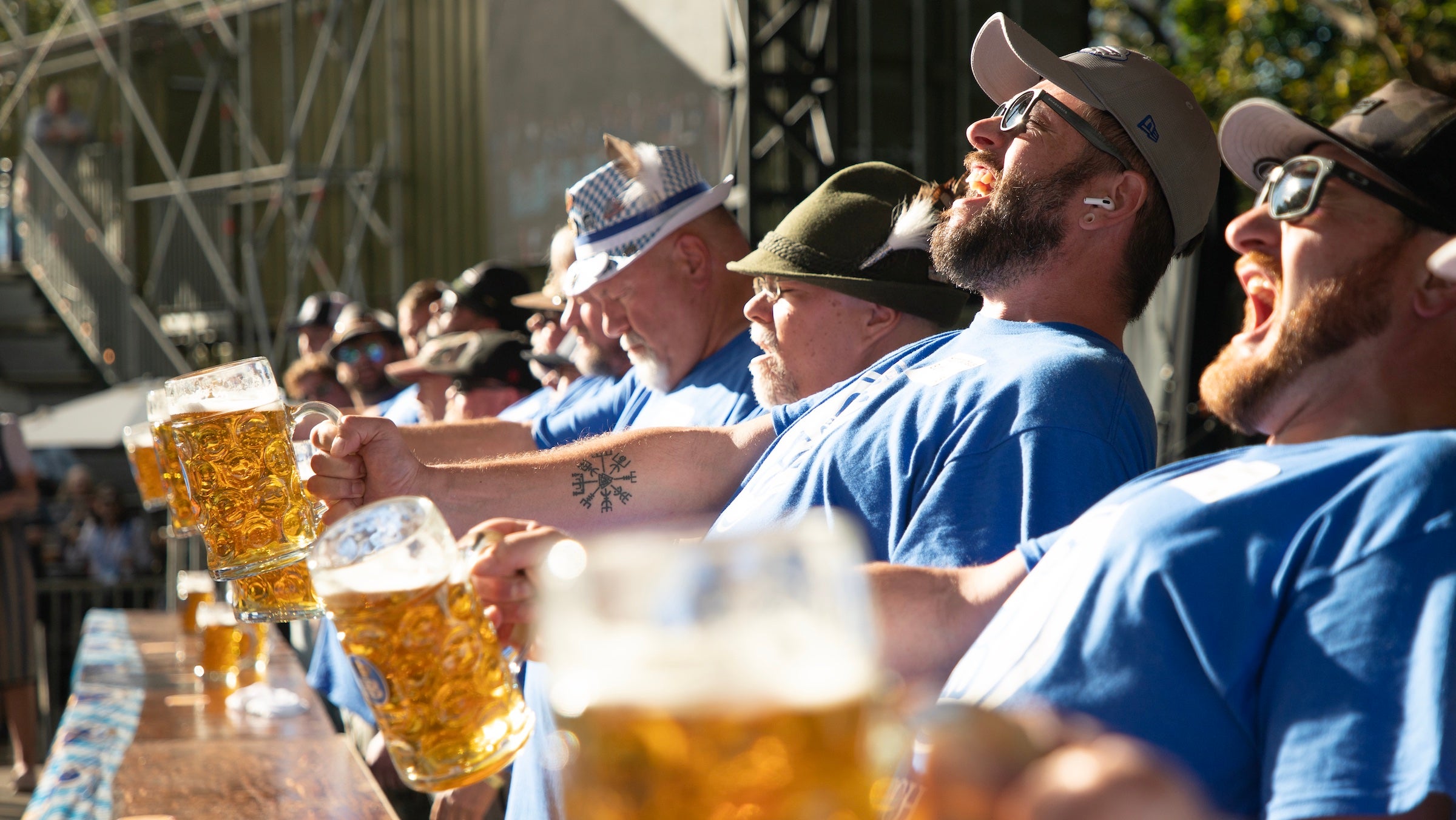
Participants in the men's competition experience the agony and the ecstasy of steinholding. (Photo: Eric Egerton)
IT’S OKTOBERFEST NYC and I’m standing with Kim Planert, a UPS driver from Ohio. We’re at Rumsey Playfield in Central Park, beneath London plane trees and a cerulean September sky. All around us is the requisite pageantry of the world’s foremost beer bacchanal: lederhosen bros, immodest dirndl cleavage, and polka music inspersed with domestic Oktoberfest classics like versions of “Country Roads” and “Sweet Caroline.” I know some haters who dismiss Oktoberfest as cosplay for alcoholics, but for those of us with a soft spot for a little seasonal kitsch there are worse ways to ring in the fall.
Planert is 71 years old and his costume is relatively understated compared to some of the more committed revelers in the crowd: checkered blue-and-white Tyrolean hat, oversized Hofbräu T-shirt, and cargo shorts. But Planert is not here just to binge on lager and wurst. For the fourth year in a row, he is competing in the Hofbräu Masskrugstemmen National Competition, which is about to take place on Rumsey’s concert stage. Masskrugstemmen is the German name for the increasingly popular sport of steinholding—where participants try to hold a five-pound glass of beer at arm’s length for as long as they can.
“I’ve actually added two minutes to my time,” Planert tells me. “I’ve done 14 minutes.” Not too long ago, such a performance would have put him in contention for a national record. But the bar has been raised in recent years. “We’ve got guys now that can do 16, 17, 19, 20-plus minutes,” Planert says wistfully.
ADVERTISEMENT
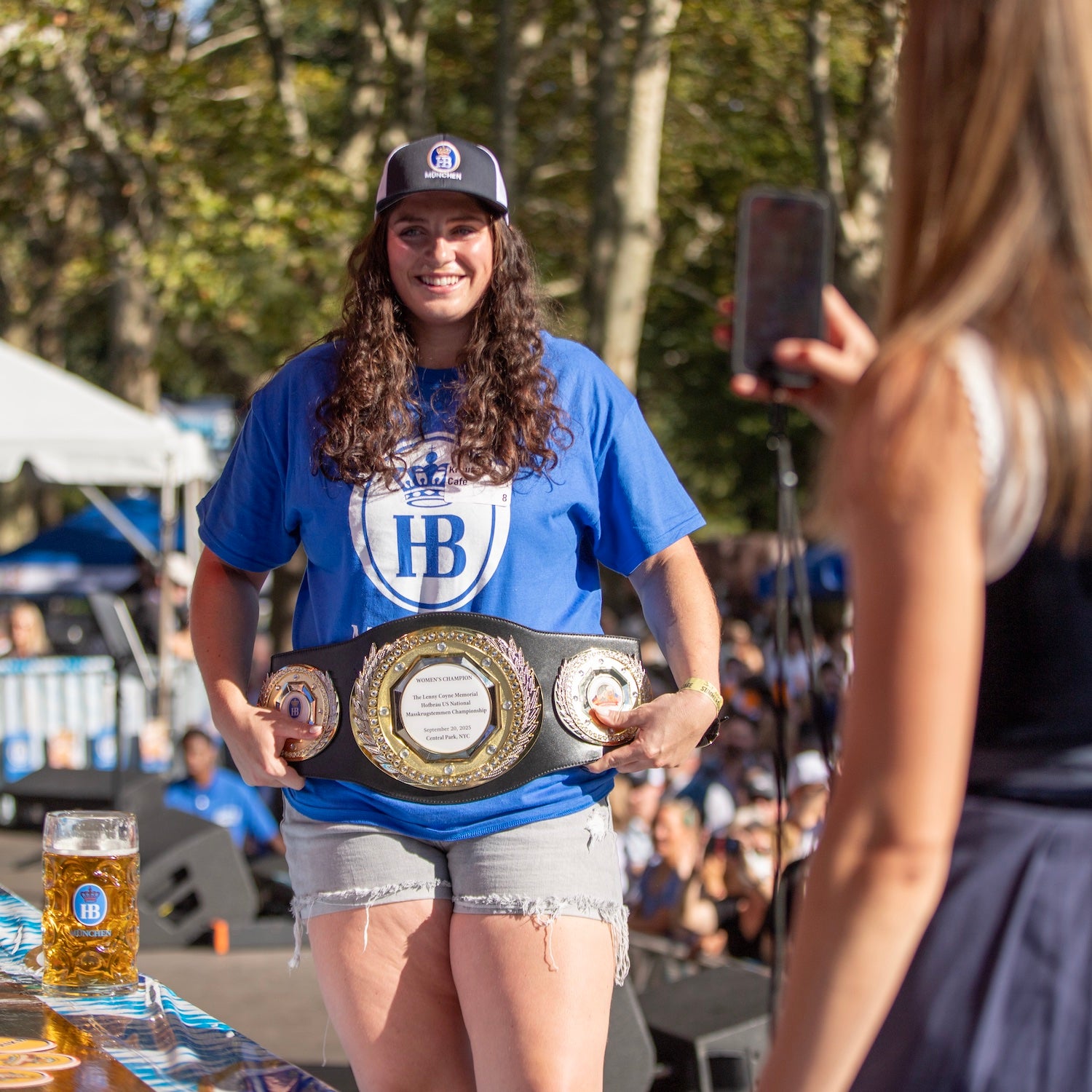
This upping of the ante is at least partially due to the marketing savvy of the Munich-based brewery Hofbräuhaus, as well as American beer brands like Sam Adams, who have been sponsoring steinholding events for years. (There are now steinholding competitions in all U.S. states.) The 19 men and 13 women who are taking part in the 2025 Hofbräu nationals have all prevailed in regional Hofbräu-affiliated competitions across the country. As a reward, they were flown out to New York for a chance to compete for the title of national champion. The annual winner in Central Park gets a paid trip to the OG Oktoberfest in Munich, as well as a blinged-out championship belt to commemorate the achievement. Let no one tell you America is no longer the land of opportunity.
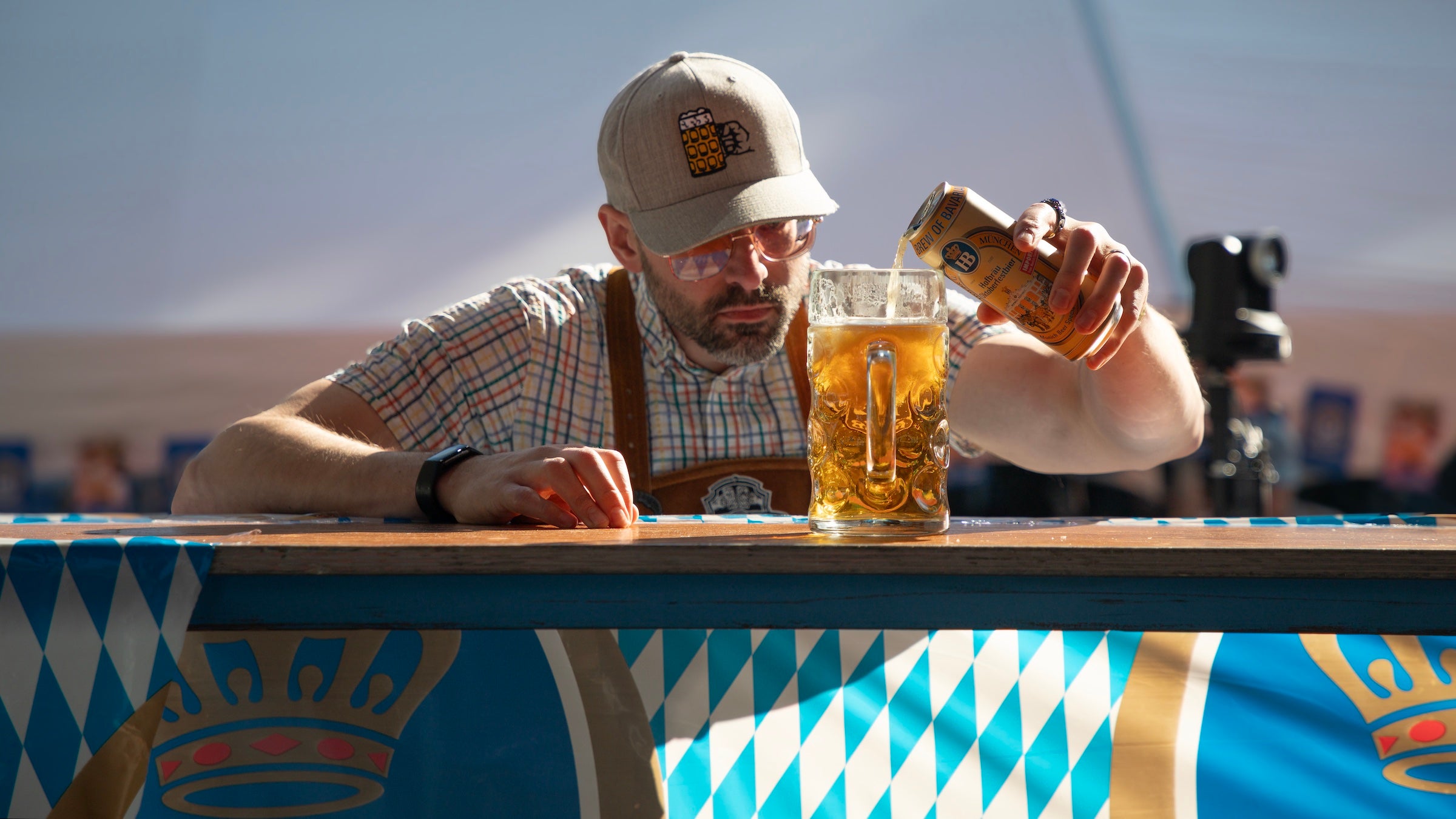
Not long after I chat with Planert, all the competitors are asked to make their way backstage for final instructions. There seems to be a wide spectrum of age and body type among participants. I’ve been told by the steinholding cognoscenti that it’s a fool’s errand to try and guess the likely winner based solely on physique. Yes, upper body strength is an asset when it comes to holding a masskrug for minutes on end, but so is having relatively short arms. It’s usually not the most imposing colossus who carries the day, but the person who, in addition to physical strength, has mastered the mental game of overriding the brain’s “central governor” — i.e. that voice inside your head begging you to stop. Steinholding is Type II fun without moving.
Backstage, Fernanda De Santos, a nursing student from Houston, tells me that her somewhat counterintuitive strategy is listening to screamo music while competing. ”It hurts my brain more than my body, so it distracts me from thinking about the pain,” De Santos says. OK.
I’ve noticed that some of De Santos’s rivals have already been hitting the Hofbräu as part of their warm-up routine.
“I only start drinking after the competition,” she says. “Just so my muscles don’t cramp. I don’t want to become super dehydrated. But after this, it’s all the beer I can drink. They are gonna have to carry me out.”
The dirndl and lederhosen crowd is already way ahead of her. People are gathered in front of the stage, suffused with boozy energy and anticipation. We are minutes away from the start of the women’s event and the emcee, an affable Texan named Jason Hurta, is making big promises to the audience.
ADVERTISEMENT
“If you’ve seen Masskrugstemmen, your life has been changed,” Hurta announces. “If you’ve not seen it, buckle in, you’ve got a paradigm shift coming.”
In Hurta’s case, this is not hyperbole. He won the 2014 steinholding nationals and has since become a fixture at the event, returning every year to serve as a competition judge and hype-man in lederhosen. (The rules of the Hofbräu event mandate that past champions aren’t allowed to compete again.) By way of analogy, Hurta told me that the bizarre spectacle of steinholding was similar to competitive hot dog eating, but “a heck of a lot more fun and not nearly as gross.”
ADVERTISEMENT
If anyone embodies the life-changing potential of steinholding more than Hurta, it would be his one-time rival and fellow competition judge, Jim Banko, who is busy topping off the steins on stage with surgical precision. Banko, 43, won the Hofbräu nationals in 2015, one year after being vanquished by Hurta in a thrilling showdown. Since he wanted to keep competing, Banko founded the U.S. Steinholding Association (USSA), which functions as the de facto governing body for the sport. The USSA website includes training tips, competition sites, and a judging certification program that goes into exacting detail about rules and regulations in an effort to standardize protocol for steinholding events across the country. (For example: The pinkie finger may be held outside of the stein handle. If positioned outside the handle, it may touch the stein handle, but it may not touch the body of the stein.) In a further push for legitimacy, the organization is hosting its own inaugural national championship in Cincinnati, Ohio, on November 22; the men’s and women’s winners will each receive $4,000.
Banko, who was wearing customized lederhosen emblazoned with the U.S. Steinholding Association logo, tells me he probably takes the sport a little “too seriously.”
Hurta begins introducing the female competitors, who take their positions on stage: prizefighters ready to rumble. When the lineup is complete, there’s a quick introduction of the judges who will be keeping vigilant watch that elbows remain locked and arms parallel to the ground. Steinholders are allowed two infractions before disqualification ensues, although spilling your beer is an automatic out.
“We’re gonna have good clean holds!” Hurta says. After getting confirmation that the timekeepers are ready, he gives the final countdown: “3, 2, 1 . . . LIFT!!!”
THOUGH OFTEN CITED as a “Bavarian drinking game,” steinholding is relatively obscure in its country of origin. You can find old YouTube videos of FC Bayern Munich players doing it at media events. But most Germans would associate Herculean feats of beer lifting with the iconic image of the Oktoberfest barmaid carrying an armload of Masskrüge through a crowd of drunken idiots. For the record: Munich’s Oktoberfest has no official Masskrugstemmen events. (In an email, a representative from Munich’s tourism bureau told me that Masskrugstemmen competitions are “usually held at private festivals and smaller events.”)
Robert Terrell, an associate professor of German history at Syracuse University and the author of A Nation Fermented: Beer, Bavaria, and the Making of Modern Germany, told me that, in his opinion, steinholding “wasn’t really prominent” in Bavarian bar culture. (Meanwhile, fingerhakeln, a kind of absurdist tug-of-war where two men try to yank each other across a small table by pulling on each other’s fingers, has had an annual national championship in Germany for decades.) Terrell suggested that steinholding had some of the hallmarks of an invented tradition. He wasn’t explicitly saying that steinholding didn’t originate in Bavaria, but rather that its legacy is being exaggerated for marketing purposes abroad. As he put it, an invented tradition is “something seemingly old that conjures a particular past, but that is more designed for purposes in the present. In this case, to sell more beer.”
Terrell sent me an article he’d published in 2020 on Löwenbräu, another storied Bavarian brewery. In the 1950s and 1960s, Löwenbräu took great pains to appeal to the American consumer by importing not just its beer, but the entire Germanic drinking experience. The war was over, and Americans were ready to be introduced to beer gardens, Tracht, and Oktoberfest-style events. Terrell argues that Löwenbräu did this, in part, to outmaneuver U.S.-based breweries that made their own German-style lagers and were thus profiting off a faux Germaness. “Unlike the versatility of pilsner, the authenticity of Bavarian beer was inherently tied to the place. It was thus also tied to mythologies and stereotypes about the place and beginning in the 1960s, the commodity and the mode of consumption became intimately related,” he writes.
Given the proliferation of microbreweries in the United States in recent decades—and near-infinite American takes on German beers—it seemed feasible that Hofbräu was making a similar play for genuineness with its Masskrugstemmen event, which it first started back in 2009 in New York. But Steve Ksycki, the current CEO of Hofbräuhaus of America, the German company’s U.S. subsidiary, suggested otherwise.
“The odd thing about Masskrugstemmen is that it’s more American than it is German,” Ksycki told me over a can of Helles in Central Park. “The Germans laugh at us,” he added. “They’re like: ‘I don’t get it.’ But for Hofbräu this is a great marketing opportunity.”There is something refreshing in this lack of pretense. No need to make a fetish out of authenticity. For years, the story behind the hot-dog-eating contest on Coney Island was that, in 1916, a group of immigrants decided to settle an argument over who was most patriotic by seeing who could scarf down the most wieners. In 2010, the New York Times reported that the story was invented by PR professionals in the early seventies. But the popularity of Nathan’s Famous annual contest didn’t seem to suffer. Likewise, it’s doubtful that those competing for the title of U.S. national steinholding champion are too bothered by the sport’s tenuous Bavarian roots. A good time is a good time.
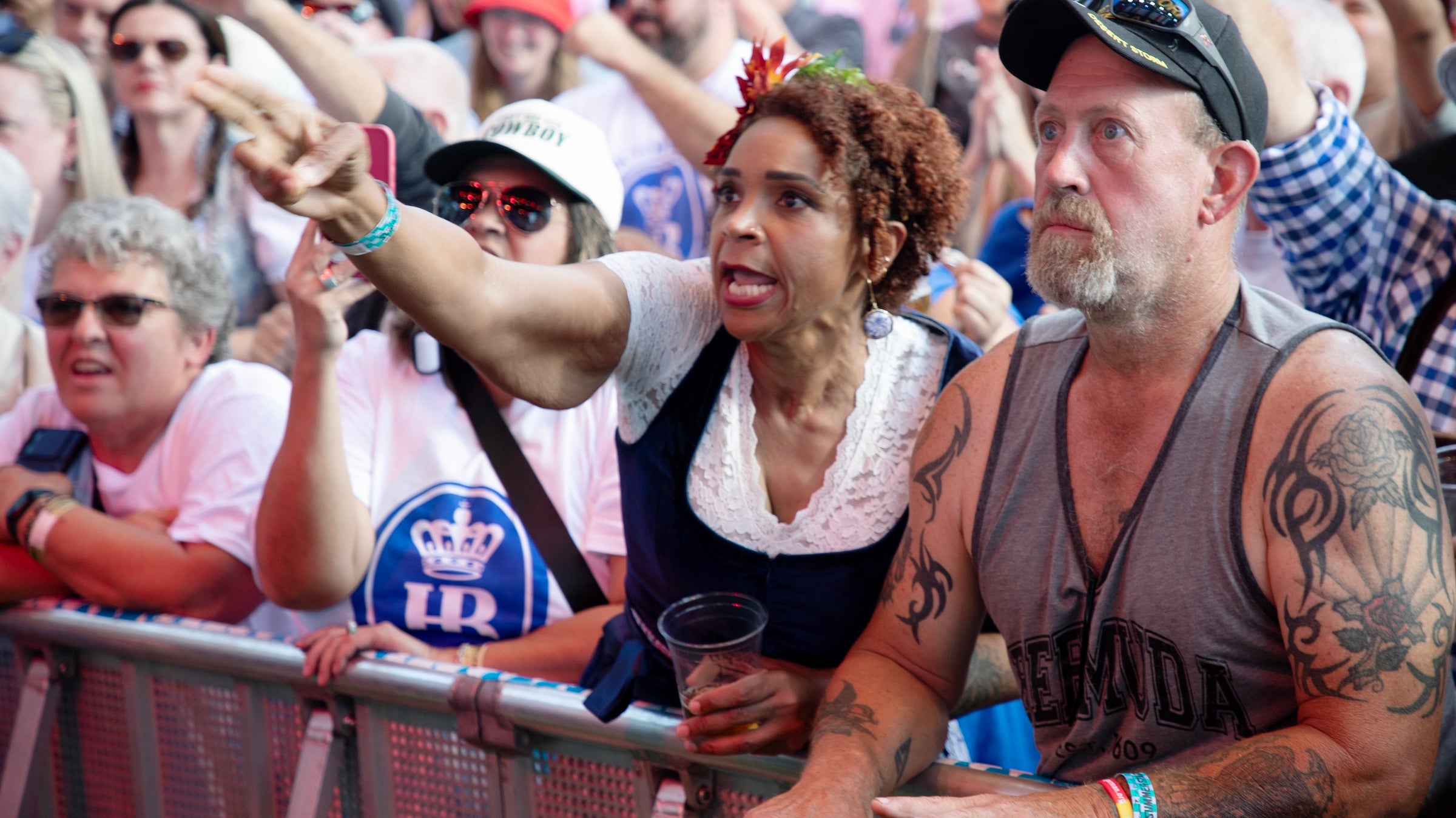
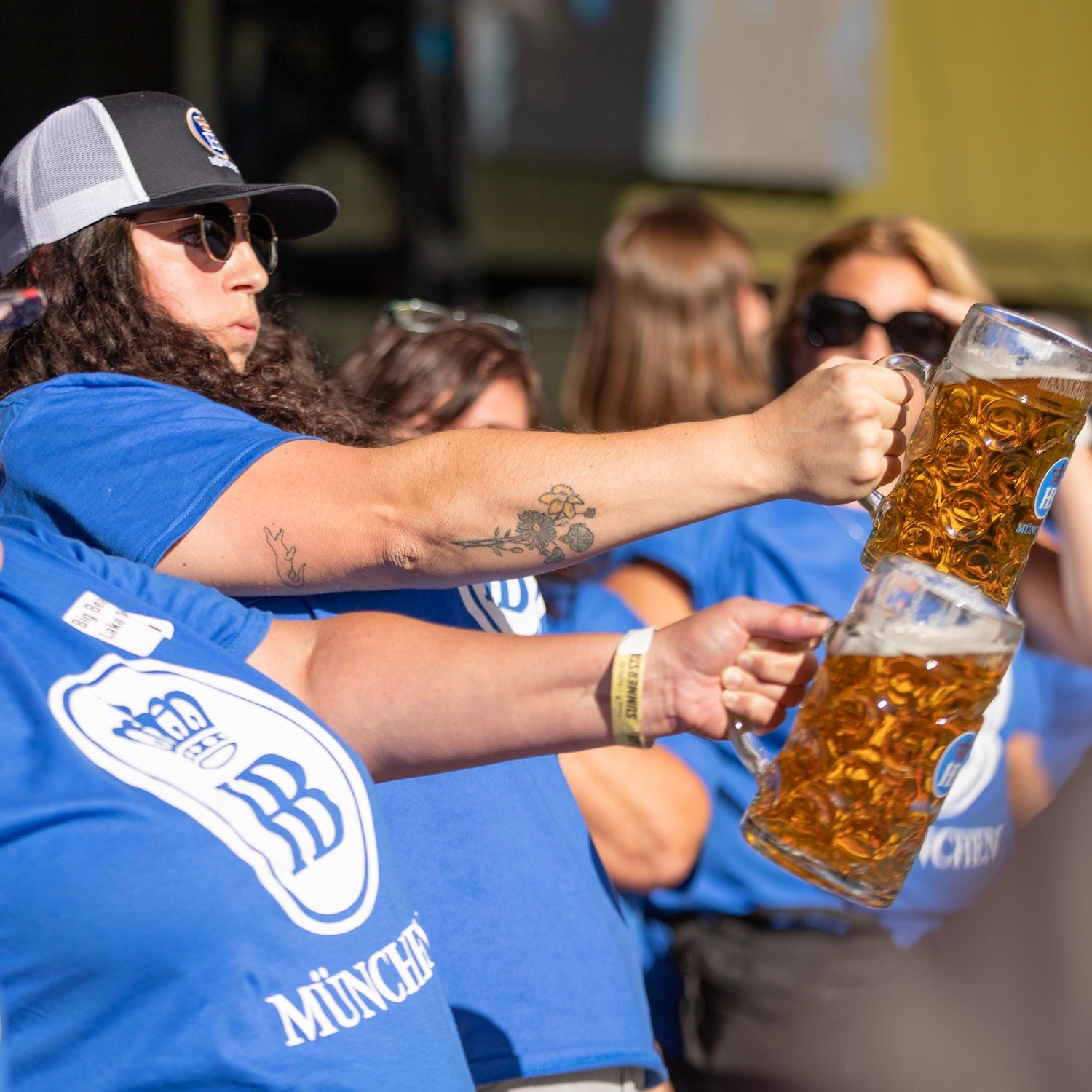
TO WITNESS A STEINHOLDING competition is to witness the creep of entropy. Everyone starts with good form: arms straight, stable, and parallel to the ground. Pretty quickly, though, the twin forces of gravity and psychological second-guessing (or, less politely, the fuck it impluse) begin to winnow the field. Form begins to deteriorate. Forearms start to quiver. Elbows dip. The steins, once perfectly level, suddenly have an ominous tilt. Grimaces abound.
I’m seeing this play out in the women’s competition in Central Park. One by one, participants are eliminated, either because they’ve conceded by putting down their glass, or because one of the gimlet-eyed judges has called them for a third and final infraction.
Hurta is pacing back and forth on stage, flanked by fellow judges in lederhosen and a guy curiously dressed in blue satin regalia—a look that one attendee described to me as “supreme beer wizard.” For his part, Hurta is deftly toggling between dual roles of umpire-in-chief and dynamic master-of-ceremonies. As one woman struggles to keep her arm straight and elbow locked, he admonishes the judges for being too lenient: “Lock her out, or strike her out,” he yells. In high-stakes strongholding, there can be no mercy.
ADVERTISEMENT
“Come on! Get ‘em going! This ain’t easy,” Hurta encourages the crowd, which obliges by starting a chant of: “Hold that beer! Hold that beer! Hold that beer!”
After four minutes, it’s down to only three women.
“Who wants it?” Hurta asks.
In the end, it is Sydnie Mauch who wants it the most. She perseveres for an official time of 5 minutes and 20 seconds. A 31-year-old CrossFit devotee and former college volleyball player, Mauch is the sixth national champion to represent New Braunfels, Texas. (This exclusive legacy is locally known as the “Steinasty.”) She is also last year’s runner-up, as Hurta informs the crowd, adding another dose of narrative intrigue.
“Last year she was second-place on this stage, and lost by three seconds! You don’t think she was determined?” Hurta asks. “There she is! Sydnie Mauch! I’m not going to hold her right arm up. Because I’ve been there.”
ADVERTISEMENT
Though elated by her win, Mauch is a little disappointed that she didn’t improve on her performance from last year, when she managed a hold of 5 minutes and 57 seconds. The current women’s steinholding record of six minutes and ten seconds seemed very much within her reach.
“I might have overtrained,” Mauch confesses.
ON THE U.S. STEINHOLDING ASSOCIATION website, you will find extensive information on how to maximize your Masskrugstemmen potential. There are specific exercises for targeting your shoulder and core, with an emphasis on muscular endurance. The site displays interval-style training techniques, a sample weekly workout schedule similar to what you might find online for aspiring marathoners, and advice on how to approach the “off-season.”
If such dedication sounds a bit overzealous for a frivolous drinking game, it’s worth remembering that, a few short decades ago, performance-oriented distance running was a pursuit for loners and lunatics. Compared to running laps on the track, doing multiple reps of practice steinholds until failure might not seem too crazy. Certainly not among those who have qualified for the Hofbräu national championships.
“I definitely focus more on time under tension training and just endurance training over powerlifting and strength training,” Mauch tells me. “I’ve always been strong, so I was like, ‘I don’t need to be strong to do this, I just need the endurance.’”
ADVERTISEMENT
Many of the competitors in Central Park abide by a similar philosophy. Joel Griffin, from upstate New York, tells me his approach was doing practice holds, five days a week, using a 35-pound dumbbell. Bob Shalack, a 58-year-old from New Jersey, who had narrowly lost to Griffin in an “epic competition” in Philadelphia, says his go-to training method is walking 300 yards while holding a 25-pound dumbbell at full extension. “I think when you walk, it builds up your deltoid,” Shalack tells me.
Even by the standards of the steinholding faithful, Shalack’s commitment to the sport stands out. Losing that showdown against Griffin in Philly torpedoed his qualification for the Hofbräu event in New York. In May, he flew across the country, ostensibly to watch the Mets play the Dodgers, but also to compete at the steinholding event at Big Bear Lake, California—another Hofbräu nationals qualifier. He won in an unofficial record time of 25 minutes and 29 seconds. (In order for a record to be ratified, the U.S. Steinholding Association requires the presence of at least two certified judges and two camera angles documenting the feat.)
ADVERTISEMENT
Shalack’s wife, Chantell, didn’t have to travel as far to qualify for the event in Central Park; she won the steinholding event at the Hofbräu Bierhaus in mid-Manhattan. She trains by doing deltoid-specific workouts in the gym and practice holds. I ask her if she also walked around holding the stein like her husband. “No,” she says. “I’m not insane.”
Most competitors discover their talent for steinholding by accident. Jill Roberts, a dental assistant who grew up in Cleveland but now lives in Georgia, was introduced to steinholding at the German-American Cultural Center in Ohio. “I got talked into doing it and I won. It was just such a weird thing,” she said in a recent phone interview. This was in July 2022. At the time, Roberts had been working as a dental assistant for 40 years, while also running a small farm outside of Atlanta. She told me that holding dental equipment all day and carrying haybales and farm equipment in her spare time gave her the skill for her new sport. Last year, Roberts won the Hofbräu national championship with a six-minute hold.
ADVERTISEMENT
In an era where mainstream sports increasingly encourage hyperspecialization from early childhood, part of what makes steinholding compelling is that the activity can still produce unexpected heroes–the everyman athlete whose day job has bestowed him with a latent superpower.
No one personifies this romantic notion quite like Kim Planert. Prior to his career in shipping, Planert was a mover. By his own estimate, he has folded over 600,000 8-pound moving pads in his career–a monotonous task that he credits as the secret to his steinholding prowess.
Planert had never heard of steinholding when his granddaughter encouraged him to enter an event at an Oktoberfest in Hamilton, Ohio, in 2011. He won easily that time and defended his title in subsequent years with five and six-minute holds. “Eventually, I told my wife that I need to branch out,” Planert says. In 2019, he took part in the steinholding at “Zinzinnati”–- billed as the nation’s largest Oktoberfest. As he tells it, Planert asked the emcee what the local record was, but was initially dismissed as a delusional geriatric.
ADVERTISEMENT
“So then the guy is starting to introduce us to the crowd and I kind of shouted out: What’s the record here?,” Planert says. “And he looks at me and says: ‘He wants to know the record. Well, Mr. Kim, the record here is 6 minutes and 45 seconds, OK?’ And I said: ‘OK.’ And then I went for nine-and-a-half minutes and this guy’s mouth was dropping to the ground.”
Having recently entered his eighth decade, Planert takes distinct pleasure in defeating younger rivals. “There’s nothing like an old person beating a young person in anything physical,” he says. “I don’t care if it’s hopscotch. If a guy who’s 70 years old can beat a 35-year-old, it’s a fantastic feeling.”
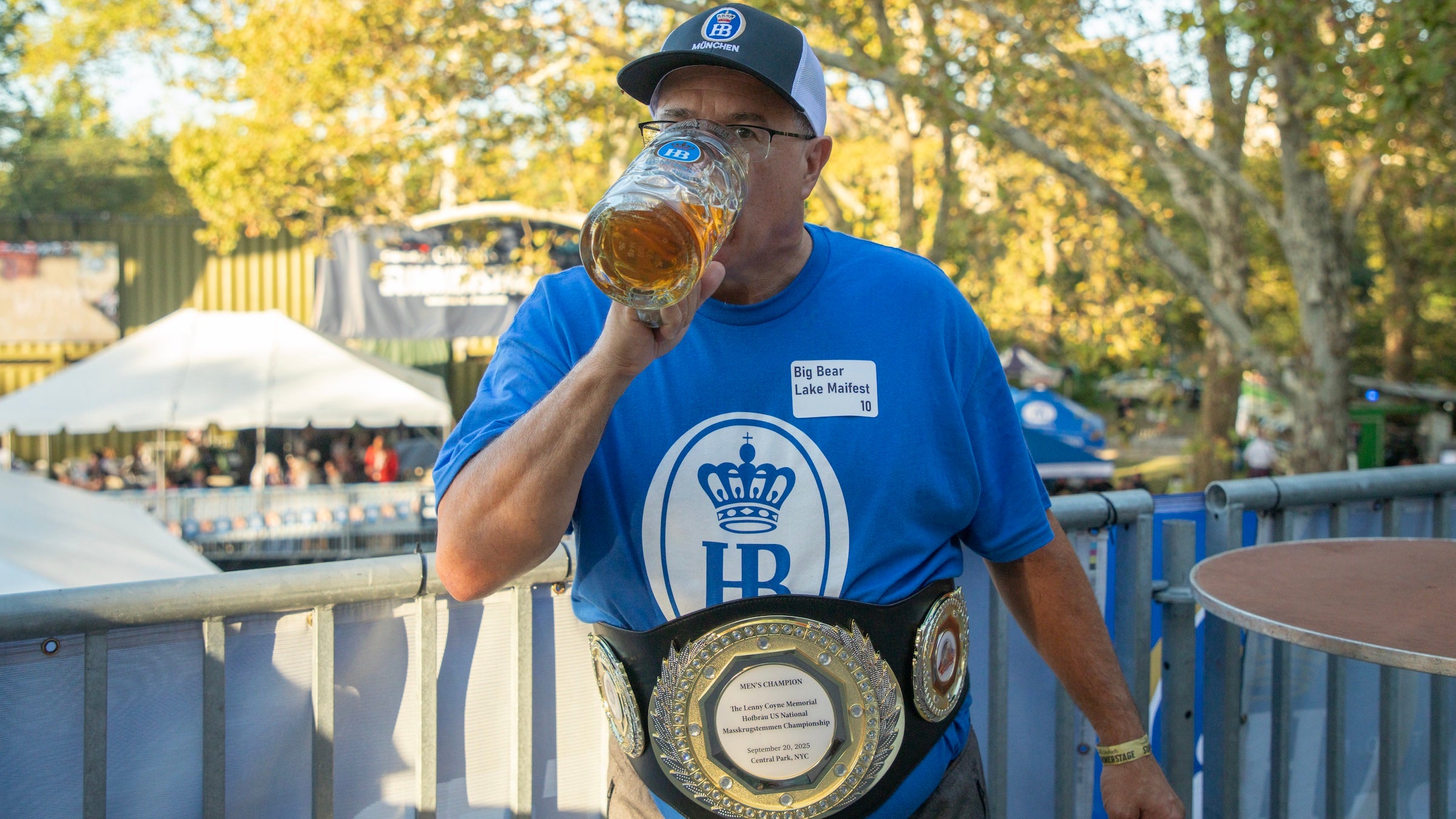
AS THE CLOCK NEARS the 20-minute mark in the men’s competition in Central Park, only three competitors remain: Shalack and Griffin, who seem poised to renew their rivalry, and Henry Tomason, the latest heavy hitter from New Braunfels.
It’s Griffin who falters first when a speck of beer foam splashes over the rim of his glass. “Oh! Spillage!” Hurta cries. “We’re down to two, ladies and gentlemen.”
The showdown lasts for another two minutes, at which point Tomason’s arm starts to give out; he seems unable to lock out his elbow, as though suddenly overcome with the weight of Steinastic expectation. Game over.
But Shalack isn’t finished. Alone in the spotlight, he removes his baseball cap with his free hand and insouciantly tosses it over his shoulder while maintaining his hold. A murmur goes through the crowd: the official USSA record of 23 minutes and 40 seconds is about to be eclipsed. Ksycki, the Hofbräuhaus CEO, whispers in my ear: “You’re witnessing history.”
ADVERTISEMENT
Shalack ultimately sets down his stein after 24 minutes and 14 seconds. He takes a bow. A wasted woman in the crowd starts chanting: “Rudy! Rudy! Rudy!”
“When I go to competitions, nobody figures I’m gonna win,” Shalack tells me afterward. “But for whatever reason, I’m very strong-willed.” As for distracting himself from the pain while competing, Shalack’s strategy is to go through refrains of “100 Bottles of – Beer -on – the – Wall” in his head and to “pick a spot 300 yards in the distance and just stare at it.” From my vantage point backstage, I’d noticed that Shalack and Mauch, the women’s champion, were the only participants to take their shoes off. When I bring this up to Shalack he assures me that there was “no collusion,” and that he prefers to compete in his socks for optimal balance. I ask Shalack what he does for a living, secretly hoping to hear that he’s a bricklayer or a welder so I can bolster the myth of the working-class hero steinholder. It turns out that Shalack spent 20 years working as a mathematician for MetLife and now works for a structured finance firm. Alas.
ADVERTISEMENT
“I do spend a lot of time driving down the road, steering with my left hand and holding a weight with my right hand while I’m waiting in traffic,” Shalack says.“There’s a lot of traffic on the Jersey Turnpike, and I can do 14-minute lifts with a six or eight-pound weight.”
Shalack is not the only steinholder who uses his daily commute as a chance to train. The practice, it turns out, is fairly widespread among those committed to their craft. Planert, for one, does reps of five-minute holds in his UPS truck. (Although he wants to assure his employer that he doesn’t do it while driving.) Jill Roberts has spent a lot of time motoring around the Georgia countryside holding a weighted stein.
“It’s mostly country roads that I’m on, and I’m very careful,” she said. “Some people hold coffee in their cars. I hold a stein.”
