Published January 24, 2026 07:50PM
Alex Honnold Just Climbed the Taipei 101 Skyscraper on Netflix, Setting a New Record
The ‘Free Solo’ star wrote another chapter in the history of rock climbing with a high-profile stunt beamed live around the globe.
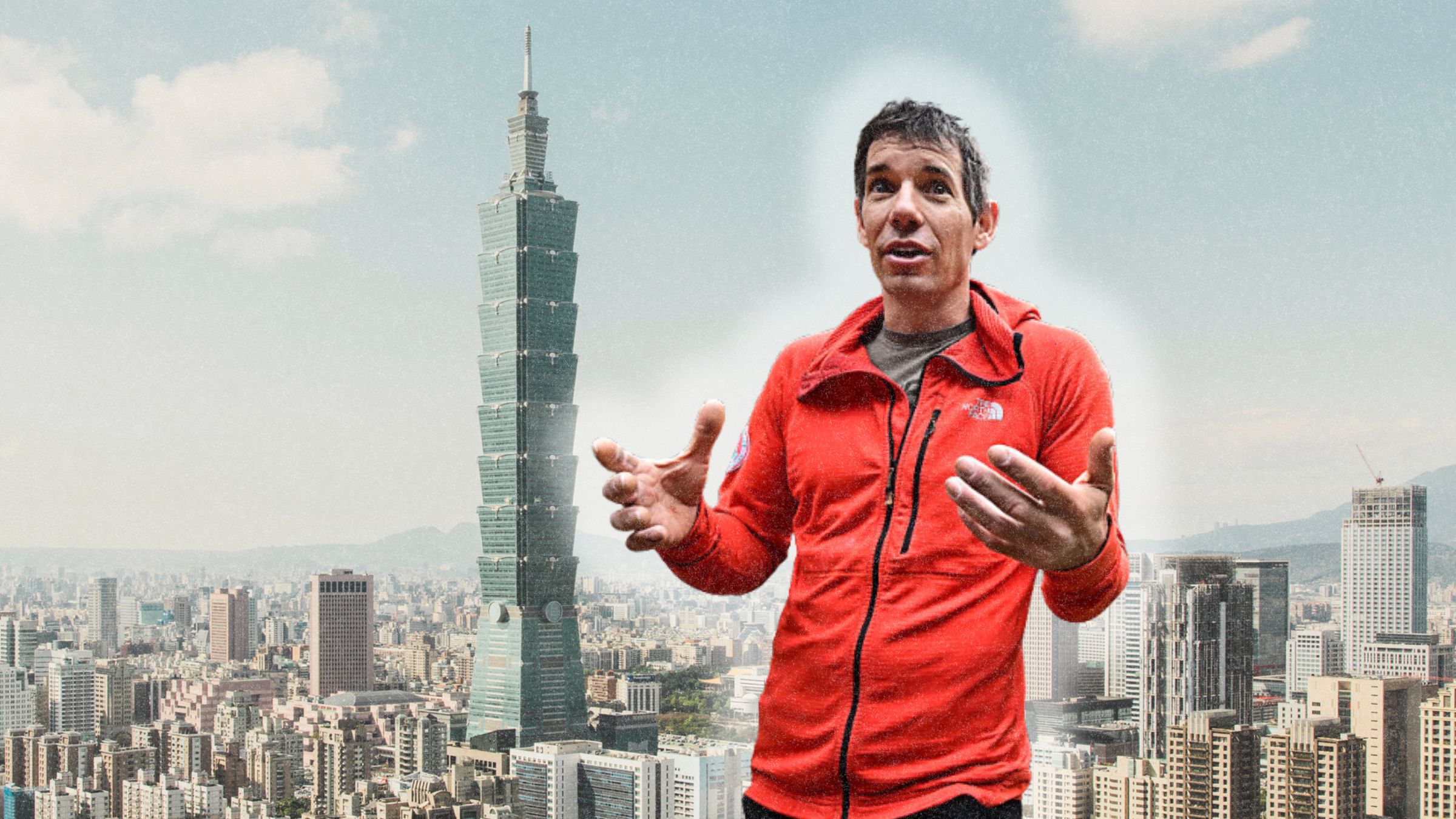
Honnold ascended the massive building (Photo: iStock / Getty Images Plus; FREDERIC J. BROWN / Getty; Canva)
Alex Honnold just became the first person to free solo the 1,667-foot skyscraper Taipei 101 in Taiwan and set a record for the biggest urban free solo in history. He climbed without ropes from the ground to the top in one hour, 31 minutes, and 34 seconds and his ascent was streamed live on Netflix. Skyscraper Live was scheduled to happen on January 23, but it was delayed by one day due to weather, and Honnold completed the endeavor just before 7:45 P.M. M.T. on January 24. At Outside, my team and I watched along with millions of other viewers.
“I’m so psyched, and you know what, pretty tired actually,” Honnold said atop the building. “The whole top of the building was very physical, and I was like, my arms are starting to get really tired.”
The event was hosted by a panel of sports and climbing experts: anchor Elle Duncan, Mark Rober, an engineer who worked at NASA, WWE champion Seth Rollins, climbing commentator Pete Woods, and big-wall climber and mountaineer Emily Harrington. As Honnold ascended the building, Netflix cut between the live climb and the hosts’ commentary and interviews with Honnold’s wife, Sanni McCandless. The two-hour live event also showed pre-filmed clips of Honnold training, hanging out with his two children, and soloing on rock.
Throughout the entire event, he wore a mic and a camera followed him from above. “He’s doing what he loves,” said McCandless before he began. “I’m just trying to stay calm and be in the moment.”
ADVERTISEMENT
My Favorite Part of the Ascent
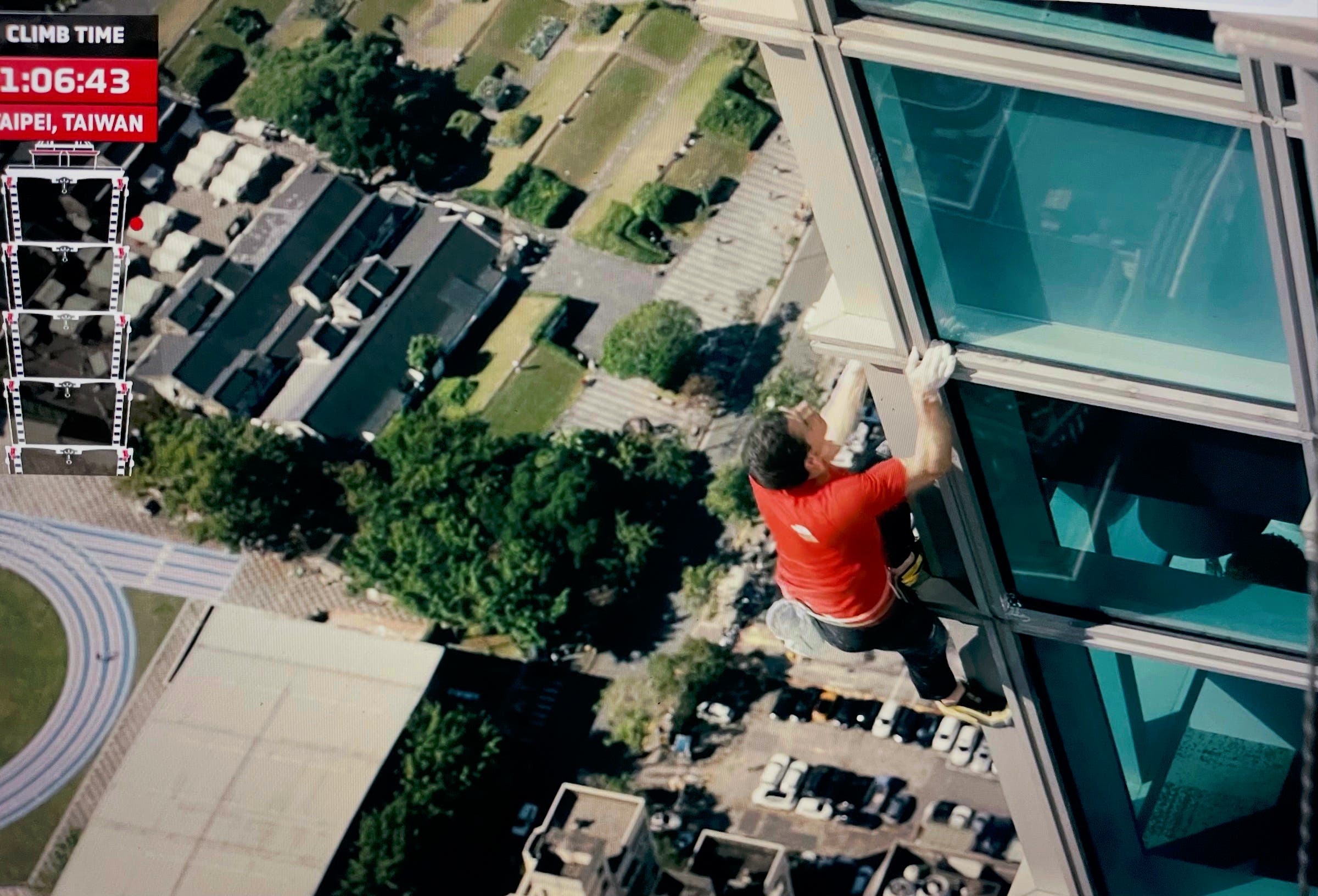
About 15 minutes into his climb, Honnold approached a swirling steel structure. It was the first of ten 16-foot-tall abstract dragons on the skyscraper. “They’re not going to breathe fire, though, right, Mom?” my three-year-old, who recently started climbing himself, asked me as we watched.
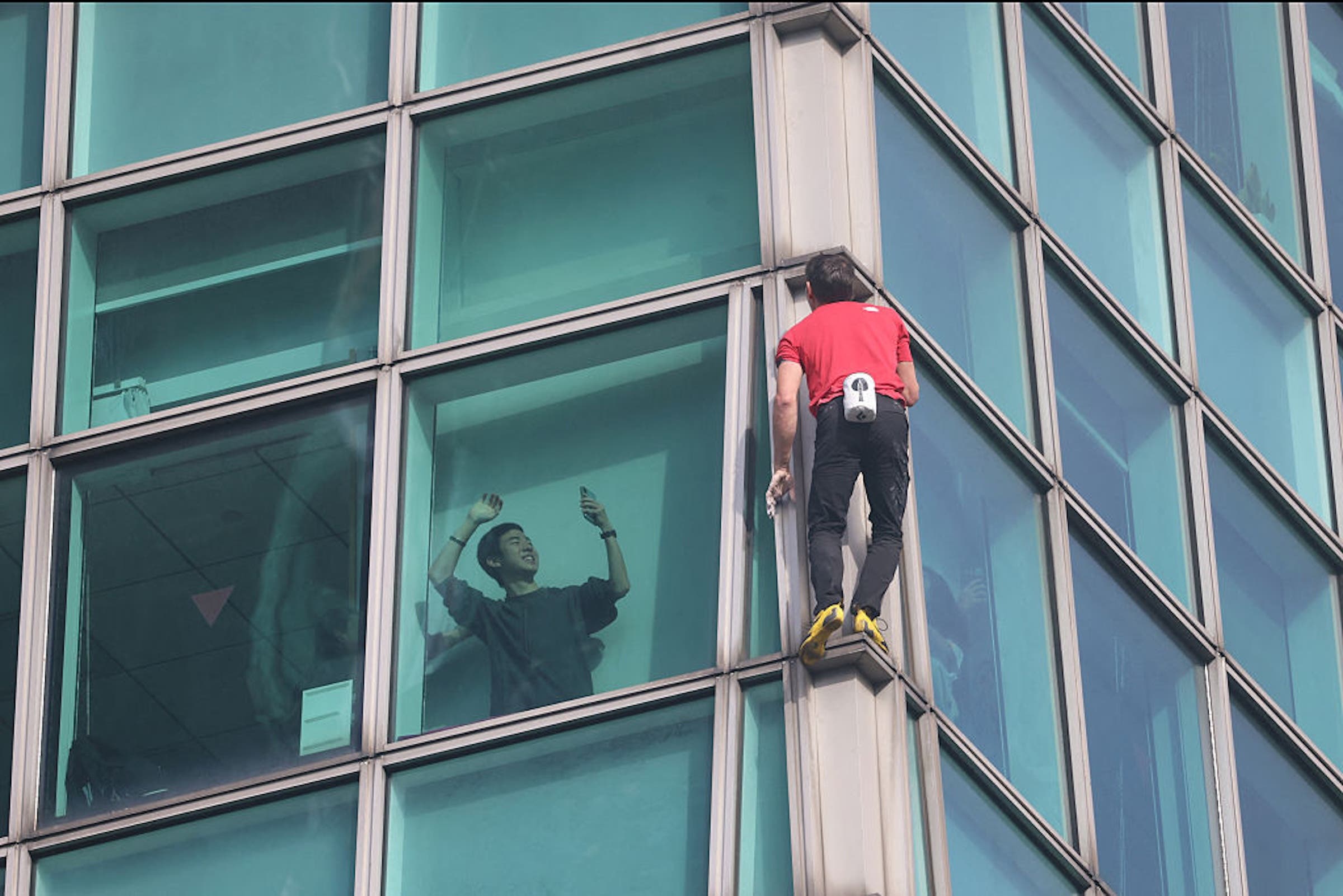
Honnold peered into the window in front of him, where a group of kids was gathered to cheer for him. He said into his mic that he was going to give them a high five through the window, but they were too busy taking photos and videos. “Kids these days,” Honnold joked, as he chalked up directly below the first dragon. He then stared up at the overhang and studied it for a moment before traversing to the right and stepping directly onto the feature.
ADVERTISEMENT
As he climbed, the reflection of him in his signature red T-shirt mirrored each movement. When he reached the top of the dragon, he turned to face the crowd and gave a small wave. “What a day in Taipei,” he said, before turning back to the building.
“[The dragons are] difficult to climb. It’s not a repetitive movement over and over again. It takes some creativity; it takes some thought. You saw him kind of go out towards the edge of the feature,” Harrington told the other hosts. “He had to really rely on his upper body strength in order to get up there. And, yeah, they’re just a bit more like real rock climbing.”
After climbing for an hour and a half, Honnold hauled himself over the last small steel ledge and reached the top. He stood at the peak of Taipei 101 and looked around, taking in the view. The crowd cheered from below, and he snapped a selfie.
What Honnold Had to Say After His Climb
At a press panel after the event, Honnold, McCandless, Harrington, Duncan, and executive producer James Smith discussed Honnold’s historic climb. Here is what they shared on the panel.
ADVERTISEMENT
“I don’t think that many people are drawn to free soloing, and I’m not drawn to it. I get enough of my fear management out of just rock climbing with a rope. I feel very good about that, and I get enough challenge from it. I think free soloing is very unique, and there aren’t that many people who even want to do it. What makes Alex so special is that he is an elite climber, so he’s very technically good, physically strong, and works really, really hard. And then that mental side—that sort of ability to shut everything out and be so pinpoint focused and super present, when the consequences are so high—is unique. Then the third piece that I think a lot of people gloss over is that there’s an intense desire to do it. He gets something out of it that’s so powerful, that makes you keep wanting to do it and seek out these objectives. I think that combination… there’s only one Alex Honnold, and that’s why.” —Harington
“I think that what people don’t understand until they watch is how much fun he’s having—and just how joyful he is when he’s doing it. It’s almost like a childlike joy of just, like, I’m up here, and I’m playing, and I think that was a really cool part of today. We all got to watch him have a lot of fun.” —McCandless
“One of the things that I learned from the film Free Solo over the years was that people kind of take the message that they need from it. I think that people often find the inspiration that they need to pursue their own challenges, their own goals. Or it’s often the kick they need to do whatever it is that they want to do in their life. I mean, I don’t think anybody watches [free soloing] like this, and they’re like, ‘I’m going to go free soloing.’ But often they’ll watch something like this, and it’s a reminder that their time is finite, and they should use it in the best way, the most meaningful way that they can.” —Honnold
Honnold Continues to Thrill Us Almost a Decade After Free Solo
I first connected with Honnold when I was still in grad school about 15 years ago. He’d recently appeared on 60 Minutes and was beginning to gain fame in the mainstream, but he wasn’t yet a household name. Honnold agreed to talk to me for a project I was working on for my university’s tiny website. He told me about his first-ever solo climb, Knapsack Crack at Lover’s Leap, near Tahoe, a 250-foot 5.3. “Honestly, when I started, it was really exciting. Or maybe just scary,” he wrote to me in an email back then. “Anytime you do something totally new, it’s pretty exhilarating. I didn’t know what it would feel like, just that I could do the climbing.”
Honnold rocketed to fame when Free Solo hit theaters in 2018 and won the Academy Award for Best Documentary. Since that moment, he’s been inescapable in outdoor media.
A decade and a half after my interview with him, he is still soloing, confident that he can do the project in front of him. As he said before he began his ascent of Taipei 101, “I’ve always wanted to climb the coolest thing that I can climb.”
