Published November 26, 2025 09:19AM
How a Mushroom Hunt Became a Survival Test for This 72-Year-Old Woman in the Oregon Wilderness
An elderly woman who recently became stranded while mushroom hunting raises an important question: Are foragers, especially those seeking prized fungi, at a higher risk of getting lost than other outdoor enthusiasts?
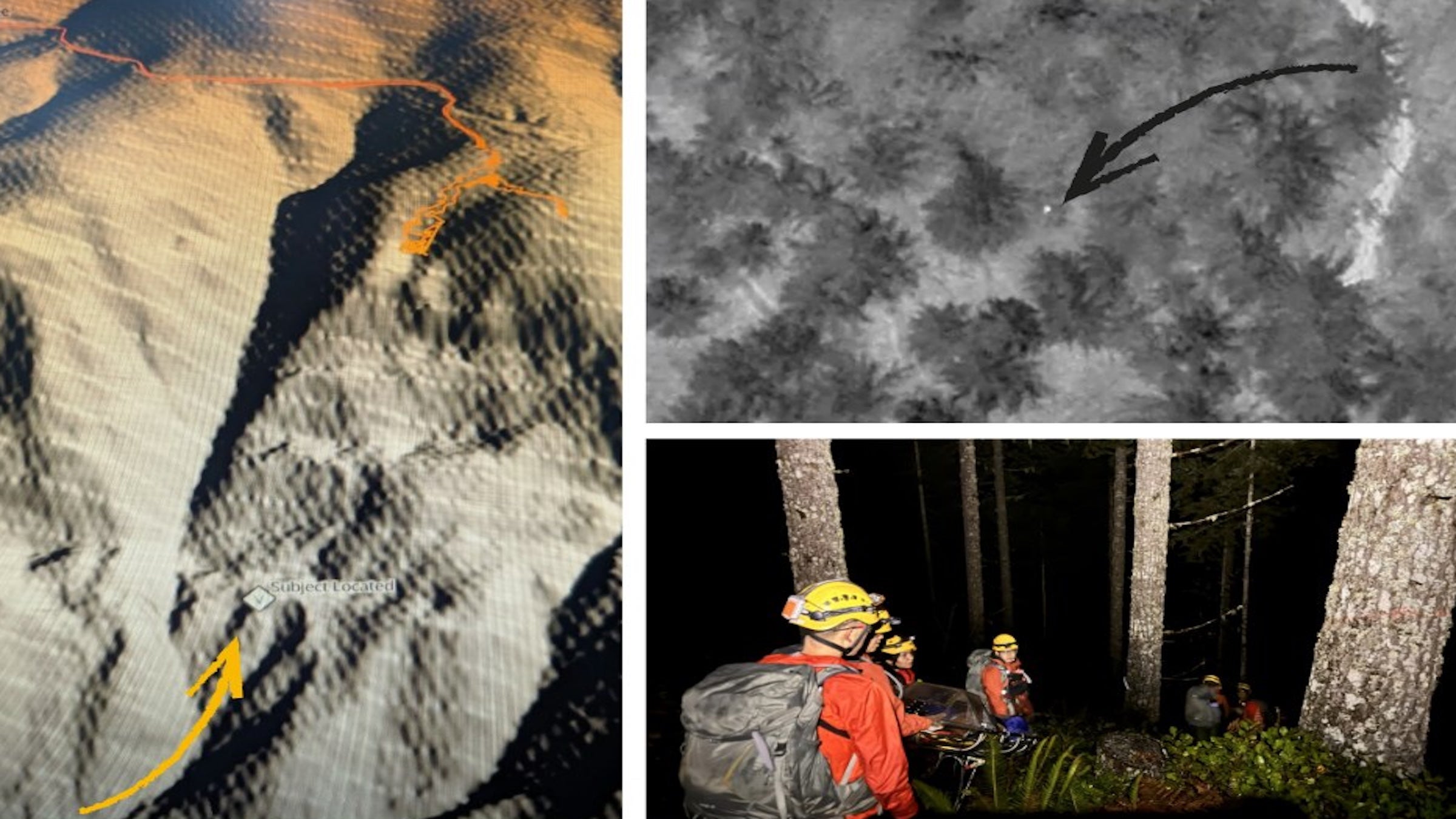
Authorities deployed k9 units and drones to find the missing woman (Photo: WCSO)
A 72-year-old woman who became stranded in steep terrain while foraging for mushrooms in rural Oregon was rescued on November 23 after texting 911 for help.
A distressed mushroom picker foraging for chanterelle mushrooms texted 911 operators just after 3 P.M., saying that she had entered an area from which she was unable to get out due to slick terrain and a steep incline, wrote the Washington County Sheriff’s Office (WCSO) on Facebook. She was located in the Oregon wilderness, roughly 50 miles west of Portland.
Authorities weren’t initially able to locate the stranded woman, and several other agencies were called in to assist, including search-and-rescue teams from nearby jurisdictions. Drones with thermal imaging and a K9 unit were also deployed.
“Several hours into the search, the woman was located by using GPS coordinates from the drone and ground searchers,” wrote the WCSO on Facebook. The sheriff’s office added that rescuers were able to pinpoint the stranded woman’s location in part because she was blowing on a whistle.
ADVERTISEMENT
When first responders reached the lost woman, they found the terrain so precipitous that they were forced to deploy a rope system to rappel down and extract her. Still, despite being cold, wet, and thirsty, the lost forager reported no injuries.
This incident serves as another testament to the usefulness of the safety whistle, which also helped save a lost hiker on a Colorado 14er earlier this year.
Her usage of the Text-to-911 service also likely played a key role in her survival. Voice calls often fail or are otherwise garbled in remote areas with patchy cell coverage, if they go through at all. SMS text messages, on the other hand, require significantly less bandwidth and signal strength to transmit. The ability to reach 911 by text message is now available in parts of the U.S., providing a critical lifeline for backcountry users.
ADVERTISEMENT
“The Sheriff’s Office is grateful for the collaborative efforts of all the responders and thankful that the woman was safely located,” the WCSO said. “If you choose to adventure into natural areas, remember to dress for the weather, bring a whistle, food, water, and tell others where you are going. In this instance, preparation contributed to a positive outcome.”
Are Mushroom Hunters at a Greater Risk of Becoming Lost?
Mushroom foragers may be at a higher risk of getting lost in the woods than the average outdoors enthusiast. In Catalonia, Spain, at least 15 different mushroom hunters were rescued from the wilderness this year. Last November, three different foragers were rescued in Oregon in the span of a single week. In September 2021, more than 137 mushroom foragers in Estonia had been lost in the country’s woods that year alone.
Many foragers are secretive about the locations where they pick mushrooms. It’s also easy for mushroom hunters to lose track of their surroundings when they veer off established trails. They may know the mountains well, but can easily become disoriented and experience physical limitations that make them unable to get out on their own. Two, many foragers are secretive about the locations where they pick mushrooms.
ADVERTISEMENT
It’s also easy for mushroom hunters to lose awareness of their surroundings, because unlike hikers, they aren’t following a given trail or even looking up in general to take note of the position of the sun, ridgelines, or landmarks. Instead, they’re keeping eyes locked on the forest floor to scan for fungi. This makes it easy to get lost.
Chanterelles and other fungi tend to thrive in areas with moisture, which collects in drainages, ravines, and steep creek beds, where the ground may be slick with mud and decaying vegetation. It can be easy to get into these areas, but getting back out might be much harder.
