Published February 6, 2020 12:00AM
We're Dying to Get Mercedes-Benz's Metris Weekender Van
The company is bringing its camping game to pop-tops—and we can't wait
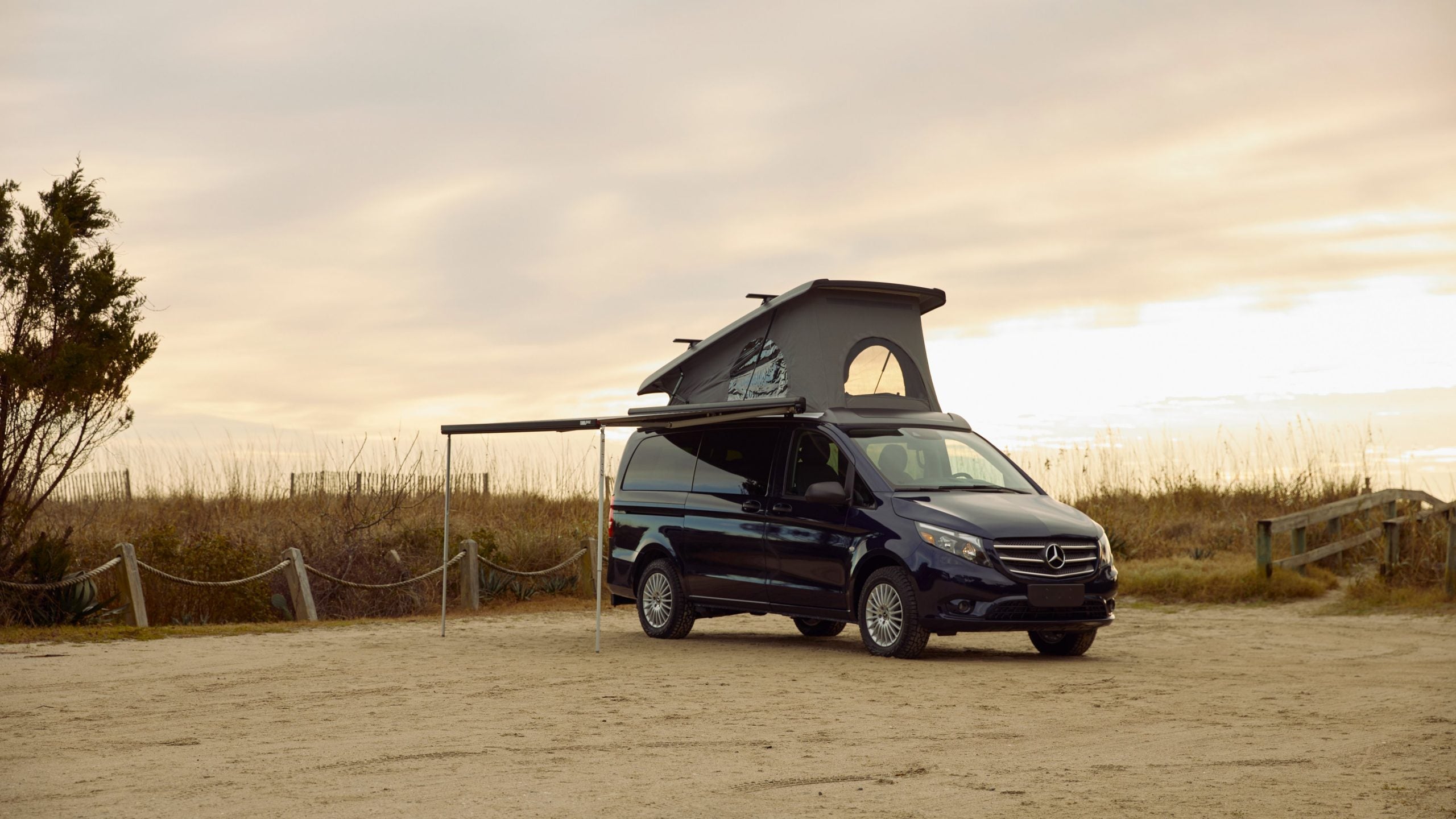
Today, Mercedes-Benz has taken the highly intriguing step of offering a factory-built pop-top camper to the American masses.
Well, it’s about damn time.
Today, Mercedes-Benz has taken the intriguing step of offering a factory-built pop-top camper to the American masses. Thanks to a just-announced partnership with Seattle’s Peace Vans and Mercedes-Benz Master Solutions partner Driverge, you will be able to walk into any U.S. Mercedes-Benz Vans dealership this spring (a firm date has not been announced yet) and order a fully warrantied Metris Weekender model camper with seating for up to five and sleeping for up to four. It’s the first time a manufacturer has offered a pop-top camper in America since Volkswagen ended its Winnebago-built Eurovan camper program back in 2003.
Thanks to Harley Sitner, owner of Peace Vans, one of the largest VW camper businesses in North America, I’ve been given a sneak peak of the Weekender model camper, which makes its debut this weekend at the Chicago Auto Show. As someone who’s owned seven VW Westfalia Vanagons, a 2003 VW Eurovan camper, and driven a Metris (known as a Vito in Europe) all over Scotland, I feel comfortable calling this rig an heir apparent to VW’s storied campers.
What’s the Deal?
In late 2016, Sitner made a trip to Germany to scout out camper-equipment manufacturers for his business. Though happily restoring, selling, and renting all manner of aging VW campers to eager customers at Peace Vans, Sitner was frustrated that midsize pop-top campers like the California and Marco Polo weren’t available in the States. After intensive discussions with German manufacturers Reimo (camper interiors) and CF Maier (pop tops), Sitner loaded a shipping container with parts from those two companies and worked with his crew to engineer a U.S.-built Metris camper. That camper, which he dubbed the Weekender, quickly sold, and he soon convinced the owner of neighboring Mercedes-Benz of Seattle to stick a couple of Peace Vans rigs on his lot. Sitner was soon selling as many of his Weekenders and full-camper models—equipped with a stove, sink, refrigerator, and furnace—as his small shop could supply.
Around a year ago, Sitner was contacted by Mercedes. The team at the Mercedes Vans factory in Charleston, South Carolina, had been paying close attention to the U.S. camper-van market. While there were all manner of RVs available on the larger Sprinter platform, the team agreed with Sitner that the smaller Metris might prove to be the perfect pop-top rig for a much larger fan base.
Sitner didn’t have the resources to build a factory, but just up the road from the Charleston plant, upfitter Driverge had the room and ability to produce Peace Vans campers on a manufacturer’s scale.
ADVERTISEMENT
“One thing we struggled with was, How do we capture the passion and knowledge these smaller, great upfitters bring to the table?” Mercedes Vans upfit manager Don Maxwell told me. “That’s what we feel like we’ve done partnering with [Sitner]. It’s the best of both worlds, having [Sitner] and his credibility and design and our trusted partner Driverge, which has invested a lot here in Charleston and can produce with the same material and processes [Sitner] uses but at a quicker rate.”
What You Get
Size-wise, the Metris is in a class of its own. It’s a bigger vehicle than Dodge’s ProMaster City, Ford’s Transit Connect, and Nissan’s NV2000, but it’s not nearly so large as a full-size Sprinter, ProMaster, or Transit. The pop-top-equipped Metris will fit inside a standard seven-foot-high garage and offer a very tight 36-foot turning circle (which destroys my Eurovan Camper’s 47-foot circle but is slightly less than the 34.5-foot circle made by my nimble Vanagon Westfalia). It’s as maneuverable as a car.
Pricing isn’t completely nailed down, but for somewhere between $26,000 and $30,000 above the base Metris’s sticker price ($31,000) you’ll get the following. (The starting price for an empty 2020 Mercedes-Benz Sprinter cargo van is $34,495.)
ADVERTISEMENT
A Pop Top
The tough, crash-tested, elevating fiberglass roof features a water-resistant heavy-duty tent and has a sleeping area for two. The upper bed is very comfy, with an integrated spring system, a two-inch memory-foam mattress, three windows, and added USB ports for lights and charging. Two of the three zip-open windows are outfitted with fine-mesh screens, while the third zips down to reveal a clear plastic window—a terrific option for seeing outside when it’s cold or rainy. Another thing I really dig is that both the top and the bed are gas shocked/spring loaded, so they go up with an easy push. Unlike the Eurovan or Vanagon, the Metris top pops up around 19 inches—high enough in back that you can sleep with your head toward the rear. (At the front edge of the mattress, that height increases to 38 inches.)
Unlike with a Eurovan or Vanagon pop-top, you can’t really leave your sleeping gear up top after the bed is folded away, but there’s plenty of room for that behind the rear seat.
Curtains
Hand-sewn by Peace Vans, the Weekender has privacy curtains all around, including a big one that covers the front driver and passenger windshields, just like in an old-school Westy.
ADVERTISEMENT
Rear Bed/Seat
The Reimo seat has three shoulder belts and attachments for two child seats. The seat doesn’t come out but slides forward on rails into four different positions—including flush up against the front seats—allowing the van to function as a cargo rig should you need it. It folds down into a double-size bed, and the seat itself pops open to reveal a huge storage area. There’s a swing-out leg that allows for the mounting of a sturdy table inside (or even outside) the van. The table, which mounts to the back of the seat, also has freestanding legs. Because it’s Reimo, and a standard design, the seat tracks should accommodate all manner of Reimo hold-downs for gear. This versatility allows you to make quick changes to your living area while you’re on the road.
ADVERTISEMENT
Rotating Front Seats
The comfortable and firm stock Mercedes seats rotate 180 degrees with the flip of a lever, making it easy to lounge in the van’s interior.
A Coach Battery
Key for any camper van, the second auxiliary battery will keep an ARB-style fridge running without draining the starter battery and will power lights, a small inverter, or other accessories.
A Rear Receiver Hitch
The rear features a standard receiver, wired with a trailer brake and solar connector for portable panels, to provide additional power to the coach battery. The Metris features a solid 5,000-pound tow capacity. Pull a tow-behind trailer and you have two bedrooms.
ADVERTISEMENT
On the Road
It’s important to note that Mercedes has a higher safety standard for this camper than essentially any other vanlife camping rig on the road. RVs aren’t subject to the same crashworthiness requirements—that’s why so many have rear lap belts instead of shoulder belts and no rear airbags. But if a vehicle is sold through a dealer, stricter rules apply. The Weekender maintains the Metris’s stock rear airbags and collision prevention, and it includes its excellent crosswind-assist technology, plus a rearview camera.
I had the opportunity to drive a turbo-diesel Vito—the European version of the Metris—all over Scotland. I was amazed at the van’s stability, power, and collision prevention, and I fell in love with its steering-wheel-mounted paddle shifters, which were a boon on long Highlands downhills.
ADVERTISEMENT
For a bit more information on an actual Peace Vans build, I reached out to a Weekender owner named Scott Erickson. Erickson lives in Ojai, California, with his wife and two young kids. He bought a Weekender last year, and the family calls it Scout.
Like me, Erickson has had a decades-long love affair with VW vans. After owning everything from microbuses to a Eurovan Weekender camper, he said he and his wife were looking for the safety and reliability of a new vehicle. “You don’t have time to worry about working on a van when you have two kids,” he said. “Our van had to be a daily driver. When we saw the Peace Vans Metris, I was like, Holy shit, this is it.”
Erickson said he looked at a couple of other Metris upfits, but none had the Peace Vans fit and finish or what he called the van’s “magical” sliding seat. “Plus, the dual swivel seats provide a tremendous amount of room,” he said. “In the summer, we take her down the beach when I get off work and play and swim for an hour and then share a pizza right in the van as the sun sets with our dog at our feet. It’s a beautiful thing.”
ADVERTISEMENT
He described the 2.0-liter, 208-horsepower turbocharged motor as plenty powerful for effortlessly propelling Scout through the High Sierra at 80 miles per hour. Equipped with Peace Vans’ 1.5-inch lift, and shorn with all-terrain tires, the rear-wheel-drive van has camped everywhere he’s wanted to go with little drama. In economy mode, which shuts the motor at stoplights, he’s seen 25 miles per gallon. By contrast, my 201-horsepower 2003 Eurovan camper averages around 18 miles per gallon wherever I go.
Mostly, he said, the family just piles into the camper and goes, without a care in the world. “We get stopped by people all the time. Getting gas, people run across the street—‘Hey man, can I check it out?’”
“[Sitner] built a modern version of what we wanted from Volkswagen,” Erickson said.
ADVERTISEMENT
Optional Upgrades
The options list for this van are expected to rapidly expand as production ramps up. But the current rundown is as follows:
- Solar panels, which can be mounted to the pop top, an off-grid charger, and a plug-in outlet for charging at campsites.
- A Kenwood touchscreen head unit with navigation and Android/Apple interface to replace the stock model.
- 3M body wrap with a choice of over 200 colors. This actually makes a good bit of sense if you’re going to be traveling off the grid and want to protect your paint.
- An eight-foot Fiamma F-45 awning—an industry standard with an integrated gutter to keep rain from running down into the hatch.
- Mosquito/bug screens for the rear hatch and sliding doors. This would be key for places like my home in buggy Charleston, where the van is upfitted.
- A rear tent that quickly attaches to the back lift gate to add space and privacy.
- Swing-out rear doors. The van comes standard with a lifting hatch, which is better in most instances because it blocks sun and rain. But if you want to attach something to the rear doors like a bike rack, or cut out a hole for a window air-conditioning unit, optional swing-out doors can make sense.
- Roof racks for hauling surfboards, cargo boxes, or skis.
- A pullout rear kitchen custom-designed by Trail Kitchens.
- A 1.5-inch lift, available if you purchase a van directly through Peace Vans. Before Mercedes offers this option on dealer-purchased vans, it will have to go through additional testing.
Possible Upgrades
- A middle seat. It will have to undergo additional testing, but a removable middle seat is on the horizon, according to Sitner.
- A full camper. If you want one of Peace Vans’ amazing, European-sourced interior full campers, you’ll have to purchase it directly from them for at least the next six months. After more testing and certification, Maxwell said, Mercedes hopes to build full Peace Vans campers as well.
