Updated October 14, 2025 03:38PM
If you buy through our links, we may earn an affiliate commission. This supports our mission to get more people active and outside.Learn about Outside Online's affiliate link policy
The 10 Best Splitboards of 2026
Ditch the resort crowds and enjoy the pow with our testers’ favorite splitboards
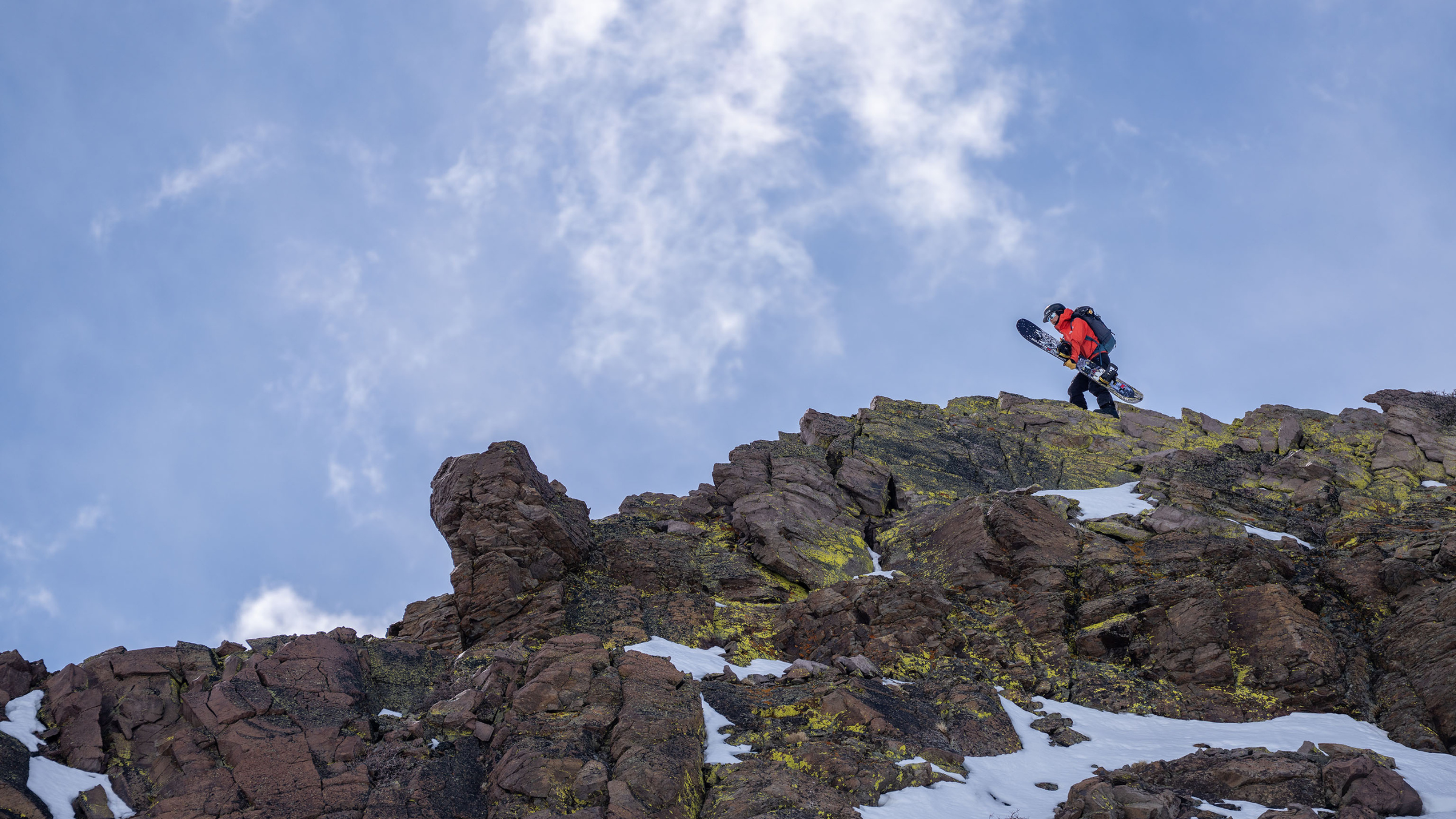
A tester walks along a rocky ridge at Kirkwood Mountain Resort. (Photo: Katie Botwin)
Table of Contents
Every snowboarder knows that first tracks at the resort don’t last long. Luckily for the antisocial powderhound, ditching migraine-inducing liftlines for backcountry bliss has never been easier, thanks to advancements in splitboard tech and a proliferation of options for backcountry shredders of all creeds.
Not only that, but we’re seeing better, more widespread avalanche forecasting and avalanche safety education, both of which are obligatory for exploring the backcountry responsibly. Whether you’re new to the game or frequently use quadriceps over quad chairs for your powder fix, below you’ll find our best splitboards of 2026. First step: Sign up for an AIARE class.
Best Splitboards: At a Glance
- Editors’ Choice: United Shapes Covert ($899)
- Best Freeride Splitboard: Weston Gnarnia ($989)
- Best All-Mountain Splitboard: Jones Stratos ($1,000)
- Best First Splitboard: Jones Frontier and Dream Weaver ($850)
- Most Playful Powder Splitboard: Burton Fish 3D ($1,000)
- Most Versatile Powder Splitboard: Rossignol XV Slashimi ($800)
- Most Durable Freeride Split: Venture Storm ($999)
- Most Durable All-Mountain Split: Venture Paragon ($999)
- Best Volume-Shifted Split: Stranda Biru ($949)
- Best Powder Split: Jones Storm Chaser ($1,000)

Editors’ Choice
United Shapes Covert
Weight: 7 lbs (157 cm)
Sizes: 153, 157, 161
Profile: Camber underfoot, rocker nose
Pros and Cons
+ Versatile
+ Agile for such a wide shape
+ Reasonably priced
– Heavier, hard-chargers may want more stiffness
– Minimal size run
The Covert is the sole splitboard in United Shapes’ purposefully simplistic line. Normally, this measured approach would irk our test team, as we love it when brands drop a variety of shapes that speak to different riders and riding styles. Not in this case, though. United Shapes hit the backcountry bull’s-eye with the Covert. It floats like a helium-injected hoverboard, zips across a variety of terrain, and speaks to a significant swathe of the splitboarder spectrum.
The latest update of the Covert has a lighter, more durable, and more eco-friendly (bio-based topsheet) construction. The board features a squared tail and rockered spade of a nose, with camber underfoot and a wide waistline (26.4 centimeters for the 157-centimeter length we tested). “The float here is second to none. The nose is like the prow of a viking ship, floating over whatever waves come its way, and that fat waist provides excellent buoyancy when the stellar dendrites stack up,” commented a Sierra splitter after a multi-day mission on the Covert.
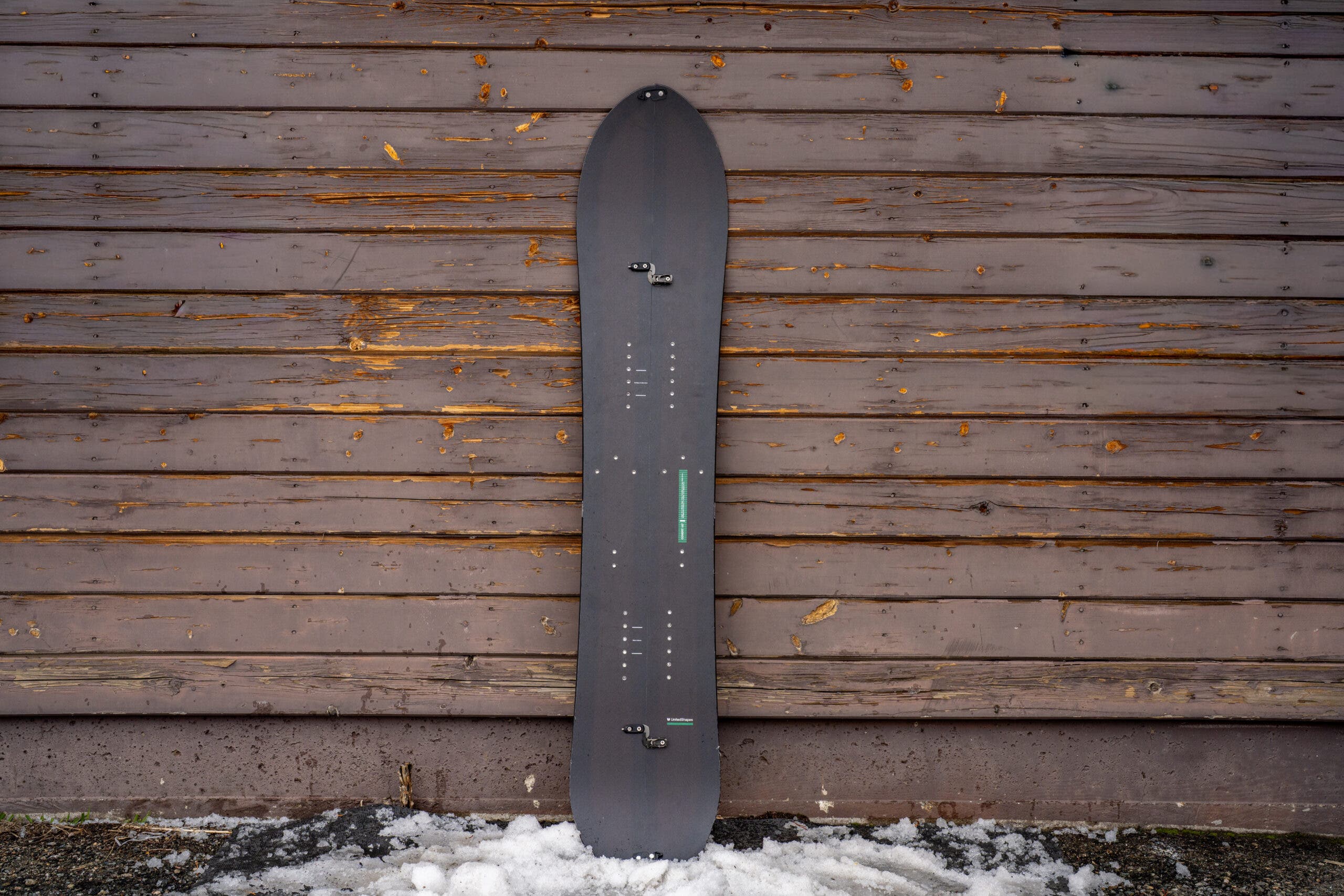
However, our testers know that even barn doors ride well in pow, and were more concerned with the Covert’s ability to rally through less optimal conditions. That Tahoe tester found the mid-radius sidecut and cambered midsection “gripped, ripped, and railed short-to-medium turns in hardpack, and made harvesting corn on solar aspects a transcendentally surfy experience.” The nose transitions effortlessly into carves, while the stiffer tail held well while exiting turns. “That tail even helped provide some bite and trustworthiness when hop-turning,” he reported after a techy tour.
ADVERTISEMENT
The Covert’s construction gives riders a balanced flex. A poplar, paulownia, and ash core is reinforced with energetic stringers, providing decent pop and landing gear. Woven carbon laminates add torsional reactivity and save weight, leading a Colorado tester to claim the Covert would crush the Dirksen Derby’s banked slalom split race.
While the majority of testers were happy to call the Covert a quiver-killer, our Colorado rider pointed out that he’d rather have a longer effective edge and stiffer deck underfoot for more stability when pinning big mountain lines. Another heavier, hard-charging freerider who prefers stiffer big mountain shapes that can be ridden at full throttle agreed with that take. He had little confidence when straightlining and found the build “twitchy.” Lastly, while testers appreciated the lightweight build, generous surface area, and camber under the toe when touring, a couple said the massive nose dove on kickturns.
Those shortcomings aside, for intermediate to expert all-mountain splitters who value turning ability, versatility, and float (and want a touch of freestyle ability and freeride chops), the Covert is a fantastic choice and an elegant backcountry companion—especially for the price.
ADVERTISEMENT
Best Freeride Splitboard
Weston Gnarnia
Weight: 7.4 lbs (158)
Sizes: 143, 147, 151, 154, 158, 162, 162w, 166w
Profile: Freeride camber (camber underfoot, rockered nose and tail)
Pros and Cons
+ Reliable
+ Handles speed like a boss
+ Rails turns
– Overkill for most riders
– Doesn’t perform as well at slower speeds or on mellower terrain
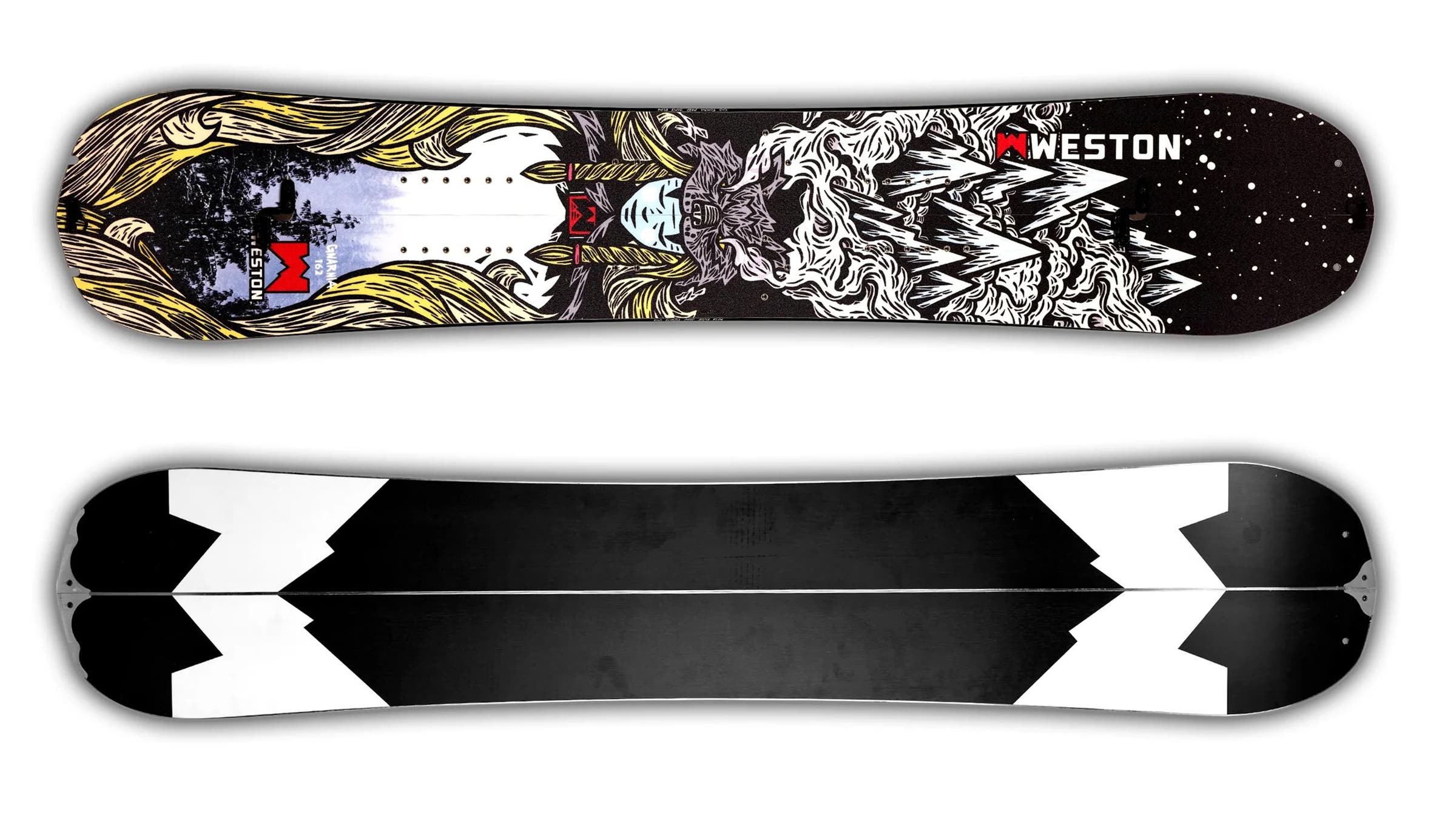
If you’re a freerider who loves to hammer the gas pedal and needs a deck that can chew up chundery landings, straightline chokes, and hop-turn in tech-gnar, then you might have just found your next dependable and sendable daily driver: the new, unisex Weston Gnarnia.
A burly poplar, paulownia, and bamboo core, bolstered by a nose-to-tail carbon backbone in each half of the split, gives the heavily cambered Gnarnia a stiff flex pattern that’s comfortable at full throttle. “I could ride alpine faces and harvest corn at full speed without hesitation,” said an Eastern Sierra avalanche course instructor after testing the Weston in Kirkwood’s spectacular sidecountry and all spring long in his home range.
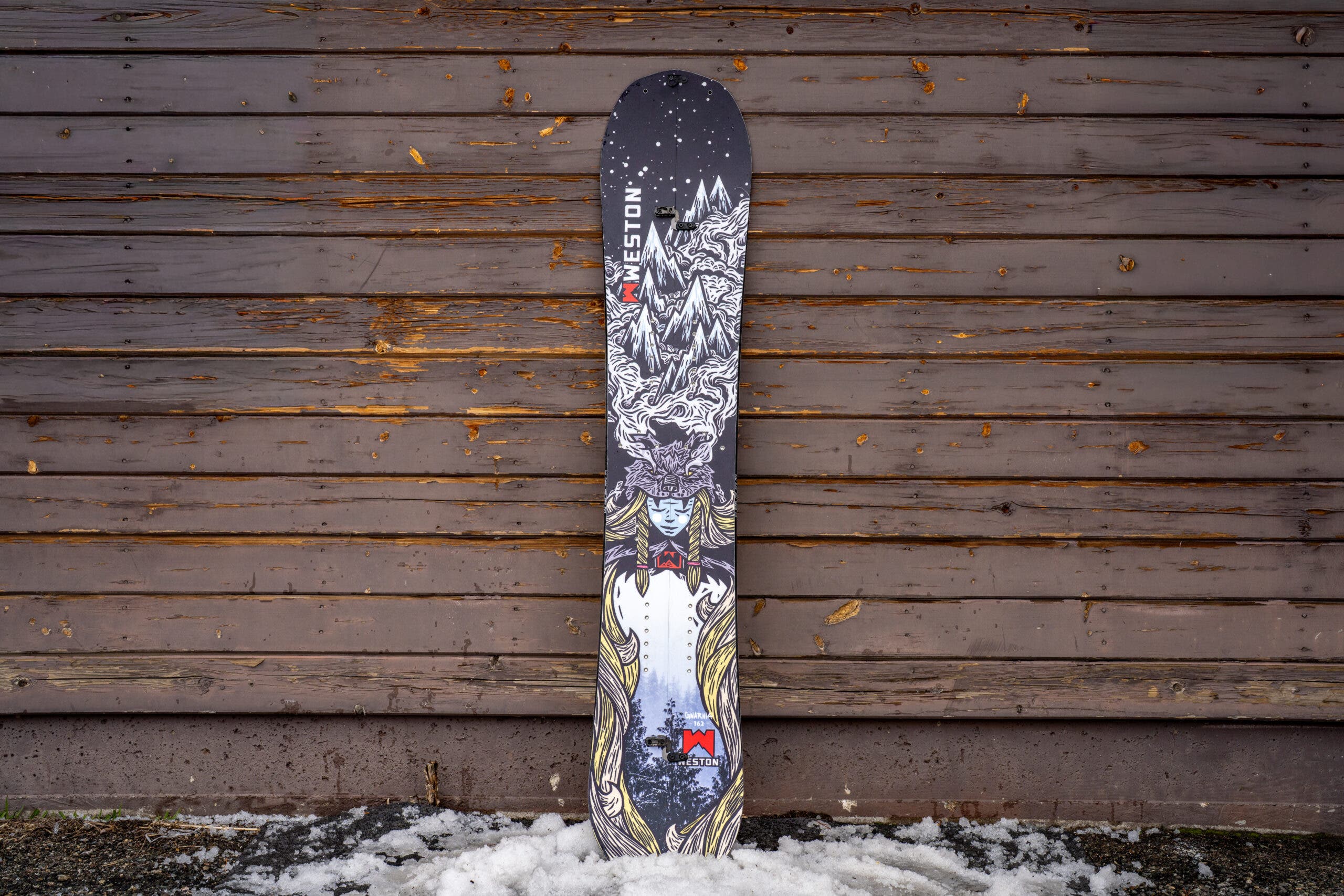
He loved the dampness of Gnarnia, too, which comes from both the core composition and shock-absorbing polyurethane sidewalls. “It rendered chop meaningless,” he said. Thanks to that innate suspension, freeride-focused setback and taper, grip-enhancing camber, and a big mountain-ready, multi-radial sidecut, the Gnarnia “rails turns on the biggest waves with confidence” and stomps cliff drops and natural airs with authority, he reported. It pops—and rides—best at speed. “It struggles when you’re riding casually, let your guard down, or are moving slowly,” he said. His hot take? Ninety percent (maybe more) of splitboarders reading this review will be happier on less aggressive decks.
ADVERTISEMENT
Last but not least, the Gnarnia earned additional kudos for above average durability, a fast base, and a wall-hanger of a wood-carved topsheet.

Best First Splitboard
Jones Frontier 2.0 and Dream Weaver 2.0
Weight: 6.84 lbs (156 cm)
Sizing: 145, 148, 151, 154 (Dream Weaver 2.0); 156, 158w, 159, 161w, 162, 164w (Frontier 2.0)
Profile: Directional camber underfoot, rocker nose and tail
Pros and Cons
+ Forgiving, playful, and floaty
+ Great first splitboard
+ Relatively affordable
– Floppy nose in variable conditions
– Soft flex can be overwhelmed in high-speed freeride terrain
Jones’ recently revamped men’s Frontier 2.0 and women’s Dream Weaver 2.0 are more forgiving, directional, buoyant, and playful than in years past, making them a great pick if you’re dipping your boots into backcountry boarding for the first time.
A two-to-one paulownia-to-poplar core laminated with forgiving biaxial fiberglass gives these decks a softer, buttery feel that’s “fun and playful while still feeling stable,” according to a laidback Eastern Sierra splitboarder who tested the Dream Weaver 2.0 in Kirkwood’s freeride terrain. A more aggressive, often airborne Tahoe rider agreed, loving a “balanced” flex that contributes to the Jones’ popping and stomping abilities.
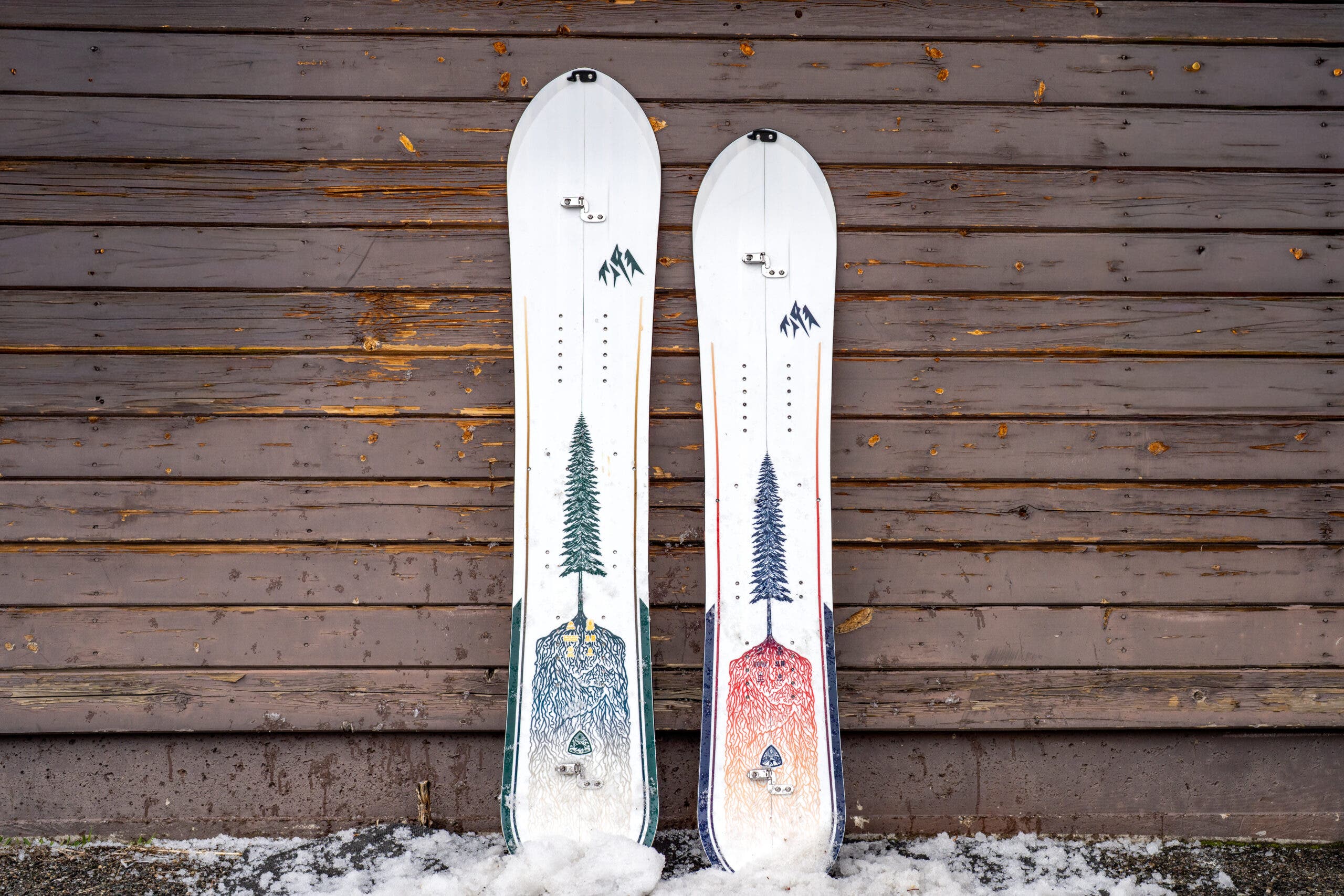
The elongated, lifted, and three-dimensionally contoured nose helps the Jones float in the deep stuff and roll naturally in and out of turns of all shapes and sizes. “Nimble maneuverability,” penned that Eastern Sierra rider, stoked on the edge hold of the camber and subtly serrated sidecut through medium-radius turns. She was also impressed by the splitboard’s ability to pivot quickly while dancing through tight glades. However, multiple testers reported that big schnoz could feel floppy at speed in hardpack—somewhat unsurprising data, given the deck ranks a four out of ten in the flex department, and that nose is bigger than a proboscis monkey’s.
ADVERTISEMENT
On the skin track, testers loved the lightweight build, dedicated notches for tail clips, and balanced kickturns. When it was time to convert the split into ride mode, it “rides like a solid,” noted our Tahoe rider.
Best Playful Powder Splitboard
Burton Fish 3D
Weight: 6.8 lbs (156 cm)
Sizes: 146, 151, 156
Profile: Flat underfoot, rocker nose
Pros and Cons
+ Nimble, surfy turns
+ Fun, skatey pop and playfulness
+ Excellent float
– Niche shape
– Overwhelmed in variable snow
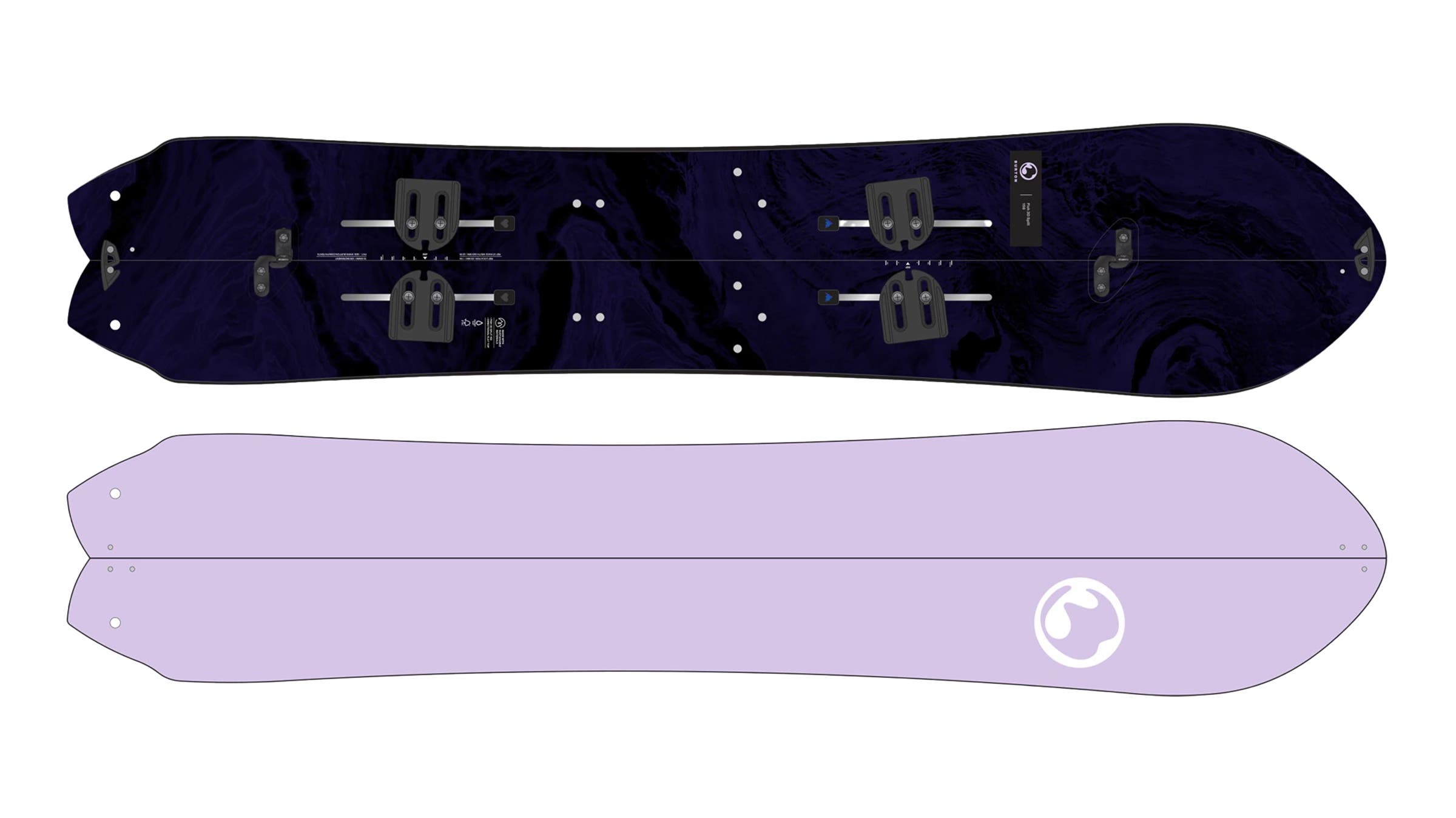
Testers were hooked on Burton’s Fish 3D from first cast. “Floats like a bloated bass—but doesn’t ride like a dead fish,” reported a Tahoe tester. This short and fat powdercraft is oddly shaped. It sports a flat base; extra-wide, rockered, three-dimensionally spooned nose; wide waist; and a relatively teeny, spooned swallowtail. The sheer surface area, rocker profile, and significant taper bring float to the forefront, while the spooned hull, deep sidecut, and soft torsional flex enable the Fish to spring in and out of turns effortlessly.
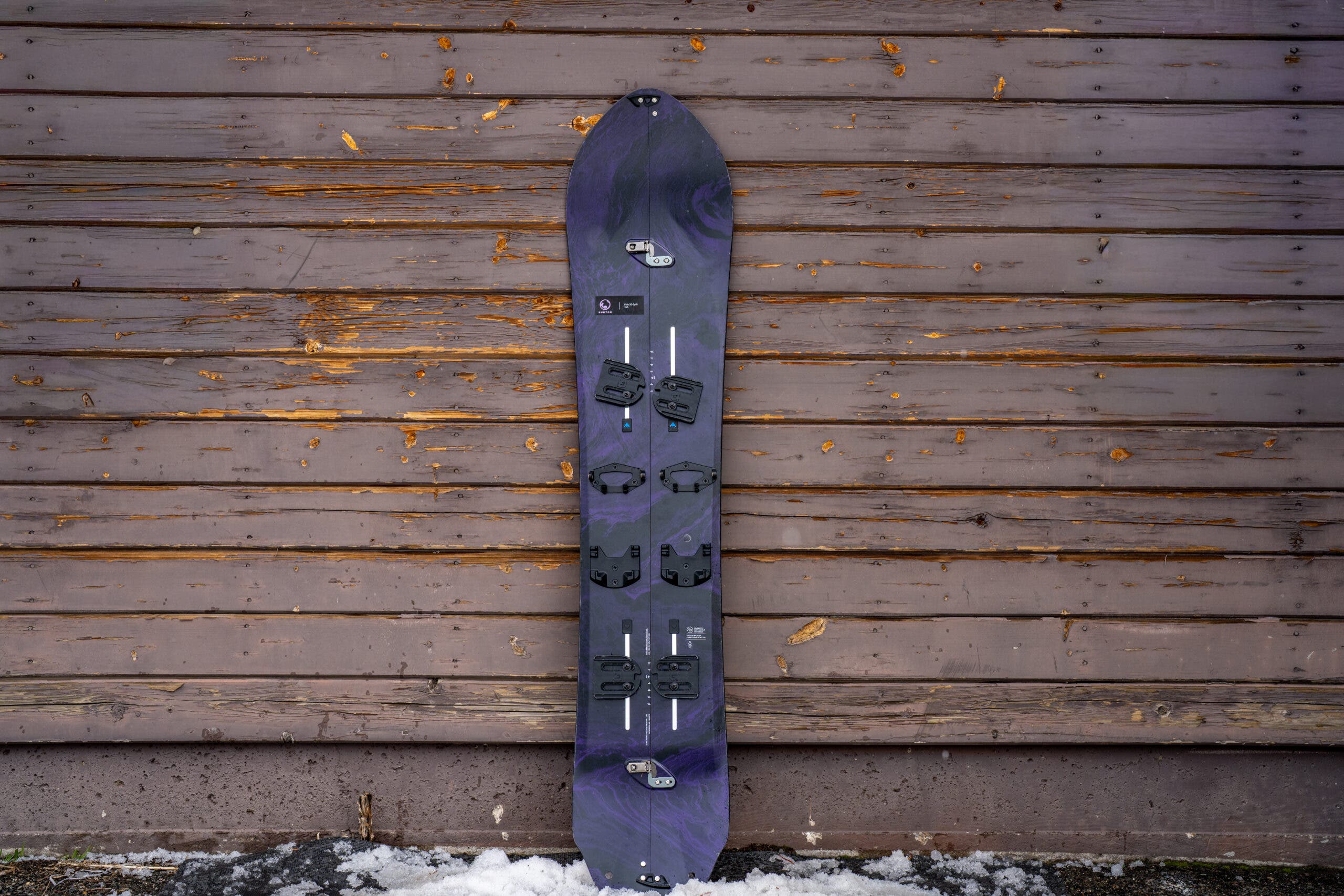
Testers agreed the Fish is best making short to medium turns in smooth snow, and feels out of water making bigger arcs or straightlining in hardpack and crud. “Turn machine. A blast to carve and nimble enough to wiggle through trees,” said an Eastern Sierra all-mountain cruiser. But she reported, “chunky firm snow made the big nose bounce a bit.” Still, she was surprised by the board’s ability to handle bigger terrain. “I took this on a tour of Kirkwood’s exceptional sidecountry terrain, and it actually straightlined the choke of a couloir surprisingly well.”
ADVERTISEMENT
One of the biggest reasons we’d add the Fish to our quiver, though, was its playful pop from the dual-density wood core. “I had so much fun buttering threes on this fat nose, and popping little ollies off natural features,” another tester explained. “It slashes and turns like a surfboard but pops and plays like a skateboard.”
Most Versatile Powder Splitboard
Rossignol XV Slashimi
Weight: 6.6 lbs (158)
Sizes: 152, 155, 158, 161
Profile: 80 percent camber, 20 percent rocker
Pros and Cons
+ Excellent float
+ Crushes carving
+ Handles technical terrain well
– Disappointing, flimsy hardware
– Too much nose for some riders
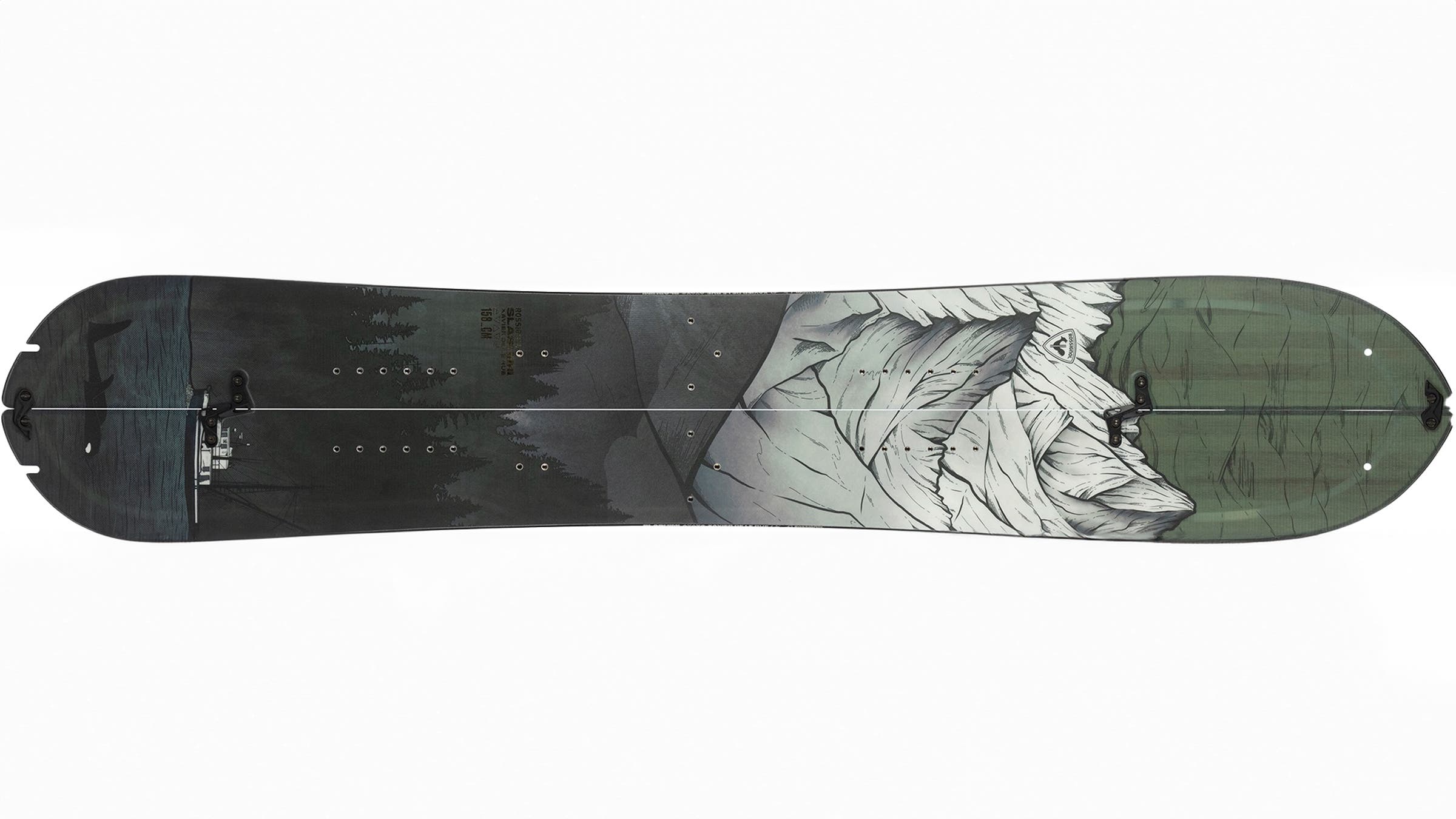
A powder board for realists, Rossignol’s mid-wide Slashimi offers unbelievable buoyancy in blower, and it’s equally comfortable in freeride terrain and variable conditions, too.
Thanks to a camber-dominant profile and an aggressive sidecut, the Slashimi “likes to go fast and holds an edge like the most experienced sushi chef,” according to a Tahoe splitter. A stiffer flex pattern centers power under the front foot for big-mountain ripping. “If I were afraid to ride something, this is what I’d want underfoot,” commented a Wasatch splitter who’s no stranger to steep, technical faces. He called the deck stiff and stable, and found the Slashimi’s punchy pintail “ready to rev out of any cliff drop.” Edge-to-edge quickness and the dampness of a sustainably harvested wood core outlined with strips of shock-absorbing polyurethane also earned kudos. Another hard-charging tester was similarly impressed, asking a rhetorical question after a Kirkwood sidecountry spin on the Slashimi: “Have you ever wanted to dodge rocks while staying in the fall line of a couloir at 60 miles per hour? This board is for you.”
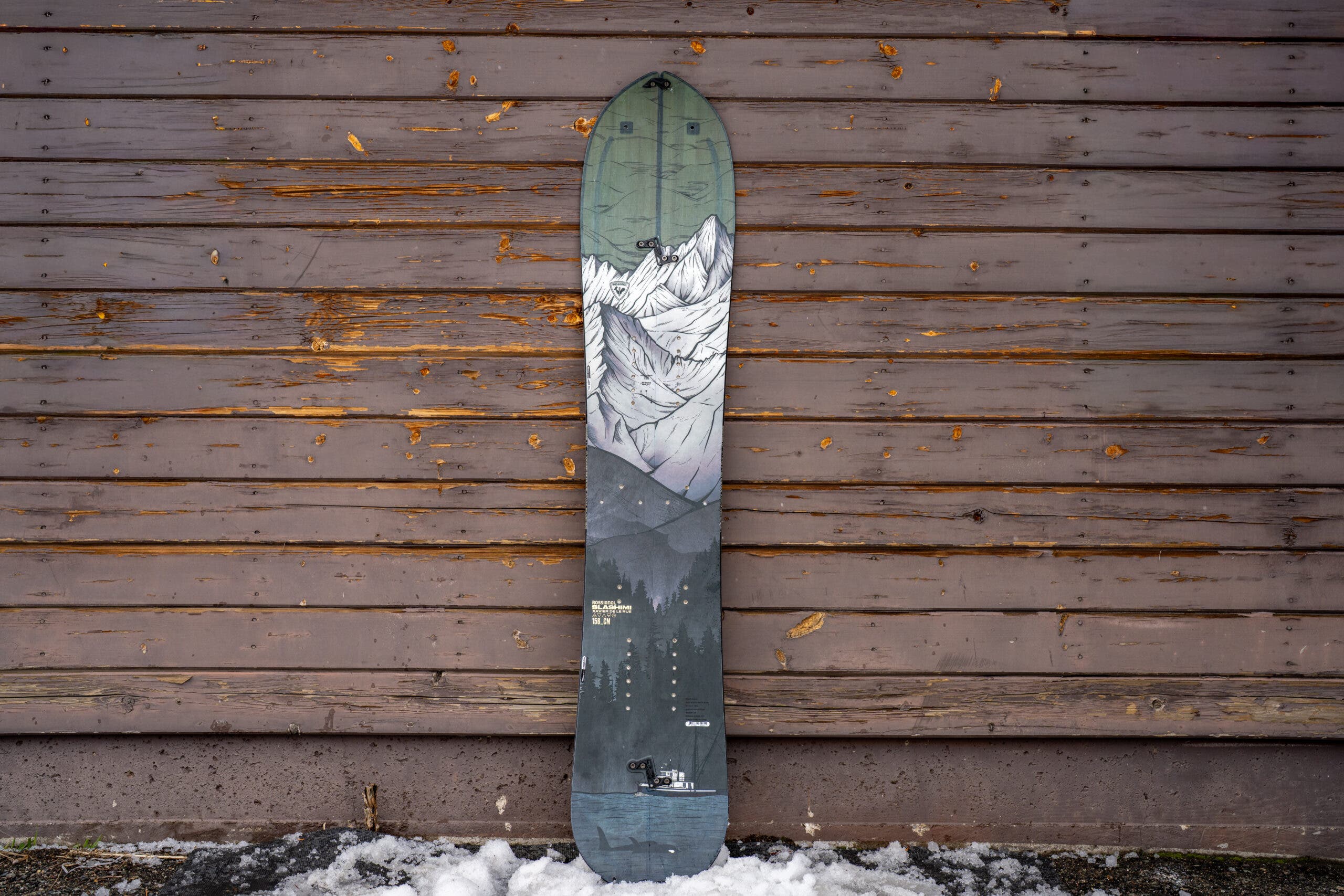
All advanced freeriders were stoked on this shape, although one more playful all-mountain rider felt the stiff, wide nose was sluggish. Our biggest gripe, however, was Rossignol’s continued use of flimsy nose and tail clips that serious splitboarders will begrudgingly replace upon purchase.
ADVERTISEMENT
Paid Advertisement by Backcountry
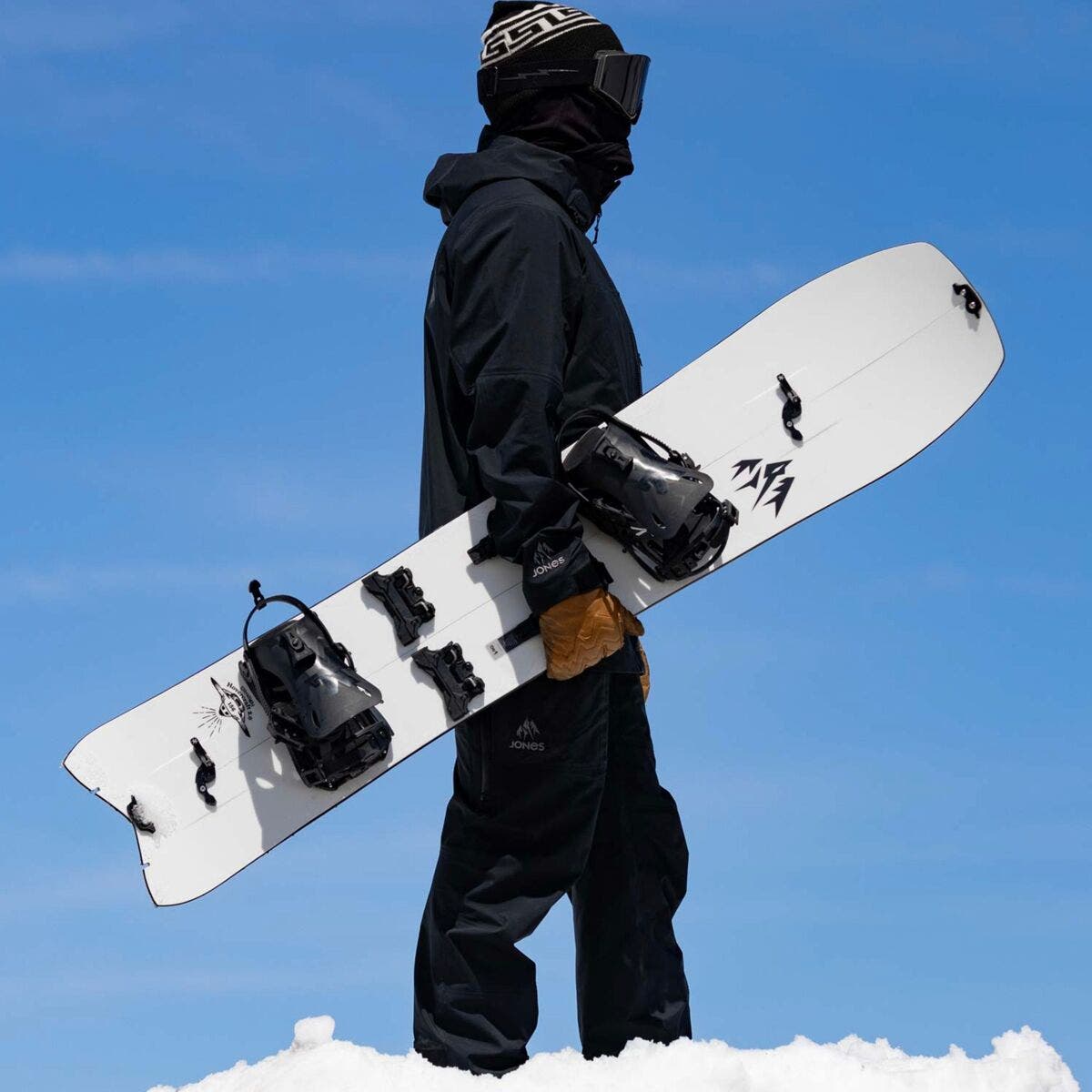
Jones Snowboards Ultralight Hovercraft 2.0 Splitboard
This powder hound helps you stay lighter, faster, and more powerful in the backcountry. It has a Camber profile with a blunt, rockered nose that helps to give you maximum float. Combine that with the fusion core (Jones’ lightest wood core yet) and you’ll be lighter than air while tearing through heavy powder. The board is also made of Koroyd, an aerospace-grade material that cuts out all the chatter underfoot and maximizes your performance. The serrated edges improve grip to help get you up the mountain on the assent and to carve on the descent. The Karakoram Ultra Clips and built-in tail clips also help to simplify your ride for a quick and seamless transition between skinning and riding down. And the cherry on top? Jones Snowboards are made responsibly, free from ink and crafted with recycled and bio-based materials.
Most Durable Freeride Splitboard
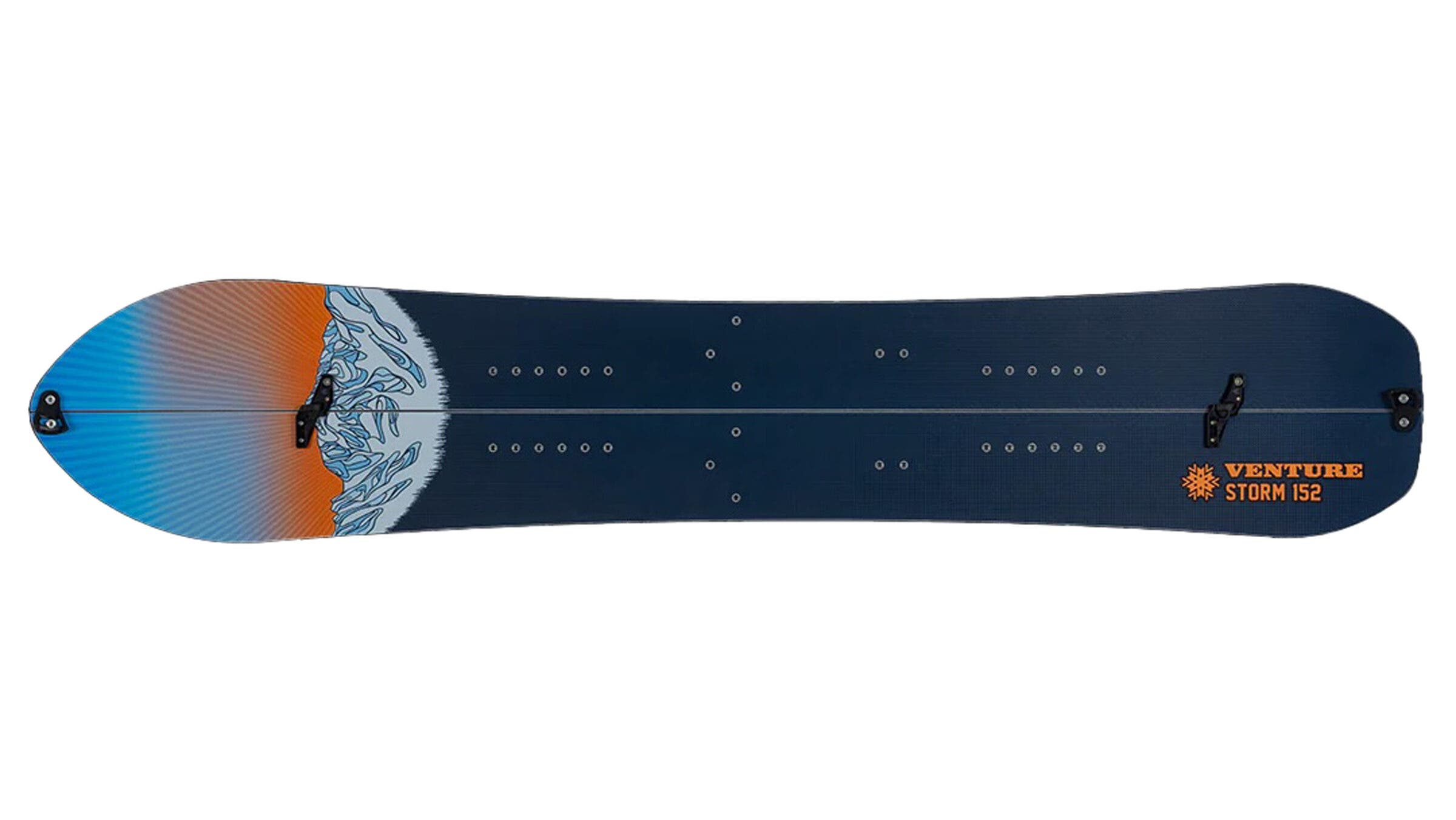
Venture Storm
Weight: 7.5 lbs (157 cm)
Sizes: 152, 157, 162, 167
Profile: Flat base, rockered nose and tail
Pros and Cons
+ Versatile daily driver
+ Bombproof, durable construction
+ Reliable and fun
– Heavier for bigger tours
– Flat profile makes sidehilling tricky
The blizzard-ready Storm features Venture’s notoriously bomber construction: tough P-tex sidewalls and base; cold-rolled, high-carbon steel edges; and a carbonium top sheet that sheds snow like a pitched roof. “If a touring partner ever asks me for a durable split recommendation, I’m sending them straight to Venture,” said a Tahoe tester after touring on the Storm all spring.
The Storm might be burly, but it’s also nimble, fun, and easy to ride thanks to an agile sidecut and a torsionally pliable flex pattern that’s smack-dab between reliable and approachable. Edge-to-edge action, especially on shorter-to-medium-radius turns, is “smooth and natural,” one tester said. “The setback, tapered Storm loves to pivot from the backseat on that stubby, dependable tail, while the rockered nose floats like a dream. It turns quickly, and cuts through tight trees quicker than a buzzsaw.”
Testers also found the nose-to-tail axis stiff enough for popping off windlips, stomping cliff drops, and hop-turning or bombing through steeper terrain. An added bonus of Venture’s construction is inherent shock absorption, and the Storm handles chop well.
ADVERTISEMENT
A con—our biggest gripe—is that Venture’s standard builds are on the heavy side, often weighing a half-pound more than similarly sized competitors, which is noticeable on the uphill. (“Worth it for the longevity,” said a dedicated splitter, echoing the sentiment of testers tired of flimsy builds.) Venture offers a snappier, lighter, and pricier carbon version of the Storm, if 5K+ vert days and multi-day expeditions are in your future. Additionally, some testers prefer traditional camber over Venture’s go-to flat profile for more confidence-inspiring edge hold while sidehilling spring skintracks.
Most Durable All-Mountain Splitboard
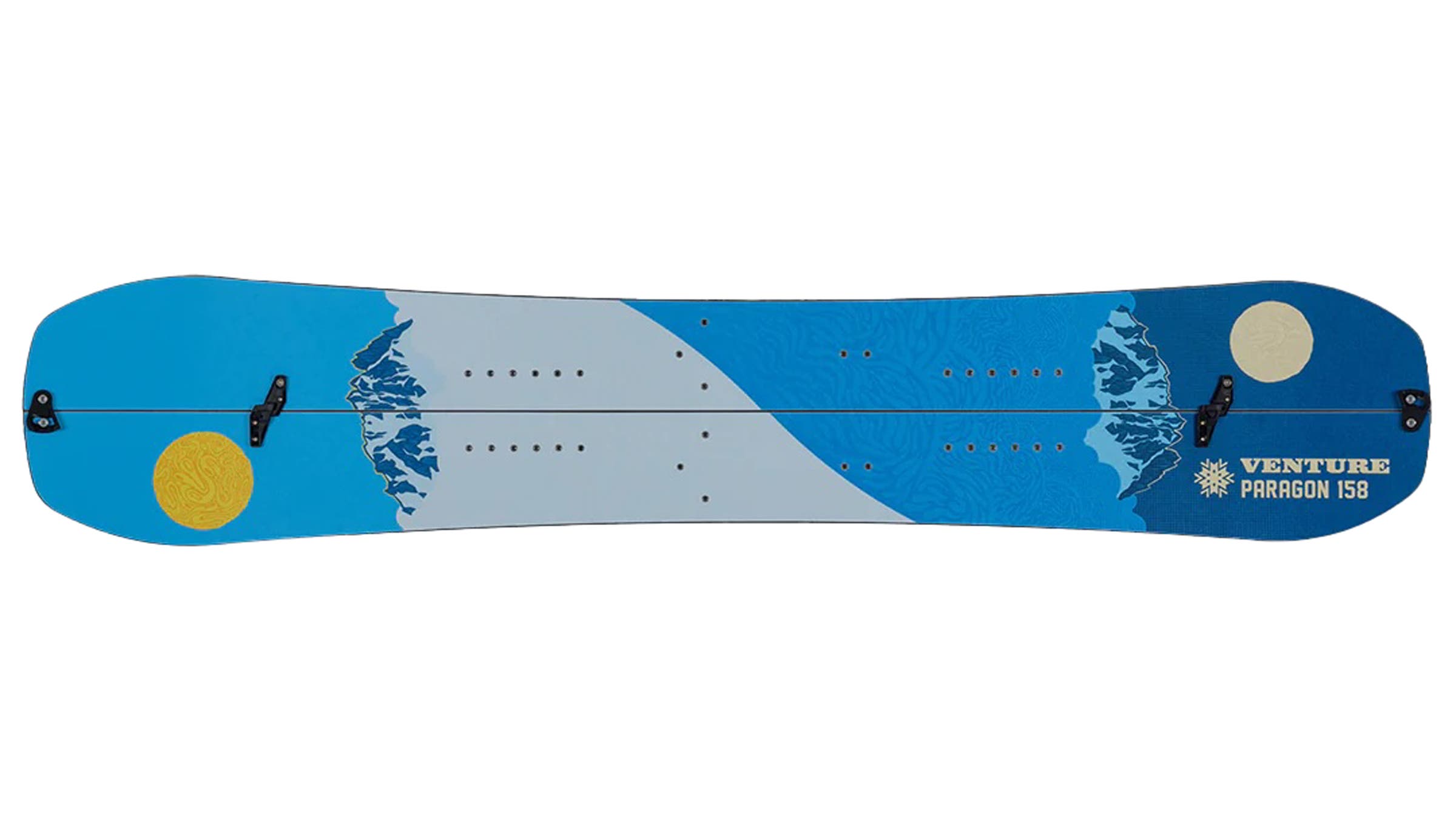
Venture Paragon
Weight: 7.6 lbs (158 cm)
Sizes: 149, 153, 154, 158, 159, 163, 164, 168 cm
Profile: Neutral
Pros and Cons
+ Floats well
+ Rides switch well
+ Durable
+ Excellent size run
– Heavy
Venture’s Paragon should be a top pick for all-mountain riders looking for a reliable-yet-playful do-it-all split for two key reasons: its versatile shape and incredible durability.
It’s a classically-shaped, easy-to-ride, flat-cambered chameleon, able to adapt to any conditions or terrain you throw at it. We were appreciative of Venture’s go-to neutral profile, which transitions from zero-camber underfoot to a gentle rocker between the inserts of the nose and tail. Testers noted that the profile, combined with a semi-tight sidecut, offers a balance of float in powder and dependable edge-hold in hardpack. That said, in technical skin tracks, some testers voiced a preference for traditional camber.
ADVERTISEMENT
The board is directional enough to handle deep snow and freeriding at speed, thanks to a touch of taper from the longer nose to the shorter tail. If you want a board that can float in powder, handle technical freeriding, and still butter, throw tricks, and land switch in more playful terrain, it’s hard to find a better option than the Paragon. When touring days after a storm in the Tahoe backcountry, testers found themselves exploring undulating, freestyle-friendly terrain that begged for airtime, but it was caked in a crust of icy snow that threatened to pitch riders head over heels at every turn. The Paragon was one of few splitboards reliable enough to navigate through the garbage with a semblance of grace, all while encouraging riders to throw little spins, ride switch, and pop off rock-hard pillows without too much concern for landing quality.
Venture crafts some of the most durable decks on the planet, and the Paragon is no exception. After scraping the base on a sliver of barely-exposed rock in the choke of a couloir, the board barely sustained a scratch. Venture goes the extra mile in every aspect of construction, lacing up the Paragon with tough P-Tex (polyethylene) sidewalls, a sintered Durasurf base, cold-rolled high-carbon steel edges, and powder-shedding and hard-wearing Carbonium top sheets.
The one downside to Venture’s burly construction is that it’s relatively heavy, with the 158-centimeter length weighing 7.6 pounds. But for most riders who are hard on their gear, a few extra ounces are well worth a few extra seasons of shredding.
ADVERTISEMENT
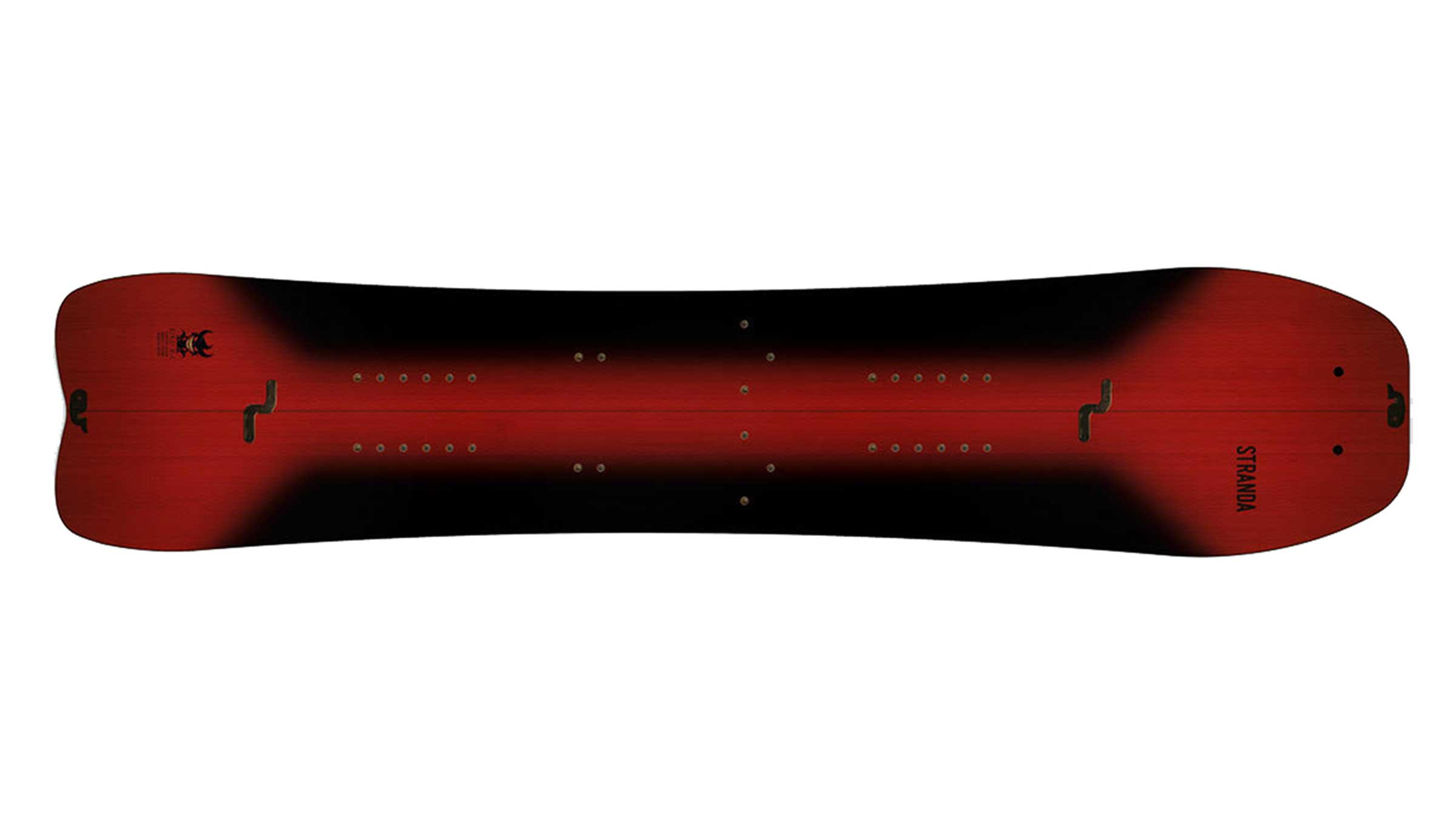
Best Volume-Shifted Splitboard
Stranda Biru
Weight: 7.3 lbs (157 cm)
Sizes: 154, 157 cm
Profile: Camber
Pros and Cons
+ Floaty
+ Stable
+ Excellent switch landing
– Too beefy for some riders
– Minimal size run
Last year, our testers were completely enamored with Stranda’s solid Biru ($690)—a short, fat, fierce, and startlingly stable speed demon with a shoveled nose and moon tail that carves trees up like a lovestruck teenager’s pocket knife. We weren’t the only ones to fall head over heels (figuratively speaking—testers rarely crashed while riding this beast), and the Swedish boutique board builder responded to the overwhelmingly positive response by dropping a split version for 2025.
The Biru split is fairly stiff and stout thanks to a paulownia, poplar, and ash core, as well as triaxial fiberglass and carbon stringers. Combined with the wide chassis (ideal for big-booted riders), the deck isn’t for the faint of quads. One cruisier Tahoe rider called it “too beefy for beginners and lighter intermediates.” But expert chargers like Wasatch splitboarder Kordell Black couldn’t get enough. “At high speeds, the Biru shreds,” said Black, digging the stiffer overall flex pattern and noteworthy dampening that “held tight in chunder and minimized chatter.”
The wide ride provides unreal float in powder, and it’s a consummate carver, too, whether you’re laying trenches in wind buff or snaking through glades. “From corn to pow to couloirs—pick your poison and point it,” continued Black, loving the grip provided by the full-cambered profile and a short sidecut dotted with four hardpack-holding bumps at each insert.
ADVERTISEMENT
Our biggest beef with the Biru is that it’s only available in two sizes: 154 and 157-centimeter lengths. Shorter, lighter testers would love to see more options on the lower end, and we expect to in the coming years, given the split’s initial success.
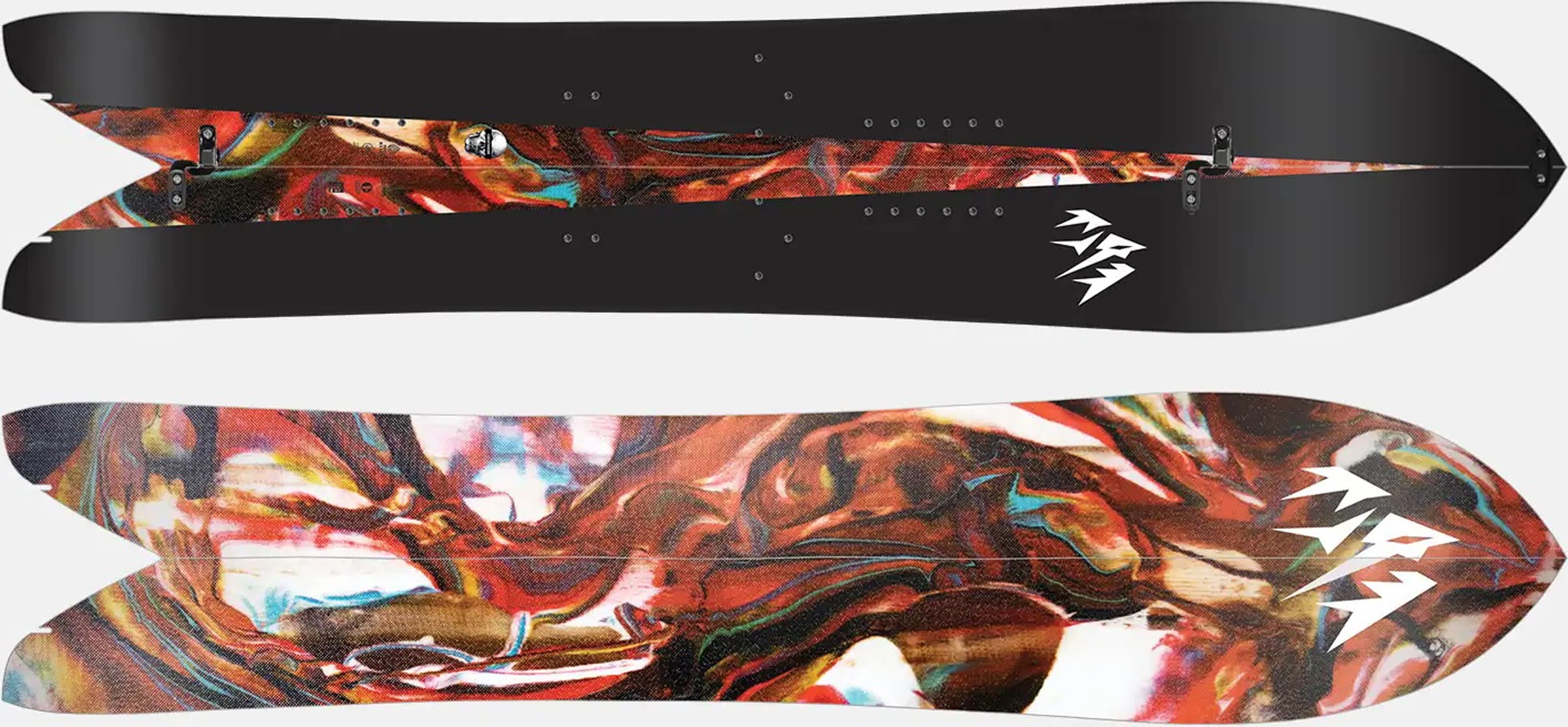
Best Powder Splitboard
Jones Storm Chaser
Weight: 6.8 lbs (152 cm)
Sizes: 152 cm
Profile: Surf camber (camber backseat, rockered nose)
Pros and Cons
+ Buoyant
+ Maneuverable
+ Versatile
– One size fits all
– Limited stance options
Riding the Jones Storm Chaser is a spiritual experience: Tester feedback forms read as if they were written during alpine ayahuasca ceremonies. Take, for instance, this powder-addled poem penned by Tahoe ski shop tech, meditative mountain man, and splitboard tester Anthony Santos: “Intended for the quest of the flow state. A board for the turn, by the turn.” It’s safe to guess that the Storm Chaser’s surfy, slashy, wildly entertaining obliteration of Sierra cement and deep powder is what inspired our snowboard reviewers to sound like Beat Generation poets.
A beloved collaboration between big-mountain royalty Jeremy Jones and surf shaper Chris Christenson, the Storm Chaser solid board has been in Jones’ Surf Series line for nearly a decade now. This year, though, the short, fat swallowtail splitboard received a major update: it got a longer swallowtail, and more impactfully, the old rocker profile has been replaced with good, old-fashioned camber. Combined with a cruisy, spoon-shaped schnoz that’s incredibly buoyant, a tight sidecut, and a medium-flexing poplar-and-paulownia core laminated with pliable biaxial fiberglass, the updated shape is an absolute blast, especially in deeper snow.
“At speed, the Storm Chaser reacts with quick edge-to-edge rhythm for slalom-like turns,” waxed Santos, speaking to the dexterity of deeper sidecut and the rollable shape of the concave, spooned nose. Ripping through powder-laden trees on the Storm Chaser puts the “send” in transcendence—you have massive float thanks to the rockered nose, while the three-dimensional contours make flowing from rail to rail effortless.
ADVERTISEMENT
This year’s camber update and the lengthened tail help the Storm Chaser find better purchase in variable conditions, too. “Added camber gave confidence in turns and support when needed,” commented Santos, who also called the tail “fun for small to medium airs and pow ollies.” However, most testers agreed that while the new Storm Chaser is capable in bad snow, it’s much better suited for soft and smooth conditions. “The small tail can give out and put you on the Jerry of the Day highlight reel,” joked one, also finding the tail a limiting factor in chop or jump-turning in steeper lines.
Testers did have a couple more complaints, namely limited puck positioning based on the proximity of the toe-piece inserts and tricky trail-breaking given the massive nose. Additionally, the update is only available in a 152-centimeter length this year, but we expect to see a wider size range in the future. However, when considering the Storm Chaser for what it is—a quiver swallowtail designed for ecstatic powder surfing that’s more versatile now than ever before—every tester would happily add this deck to their splitboard rotation.
How to Choose a Splitboard
Buying a crappy resort board can result in eternal mediocrity. Buying a crappy splitboard can leave you stranded deep in the backcountry. Here are six tips to keep in mind.
Buy, Don’t Build
The DIY split kits that slowly sparked the split revolution are still cheaper than splitboards these days—but not by much. A purpose-built split with inner edges and a split-specific flex pattern will ride better and last longer than epoxied counterparts. Buy used before you DIY. Or, go the DIY route for fun at your own peril, knowing that you may end up with a garbage product and need to buy a new split anyway.
ADVERTISEMENT
Budget for Bindings
Split bindings are arguably more critical to your enjoyment than a splitboard. Bindings are the glue that keeps your splitboard together and allows you to transition between touring and riding modes. The saying “a barn door rides well in powder” is true: any modern split will perform decently in excellent conditions, as long as it’s sized appropriately (more on that below) and you ride with speed. Old, raggedy bindings, on the other hand, will break down and leave you with nothing but expletives to keep you warm as night falls. Opt for a reputable brand with a proven interface.
Quiver Questions
A decade ago, a split quiver was unthinkable for all but a few. As the sport has boomed, riders have expanded their minds—and their board rack—acquiring different splits for different conditions and objectives. Nothing feels better than waking up to a powder day, plucking the right board from the rack, and cruising to the trailhead. But that’s not a reality for most splitboarders, especially newcomers.
ADVERTISEMENT
If you’re new to the game, start with a quiver-killer. It’s more important to have a split that can handle everything decently than one that excels at a specific riding style or terrain type. Don’t start thinking about expansion until you fall in love with the sport and put your time in on the skin track for a season or two. A carbon gun for mach-10 turns in Alaska? Sounds good. A short-fat twin for popping buttery 180s in BC pillow lines? Why not! These boards are fun additions, but they’re not what you want when you’re just starting out.
Size Smart
Size your main split as you would a freeride board that you expect to take in powder. If you size too small, you’ll lose precious float. Size too big, and you’ll lose maneuverability. If you’re using weight to inform your sizing decisions, remember that you’ll always be wearing a backpack loaded with avalanche safety gear, water, and skins. Don’t make it harder than it needs to be. When in doubt, size up a touch. That said, always pay attention to manufacturer recommendations.
Shop for Skins Simultaneously
Many board companies sell skins as an add-on. If they do, jump on it, as the skins will likely be pre-cut to fit your specific board. They can cost a little more than aftermarket options, but they’ll save you a headache and ensure the fit is solid—or at least close to solid. If you aren’t able to find a set of skins ready-made for your specific splitboard, pay close attention to skin width, length, and tail-clip style when you’re on the hunt. Make sure the width of your split is less than the width of the skins. Trim-to-fit skins generally work for a range of sizes. If you’re in between sizes, size down for a lighter skin or up for more grip.
ADVERTISEMENT
Get Educated
After buying your split and before you put it to use, hop on your computer, search for local avalanche classes, and sign up. Do it. Just do it. If you’re itching to put your split to the test before you have taken an avalanche safety course, check your local resort: many resorts have uphill travel policies that enable skiers and splitters to tour up maintained, groomed trails. This is a perfect setting to practice your skinning technique and to get a feel for setting up and using your gear without venturing into avalanche terrain.
ADVERTISEMENT
Additionally, many guiding ops offer one-day 101 classes that will introduce you to avalanche safety basics and touring gear. They’re a helpful stepping stone if you’re intimidated at the thought of jumping straight into an Avalanche Level 1 course.
How We Test the Best Splitboards
- Number of testers: 15
- Number of splitboards tested: 13 (not including 19 last year, which brings total to 32)
- Passport stamps collected: Norway, Japan, Sweden, Italy, Canada [Combination of this year and last year. Just Canada this year]
- States where we tested: California, Nevada, Utah, Washington
- Hardbooters: Three
- Longest mission: A ten-day point-to-point winter camping expedition in Finnmark, Norway, with Upguides
- Deepest powder: A couple thigh-deep days in Hokkaido with aptly named Whiteroom Guides
- Most creeks crossed on a winter camping trip in Tahoe: Approximately 17, but we lost count
- Biggest core shot: 6 inches long
The bulk of our splitboard testing this past winter took place during our annual Snowboard Test at Kirkwood Mountain Resort in March 2025. Located just south of stunning Lake Tahoe, Kirkwood is world-famous for its freeride terrain. In fact, the resort regularly hosts freeride competitions off Chair 10, also known as “The Wall.” Just last year, this zone was the stage for a Freeride World Tour qualifying event, the Junior Freeride Championships, and even a Natural Selection Tour duel.
Needless to say, the terrain at Kirkwood is varied, steep, and primed for splitboard testing. Due to the remote nature of the resort, it’s also typically uncrowded.
ADVERTISEMENT
However, the most important aspect of our splitboard analysis occurs outside of ski resort boundaries, where riders can put splits to the test both on the uphill and the down in true backcountry conditions. Kirkwood’s not lacking in this department: It offers some of the best lift-accessed backcountry shredding in Tahoe—and the Lower 48, for that matter. Our testers happily exited the resort at designated backcountry access points before exploring mind-blowing steeps, chutes, cliffs, and proper freeride terrain.
Our splitboard testing didn’t stop after we left Kirkwood, and we sent high-performing splitboards and splitboard gear home with key testers, because we value long-term testing. Testers put splitboard gear to the test on the skintrack, both at Kirkwood, at home in Tahoe and across North America, and further afield in Canada, Japan, and beyond.
Long-term testing is particularly important when it comes to touring gear, as the backcountry is notoriously ruthless on equipment. The last thing our testers want is to be deep in the wilderness with shoddy gear. As such, we assessed the strengths, weaknesses, and longevity of boards, boots, bindings, and backcountry accessories over the months leading up to the test and in the months that followed. In fact, we have actually been testing some of the gear we’ve highlighted for two or even three seasons, allowing us to better gauge durability and longevity.
ADVERTISEMENT
Once the snow melted, I—Outside’s Snowboard Test director—cataloged detailed test forms filled out in the wake of these adventures. I cross-referenced the best new splitboards of 2026 with our favorite carry-over splitboards from previous seasons, made our top selections, and finally compiled the reviews of the best splitboards of 2026 included in this guide.
Meet Our Testers
Drew Zieff is a Tahoe-based freelance writer and a lifelong snowboarder. In addition to directing Outside’s snowboard test, a role he’s handled since 2016, he directs Backcountry Magazine’s splitboard coverage and nerds out on snowboard gear and travel for REI, Gear Junkie, and Forbes, among others. He spends his winters testing gear in his backyard backcountry zones or up at Palisades when he’s not chasing stories and storms around the globe.
Anna Doucette is a lifelong snowboarder who’s been a member of the American Association of Snowboard Instructors for two decades. All of that instructing experience translates to the backcountry, where her shred fundamentals and group management skills are as strong as they come. She’s also spent so many years articulating difficult-to-grasp movements to aspiring riders and fellow instructors that she’s a natural and extremely articulate gear reviewer.
A second-year tester who’s called Tahoe home for the last decade, Andrew Allisandratos is a splitboard guide for local outfit Blackbird Mountain Guides. A welcome addition to our test team, he’s equally happy hammering bell-to-bell resort laps on splits and trying to find their breaking point, or leading a tester squad on a sidecountry excursion.
Truckee’s own Jenna Shlachter is as brilliant on the hill as she is off it–which is saying something, she’s a Doctor of Psychology, after all. When she’s not on the clock, she’s usually on her snowboard, ripping everything from park to backcountry barrels. Her trophy shelf needs regular reinforcement, as every year she seems to add banked slalom trophies to her already impressive collection. Lucky for us, Shlachter is also an unabashed snowboard nerd, and she’s been a key contributor to our snowboard test for the last few seasons.
The only thing more eclectic than Chris Cloyd’s riding style is his resume. A former touring musician, former personal trainer, and still-holding-on endurance athlete who lives in June Lake, CA, Chris Cloyd spends his winters splitboard guiding, teaching AIARE courses, and handling radministrative duties for Blackbird Mountain Guides. In his free time, you can find him crushing couloirs deep in the Eastern Sierras. A fan of strong coffee and heavy metal who often combines the two on his way to shred, Cloyd is not remotely gentle on his gear—he lives to thrash.
