Charlize Theron has just placed her right hand on a crimp when her foot slips.
Suddenly, she’s dangling from the rock by a few mere fingertips, hundreds of feet above the ground. Not only is her character, Sasha, free soloing (climbing without the protection of ropes), but she’s barefoot, and she has bruises and small streams of blood on each foot to prove it. Her jeans are filthy; her blonde hair hangs in loose, greasy strings; bruises speckle her thin arms, and there’s a patch of blood above her right eye.
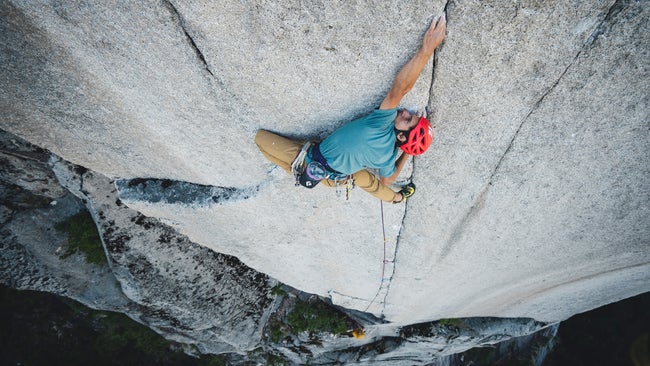
With a grunt, she swings her right foot up high, placing it in line with her ribs. Her fingers search for a better hold and jostle a few pebbles that tumble to the ground below. Finally finding a better place for both hands, she grunts again as she hauls herself up a couple more feet to a crouched position, and she begins to traverse beneath a rock roof. If she’s going to survive, she’ll need to send the overhang, and overhangs have given Sasha trouble before. Slowly, she inches up, sometimes with a dynamic reach, other times with a more subtle foot placement, gradually climbing higher and higher.
Much of ‘Apex’ was shot in the remote backcountry, including Australia’s Blue Mountains. The crew would sometimes hike for hours to reach set before spending more hours climbing or running. (Photo: Kane Skennar/Netflix)
This is only one of many physically grueling scenes from Theron’s upcoming film Apex. In it, Theron plays a grief-stricken climber and kayaker who travels to Australia to spread the ashes of her fiancé, played by Eric Bana. There, she meets Ben, a charming—and chilling—Taron Egerton. At first, he comes across as a friendly local, offering suggestions for under-the-radar rapids to run. It isn’t long, however, before Sasha finds herself literally hunted by psychopath Ben in a nail-biter that’s set to stream on Netflix on April 24, 2026.
Apex is directed by Baltasar Kormákur, who is no stranger to films that star the outdoors. He’s directed and produced other tense survival movies, like Against the Ice (2022), based on the true story of a 1909 Greenland expedition and starring Nikolaj Coster-Waldau and Joe Cole, and Everest (2015), which depicts the real-life 1996 tragedy on the world’s highest peak and features names like Keira Knightley, Jake Gyllenhaal, and Jason Clarke.