Published May 1, 2004 12:00AM
Fitness Is an Adventure
Here's the deal: Ten breakthrough workouts from the best fitness experts and coaching pros around. Great tips for nutrition, gear, and fine-tuning your form. Killer ideas to keep you motivated. Ten high-performance meals you can prepare in less than ten minutes. It's everything you need to start fresh, keep your options wide open, and realize your fitness dream
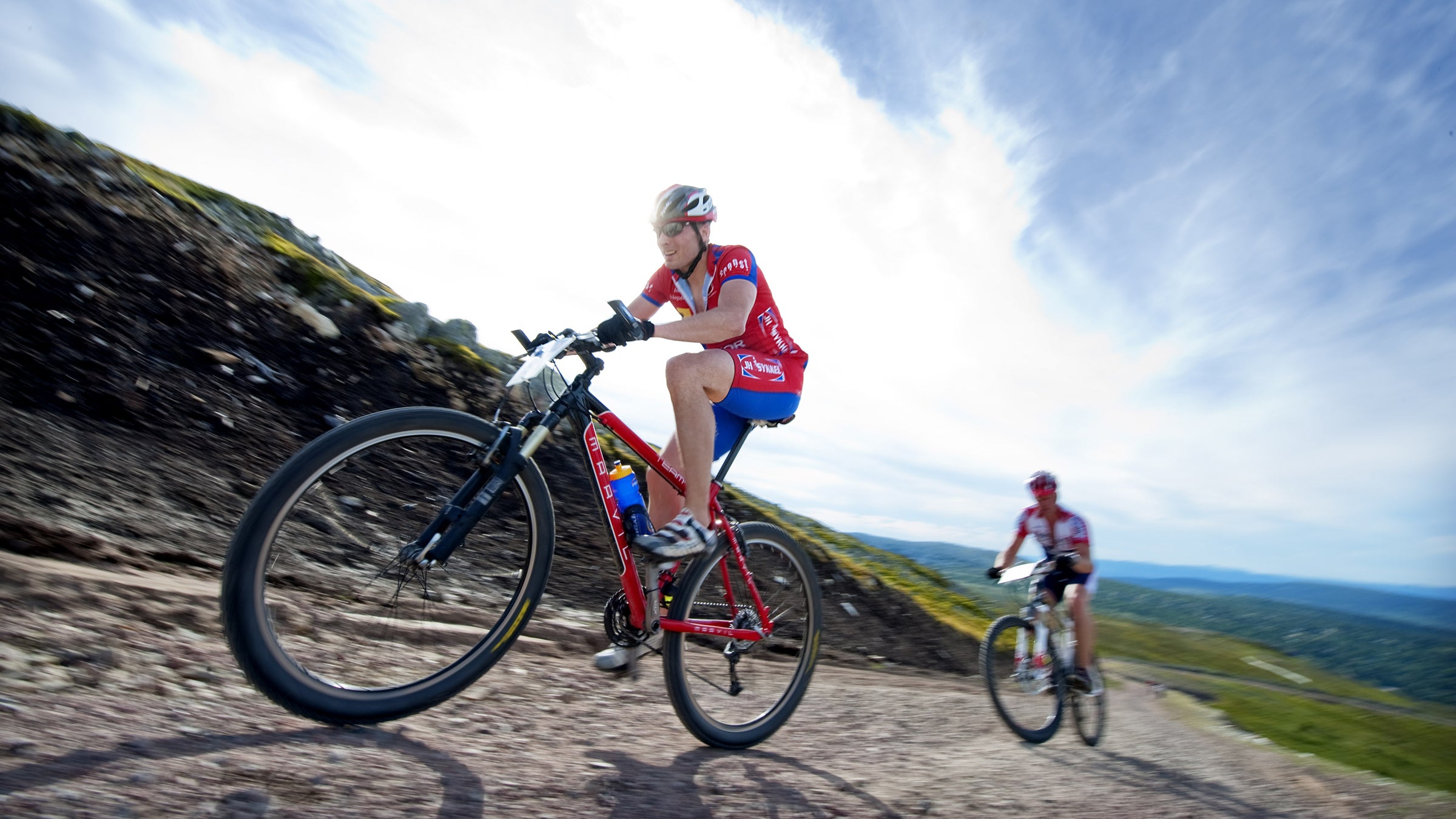
Don't forget the reason you're working on athleticism—being an athlete is fun. (Photo: Trysil/<a target="_blank"href="https://www.flickr.com/photos/trysil/">Flickr</a>)
It's all about freedom.
Been chained to a one-dimensional training plan? Has your adventure prowess devolved into a plodding routine of joyless duty? Friends, it's time for a regimen change in America; it's time to set yourself free. “To be prepared to do a variety of activities, you need to be athletic and variable in your training,” says Scott Bennett, trainer to Olympic track-and-field athletes. “You need to keep the body challenged and not get locked into one static method of exercise. That way, you'll be able to explode when you want to.”
Whether that means trail running, climbing, biking, kayaking, or whipping yourself into beach-worthy shape, we've laid out the tools to make it happen. Give credit to the Outside Fitness Brain Trust the very best trainers, coaches, and athletes, all with decades of experience in their fields who helped us compile the ten essential systems of athleticism and ten corresponding workouts to improve your strength, skill, and stamina. This team isn't just blowing smoke up your shorts; the exercises, drills, and techniques are athlete-tested and field-proven, whether your goals are endurance, speed, power, flexibility, recovery, or all of the above. We present them in optimal order—for instance, it helps to train smaller support muscles before maximizing your bigger power centers—but you can mix and match these workouts in any arrangement to meet your needs.
What—you just wanna get buff? Please note world champion surfer Andy Irons, our fitness adviser and cover icon: ripped, yes, but also in the kind of shape that lets him play hard every day. “And going out every day is one of the best ways to stay motivated,” Irons says. Cantaloupe biceps and cobblestone abs are great, but they don't mean much if they don't open the door to a lifetime of fun. Think of it as your freedom physique. Now, let's get started.
ADVERTISEMENT
Step One: Endurance
Widen Your Horizon: What defines endurance? How about running six-minute miles for an entire marathon with a heart rate of 155—a number most people hit on a light jog? That's what 34-year-old Tim DeBoom, two-time Ironman world champion, can do. The secret resides in a body that's become hyperefficient at burning oxygen to power athletic activity and equally efficient at removing stride-slowing lactic acid. The fuel efficiency was cultivated over seven years of consistent, focused training; the superior lactic flush comes from a few weeks of race-pace work prior to competition.
Ed McNeely, a strength-conditioning coach at Rowing Canada who has worked with 31 Olympic athletes in 17 different sports, explains the success of DeBoom's approach. “You can't gain endurance by training at your limit all the time,” he says. “You'll exhaust yourself before your body creates the mechanisms needed to boost its efficiency.”
ADVERTISEMENT
Ideally, says McNeely, you should develop your aerobic foundation first and save speed work for last. “You need to spend at least six weeks exercising four times a week to build a base,” says McNeely. Then, like DeBoom, you'll go faster and farther each year.
The Workout: To build bonk-proof endurance, plan your training season in the following phases.
- Base building: This phase should take up the first four-fifths of your training schedule, whether it's for an active summer season or a big event, like a marathon. The pace for building base is one that allows you to talk during a workout. Four times a week, aim for light but sustained workouts lasting at least one hour for runners, rowers, and swimmers, and two hours for cyclists.
- Threshold training: Spend the last fifth of your conditioning schedule folding in high-intensity efforts at your lactic-acid threshold (LT), “the point where lactic-acid production exceeds its removal,” says McNeely. That calls for up to, but no more than, six weeks of running for one hour, working in five- to ten-minute intervals. Start with ten minutes of recovery between each interval; by week six, recovery time should shrink to five minutes. By pushing into a high-intensity zone, you'll gradually knock back your breaking point. “By now, I know my threshold by feel,” says DeBoom, “and I'll hover right below it during a race.”
Toolbox: For a total-body endurance workout with zero wear and tear, hop on an indoor rower. It'll ramp up your heart rate, and strengthen legs, arms, shoulders, back, stomach, and butt.
ADVERTISEMENT
Step Two: Core Strength
Stay Centered: “People think core training is abdominal training,” says San Diego–based trainer Paul Chek, who's worked with surfer Laird Hamilton, snowboarder Shaun White, and volleyball legend Gabrielle Reece. “In reality, the core is the functional link between the arms and legs. If you don't have the capacity to transfer force from your legs to your arms, your performance in almost every sport fails.”
As a rule, any standing exercise, whether it involves squatting, bending, lunging, pulling, twisting, or stepping, works the core, meaning that anything you do on your feet will be vastly improved by a well-developed torso.
ADVERTISEMENT
The Workout: Twice a week, complete eight to 12 reps of the following exercises to develop core power.
- Cable wood-chop: Stand with your right shoulder facing a weight-machine cable. Positioning the handle up high, grab with both hands and, with knees slightly bent, pull down from upper right to lower left in controlled movements. “Keep your arms straight and you'll keep the load on your core,” says Chek. Switch sides and repeat.
- Straight-arm lat pull-downs: With your back to a cable-machine lat station, arms straight, standing with knees slightly bent, hold the bar about head height in front of you, then push down in a vertical plane until the bar reaches your legs. “Keep your abdominals tight and don't tip forward,” says Chek. When your arms reach the low point, slowly release the bar back upward, keeping your arms straight.
- Russian twists with stability ball: Rest your upper back, shoulders, and head on a stability ball, with your hips held parallel to the floor. Grasp a medicine ball in both hands with your arms straight out above you, rotate your trunk from the center to the right, back to center, then to the left, so the ball rolls beneath you. Do it swiftly enough that you roll onto your shoulder on each side. Don't let your hips drop. Keep your chest, hips, and knees in a straight line throughout.
- Resisted stability-ball crunches: Lie with your back draped over a stability ball. Let your head relax toward the floor, and anchor your feet under a fixed object. Hold a medicine ball under your chin and (keeping your tongue on the roof of your mouth to activate the neck flexors) curl forward just far enough to tighten your abs; slowly let yourself back down.
Toolbox: The medicine ball has remained an exercise staple for decades, and for strengthening your core, there's nothing better. Medicine-ball drills develop the rotation and explosive power that are essential to many sports. For the majority of athletes, six to ten pounds is all you need.
ADVERTISEMENT
Step Three: Flexibility
Bend, Don't Break: Stretching qualifies as a workout if you follow the gospel of active stretching preached by Jay Blahnik, a fitness consultant to Nike and author of Full-Body Flexibility. “Having someone lift my arms behind my back may make me more flexible, but it isn't as valuable as having the strength to put them there on my own,” says Blahnik. “That's called mobility, and that's what we're all really after.” It's mobility that helps us when we're in a tight jam on a rock wall or in a Class IV hole.
The Workout: Three times a week, do the following active stretches in continuous movements ten times. Hold each passive finish for 20 seconds.
- Glutes: Lie on your back with your arms at your sides and knees bent, and place your right ankle across your left knee. Lift your left leg until it's at a 90-degree angle to the floor. In that position, rotate left leg in ten slow, small circles. Repeat on the other side, with left ankle on right knee. Passive finish: Grab your elevated leg behind the knee (keep other foot on the floor), pull it toward your chest, and hold. Repeat with other leg.
- Hamstrings: Lie on your back with legs slightly bent, feet flat on the floor. Lift your right leg toward your head as far as you can, keeping the leg straight and the heel flexed. Lower and repeat with the left leg. Passive finish: Grab the elevated leg behind the knee and pull it toward your chest, keeping the leg straight. Repeat with your other leg.
- Back: Stand with feet shoulder width apart. Roll your shoulders forward, round your back, and reach out as if you're going to hug a tree. In the same motion, bring your arms slowly back to your sides. Passive finish: Stand like a rag doll. Let shoulders, arms, and head roll forward. Focus on fully relaxing your trapezius muscles.
- Hip flexors: While standing, extend one leg in the air behind you as far as possible by contracting your glutes. Keep the other leg and your body straight and upright. Switch legs. Passive finish: Step into a lunge, straighten the rear leg, and hold. Repeat on other side.
- Quads: Stand and lift one heel toward your rear, while stabilizing yourself on a chair. Switch legs. Passive finish: Reach back and grab one ankle, pull it toward your rear, and hold. Repeat with other leg.
- Abdominals: Stand, place your hands on the small of your back, and push your hips forward while slowly arching backwards. Passive finish: Lie back on a stability ball, lace your fingers behind your head, and plant your feet on the floor. Drape your head and shoulders over the ball. Hold for ten breaths.
Toolbox: A stability ball “can help with flexibility,” says Mike Bracko, a Calgary, Canada–based exercise physiologist and member of the American College of Sports Medicine. “It takes you out of the normal realm of stretching—which can be boring—plus it allows you to develop balance at the same time.”
ADVERTISEMENT
Step Four: Integrated Strength
Stand Your Ground: So you can bench-press 210? Now stand up and try pushing that kind of weight. If you've ignored integrated strength—the kind of strength you need in the real world—you're gonna have problems. Mike Clark, president of the Calabasas, California–based National Academy of Sports Medicine, makes a living teaching the Phoenix Suns and other pro athletes strengthening exercises that develop linked muscle systems rather than isolated muscle groups. “By focusing on your body's stabilizer muscles, integrated fitness training corrects weak links before they turn into muscle imbalances that render your strength ineffective or, worse, set you up for injury,” Clark says. Don't chuck out the bench press; just make it part of a more farsighted training plan.
The Workout: To develop integrated strength, Clark advises that you exercise in multiple planes of motion. After a five-minute cardio warm-up, try the exercises below, completing three sets of 12 reps for each, three times a week. Start with low weight and work up to heavier amounts once you're comfortable with the technique:
- Stand next to a cable machine with the handle positioned near your feet. Squat, grab the cable with both hands, and then stand and pull the cable up toward your opposite shoulder, as if starting a lawn mower. Turn around and repeat on opposite side.
- Face the cable machine. Position handle low between your legs and stand, lifting weight by engaging legs and hips.
- Stand facing away from the cable machine, placing one leg in front of the other. Holding separate cable handles at chest height, press weight forward.
- Face the cable machine with one foot in front of the other. Grasp two cable handles positioned at chest height. Pull handles to your chest.
- Stand on one leg, facing cable machine and holding cable handles at shoulder height, palms facing in. Press the weight overhead, ending the lift with your palms facing out. Complete six reps on each leg.
- Repeat number 5, adding a biceps curl to the overhead press.
- Face away from the cable machine. Position two cable handles waist high. Lunge forward, keeping your back straight and handles low at your sides. Step back. Do 12 reps on each leg.
Toolbox: The Free-Motion Cable Cross features multiple positions for a wide range of exercises. “The beauty of cable machines is that you can train in the same position as you perform your activity,” says Tyler Wallace, a performance-enhancement specialist for the National Academy of Sports Medicine, in Calabasas, California. For example, kayakers can put together a full menu of upper-body exercises while seated, just as they would in a boat.
ADVERTISEMENT
Step Five: Classic Strength
The Big Push: If you want to get stronger, you need to hit the weights. Just ask 34-year-old Joe Decker, record holder in the Guinness 24-Hour Fitness Challenge, which involved such Herculean feats as performing 1,100 push-ups in a row. Despite his current status as an outdoors übermensch, acquired through dizzying endurance events like the 135-mile Badwater Ultramarathon, Africa's 152-mile Marathon des Sables, and the eight-day Raid Gauloises adventure race, he still preaches the gospel of pumping iron. His weight-room M.O., though, is brief and intense. “You have to take each lift to muscle fatigue and then force yourself to do two more,” says Decker. “Otherwise you're wasting your time.” Follow his advice and you'll turbocharge muscle growth, drive up your metabolism, and increase your bone density, while shoring up your joints.
The Workout: Decker recommends a three-days-a-week strength regimen, with different large-muscle groups getting the attention on alternating days—chest, shoulders, and triceps one day; back, biceps, and legs the other. Do two sets of ten reps, with enough weight so that “the last two are nearly impossible,” Decker says. Many people are already familiar with these classic lifts, but those needing directions can consult www.outsideonline.com/workouts.
- Chest: Bench press, incline bench press, and dumbbell chest flies.
- Shoulders: Military press, dumbbell raises to front and to side.
- Triceps: Cable press-downs and dips.
- Back: Seated cable-row, lat pull-downs (alternate between overhand and underhand grips; complete four sets of 15 reps).
- Biceps: Standing straight-bar curls, dumbbell hammer curls.
- Legs: Barbell squats, leg extensions, leg-curl machine, calf raises.
Toolbox: Dumbbells are crucial for any strength-training program, but a full set of 20 will quickly swallow up most home gyms. Try the compact Bowflex SelectTech 552 Dumbbells. One pair adjusts quickly for loads between 2.5 and 52.5 pounds, while occupying a space about the size of a large pizza.
ADVERTISEMENT
Step Six: Explosive Power
The Crux Move: “You can learn to lift a lot of weight slowly,” says Scott Bennett, trainer to Olympic shot-putter Andy Bloom, “but when it comes to applying it to a sport, what sport requires you to move in slow motion?” In most sports, the difference between success and failure can often come down to an explosive burst of power. This is where Bennett's Olympic lifts come into play. Do them right and you'll be able to take all that strength you acquired in the weight room and apply it in the field, whether you're going up for a dunk or breaking away from the peloton.
The Workout: For superhero moves, you need to master the power clean. This dynamic lift recruits legs, hips, glutes, back, stomach, and shoulders in one fluid exercise that will buttress your quickness and power. Newbies should build up to a power clean by prepping their muscles to handle the four-part process. Three times a week, over the course of three weeks, practice your form, but sans weight during week one. Move gradually to an unweighted barbell in weeks two and three, and a weighted bar by week four. Meanwhile, you're going to build strength via squats, dead lifts, stiff-legged dead lifts, and upright rows (two sets of ten reps for each; check our Web site, www.outsideonline.com/workouts, if you need guidance for these).
ADVERTISEMENT
After the first week, add two sets of four jump squats—using no more than half your body weight on the barbell and springing off the floor at the top of the lift.
In week three, add the following plyometric drills to the routine: ten forward and backward jumps, then two sets of four hops up onto a two-foot-high box. By the fourth week, you'll be ready to drop the preparatory lifts and drills and replace them with two sets of eight power cleans. The Power Clean:
- Start with feet shoulder width apart. Squat down and grab the bar with hands shoulder width apart, keeping your back straight and eyes straight ahead.
- With your abs tight, stand upright using legs (not lower back, which remains straight) while shrugging the bar upward. Carry momentum up onto the balls of your feet, hoisting the bar past your waist.
- Squat under the bar, flipping your elbows outward to catch weight on the very top of your chest, then stand.
Step Seven: Speed
The Rush: Against all odds, five-foot-eleven-inch former Buffalo Bills and Green Bay Packers receiver Don Beebe finally got a Super Bowl ring out of the NFL, thanks in large part to his blazing speed. In 1998 he set up the House of Speed, a suburban Chicago clinic where he's bestowed the gift of Hermes to more than 10,000 athletes. “When I first started, people thought you couldn't teach speed, but you can,” Beebe says. Good form is the key.
Start with this simple formula: Speed equals stride length times stride frequency. In other words, don't think of speed only in terms of horsepower. Think of speed in terms of revolutions per minute. The higher your RPMs, the faster you go. It's the same principle that Lance Armstrong adopted on his bike. Instead of mashing on his pedals, Lance bumped up his cadence and now spins his way to victories. It's why top-flight track sprinters' feet never seem to touch the ground.
ADVERTISEMENT
The Workout: To perfect your form, fold this drill into your interval workouts five times a week. On a 30-yard stretch of track, road, or field, walk briskly while driving your knee up until your thigh is parallel to the ground, then snap it back down. For your second 30, move to a “funny run”, mimicking the same stride at 50 percent of a full sprint. Do a third at 60 percent of max, a fourth at 70 percent, and a fifth at 80 percent. “At 80 percent, a lot of people start to lose the knee drive,” Beebe says. It can take months to go from 50 to 100 percent, where, if you watch your form in slow motion (highly recommended—recruit a pal to videotape you), you'll look shockingly like Maurice Greene and Marion Jones.
If you want running speed, try the “funny run” drill. “Most people land on their heel and waste time rolling onto the ball of their foot,” says Beebe. “You want to force it downward into the ground, landing on the ball of your foot right under your hip, to reduce the foot's time on the ground.”
- Drive your right knee forward into your stride until your thigh is almost parallel to the ground.
- Kick your lower right leg in front of your knee, toes pointed up, as your foot drops to the ground.
- “Paw” your right leg back to the ground, landing on the ball of your foot, directly beneath your hips. At this point, the knee of your left leg should be driving forward.
ADVERTISEMENT
Step Eight: Eccentric Strength
Take Total Control: “The ability to reduce force is one of the biggest deficiencies I see at all levels,” says Vern Gambetta, head of Gambetta Sports Training Systems, in Sarasota, Florida, which conducts seminars for NBA and NFL coaches on state-of-the-art training techniques. He's talking about eccentric strength—which works something like the brakes on a car, providing the counterforce you need to control speed, direction, and impact. It's what softens your landing after a dunk, lets you turn on a dime, and sucks up 3,400 vertical feet of bump skiing at Vail.
“Eccentric contractions are the key to efficient mobility,” says Gambetta, “because if you can't absorb the shock of your own body weight, you can't perform.”
ADVERTISEMENT
The Workout: Developing eccentric strength requires a two-pronged approach: slowly lowering weights in the gym, and drills designed to strengthen your rebound. Complete these exercises before any target activities, such as a city-league playoff or your first day on the slopes, and then twice a week during intermittent two-week periods throughout the year. And take note: “You'll need a good base of general strength before you even attempt them,” counsels Gambetta. During your weekly Classic Strength workouts, slow down the lowering phase of each exercise rep so it lasts at least four seconds. Do weights one week and the fast-eccentric drills the next.
- Quick squats: Do three quick sets of 20 body-weight squats.
- Platform lunges: For each leg, do two sets of ten consecutive forward lunges off a four-inch-high platform, lunging out as far as you are tall.
- Medicine-ball squats: Stand a few feet from a partner and have him stand on a bench and toss a medicine ball from over his head to your chest. Catch the ball, drop into a squat, then spring up, tossing your partner the ball. Do four sets of ten reps as fast as you can.
- Medicine-ball lunges: Face away from your partner and have him toss the ball over your shoulder as you lunge forward. As you spring back up, toss the ball back over the same shoulder to your partner. Alternate shoulders and legs with each toss, completing four sets of ten reps as fast as possible.
Toolbox: If you want to build your legs eccentrically, hop on a leg-press machine. You'll want to press 70 percent of your one-rep maximum, then lower it with only one leg over the course of four seconds (a trick employed by the U.S. Ski Team, whose members need eccentric shock-absorbing quads like nobody's business). Complete two sets of four reps on each leg.
ADVERTISEMENT
Step Nine: Agility
The Light Fantastic: Agility is multidirectional speed, or the ability to stop, react, change direction, and start again, all in a split second. But don't expect agility to come from a simple sprint through a gantlet of overturned Goodyears. “Until you add a reaction component to your speed drills—that unpredictable next cut—you're not developing agility,” says pro trainer Vern Gambetta. Want to take some of the trials out of trail running, or sass up your soccer or hoops game? During the preseason, replace two of your weekly cardio workouts with the program below for a couple of weeks; you'll soon be juking opponents or dancing over obstacles with ease.
The Workout: “Never compromise quality of movement,” says Gambetta. “When you do, it ceases to develop true agility.”
- Warm up for five minutes by skipping and doing sidesteps, crossover runs, and backward runs in 30-yard increments.
- Now run from one end of the field to the other, making gentle S-curves. (Rest after each of the following sprints by walking briskly back the length of the field.)
- Next, jog five strides forward, then cut a mild slant to the right for five more yards. Jog downfield again for five yards, then slant left this time. Alternate direction from right to left, following this pattern the length of the field.
- Next leg: Make sharper cuts at 45-degree angles. This teaches you to plant and run, run and plant. Repeat, gradually getting to the point where you're running hard the length of the entire field.
- For your last lap, have a partner shout directions to turn.
Toolbox: “Footwork is the basis of all my agility training,” says Vern Gambetta. For fancy feet, he breaks out an ABC Ladder, a ten-yard-long lattice with flat plastic rungs, and has athletes pop in and out of the ladder in a variety of drills.
ADVERTISEMENT
Step Ten: Recovery
ADVERTISEMENT
Downtime: You've heard this one already. Recovery is a critical part of any fitness program. But did you know that this means a lot more than lying on the couch with a cold one after a hard training session? “We treat recovery as a scheduled workout,” says Lance Armstrong's personal coach, Chris Carmichael. And so should you. Ultralight workouts aid recovery much better than total slack; blood flow to muscles increases at low levels of effort, and this in turn increases the amount of muscle-building nutrients your body can absorb.
The Workout: For those engaged in weight training, sprint sessions, or building their cardiovascular base, go light on nonconsecutive days three times a week. This week, your heart rate goes no higher than 65 percent of your max. Every few weeks, try an alternative to your routine: flexibility training, a massage, a hike, a mellow ride, an easy swim, or light bouldering. Lastly, every seven to ten days, take a day off from exercising to restore your energy for the coming week's workouts.
Toolbox: Sure, beer tastes great, but, contrary to popular opinion, it's not the best recovery drink. “Right after a tough session, your body needs to rehydrate, restore its energy, and repair its muscles,” says Shannon Hayes, a sports nutritionist with the St. Louis–based NutriFormance.
Fast Food: Ten Quick and Easy Nutritional Recipes
We're not talking fries and fat, with fresh nowhere in sight. We're talking about smart nutrition to help you charge up, trim down, and get the most out of mealtime. We picked the brains of top athletes for their favorite full-flavored quick-and-easy recipes. Prep time is less than ten minutes; benefits are lifelong.
ADVERTISEMENT
Performance Porridge
Chef: U.S. Postal Service team rider Michael Barry
- 2 cups oats
- 1/3 cup millet
- 6 cups water, milk, or soy milk
- 1/4 cup raisins or currants
- 4 eggs
- Pinch of salt
Put all ingredients except eggs in a pan and bring to a boil. Add eggs. Reduce heat to a simmer, then stir well for five minutes, or until the oats have absorbed the liquid. Garnish with honey and fruit.
High-Energy Trail Bars
Chefs: Members of adventure racing's Team Epinephrine
- 1 cup rolled oats
- 4 oz unsweetened chocolate
- 1 cup peanut butter
- 1 1/3 cups brown-rice syrup
- 1/4 cup unsweetened cocoa powder
- 1 1/3 cups vanilla-flavored soy protein powder
- 2 tsp ground espresso
Preheat oven to 350, spread oats on cookie sheet, and toast until brown (about eight minutes). Mix all ingredients except oats in a microwave-safe bowl, then microwave on high for one minute. Stir and repeat until chocolate is melted. Mix oats in, spread onto a lightly greased glass baking dish, and refrigerate. When cooled, cut into bars. Makes 20.
Orange Energy Smoothie
Chef: Off-road triathlete Jamie Whitmore
- 1/2 cup orange juice
- 1/2 cup vanilla soy milk
- 1 1/2 bananas
- 1–2 scoops orange sherbet
- 1 tbsp protein powder
- 1/2 cup mixed berries
- 1–2 cups ice
Mix ingredients in a blender and enjoy.
Primo Pollo Salad
Chef: Olympic runner Jenny Adams
- 1 cup cooked, chopped chicken
- 1/2 cup plain nonfat yogurt
- 1 apple, diced
- 1 celery stick, diced
- 1/2 cup red grapes, cut in half
- 1 tbsp fresh chives
- Salt and pepper to taste
Mix ingredients in a bowl, then chill in the refrigerator. Garnish with fresh herbs before eating.
ADVERTISEMENT
Burrito de Whitmore
Chef: Off-road triathlete Jamie Whitmore
- 1 tortilla
- 1–2 tbsp natural peanut butter
- 1 tbsp fruit spread or 1 packet Sonic Strawberry Clif Shot energy gel
Spread fillings over tortilla, roll up, and cut into small bites.
Epi Goop
Chef: Adventure racer Paul Romero
- 1 packet Met-Rx Extreme Chocolate drink mix
- 2 tbsp chunky peanut butter
- 5 marshmallows or 15 mini-marshmallows
- 1 egg
- 2 cups water
- 1 cup soy milk
- 2 cups ice
Mix ingredients in a blender and enjoy.
Piceu Burrito
Chef: Ultrarunner Darcy Piceu
- 1 tortilla
- 2 tbsp natural peanut butter
- 1/2 green apple, thinly sliced
- 1 tsp honey
Spread peanut butter and honey over tortilla, top with apple slices, and roll up.
Peanut Butter Pleasure
Chef: Adventure racer Karen Lundgren
- 1 cup softened butter
- 1 cup white sugar
- 1 cup brown sugar, packed down
- 2 eggs
- 1 egg yolk
- 2 tsp vanilla extract
- 18 oz peanut butter
- 2 cups all-purpose flour
- 1 tsp baking soda
- 1/2 tsp salt
- 1 cup chopped peanuts
In a large bowl, mix butter and sugars until smooth. Add eggs, yolk, and vanilla and mix until fluffy. Stir in peanut butter. Sift flour, baking soda, and salt together, and stir into mix. Stir in peanuts. Refrigerate for at least two hours. Preheat oven to 350. Lightly grease a cookie sheet. Roll dough into walnut-size balls. Place on cookie sheet and slightly flatten with fork. Bake for 12 to 15 minutes. Makes eight dozen.
My Thai Chicken
Chef: Olympic high jumper Amy Acuff
- 1 cup basmati rice
- 1/4 cup sesame oil
- 1/4 cup soy sauce
- 1 tsp chili oil
- 1/4 cup balsalmic vinegar
- 3 chicken breasts, chopped
- 2 tbsp grated ginger
- 2 cloves garlic, chopped
- 1 bunch cilantro, chopped
- 1 can water chestnuts, drained
- 1 cup bean sprouts
- 1 cup peanut butter
Boil rice. In another pan, heat sesame oil, soy sauce, chili oil, and vinegar, then add chicken, ginger, garlic, and cilantro. Cook on medium heat for five minutes, or until chicken is done. Add water chestnuts and bean sprouts, which should soften within two minutes. Remove pan from heat and add peanut butter and rice, mixing thoroughly.
ADVERTISEMENT
Black Beauty Soup
Chef: Marathon runner Deena Kastor
- 1 tbsp olive oil
- 1 yellow onion, diced
- 4 cans black beans, drained and rinsed
- 1/2 tsp cumin
- 1/2 tsp oregano
- 1 tsp red-wine vinegar
- 1 bottle of beer
- Water or chicken broth (optional)
- Cayenne pepper, salt, and pepper to taste
In a pot, sauté onions in olive oil until browned. Stir in other ingredients and bring to a rapid boil, then mix in a blender, adding water or chicken broth if needed for consistency. Garnish with chopped cilantro, tomatoes, and avocado. Serve with tortillas.